
Entering a new clinical culture
— and a new life
Every new intern enters a new clinical culture in July — the hierarchy, the unwritten rules, the feedback dialect are nobody’s native language, whichever country trained you. This session states those rules out loud for everyone. And for international medical graduates — a substantial share of internal-medicine classes nationally, and in many programs the majority — a second transition arrives at the same time, with no orientation anywhere. An IMG may be a stronger clinician than the US graduate beside them and still struggle in July — not from the medicine, but from a hundred unwritten rules nobody states: when to call the attending, whether you may disagree, what the feedback meant. And the wards are only the first transition. The second one has no orientation session anywhere: a whole life’s culture — people, traditions, activities, foods — replaced at once, with the missing arriving months after the excitement fades. Both transitions are learnable, out loud, in a session like this.
Why this session
The national consensus behind this bootcamp lists IMG acculturation as a high-priority orientation topic “if applicable” — and in internal medicine that qualifier does almost no work (the introduction’s IMG section carries the evidence, and its honesty about how thin that evidence is). This session exists to say the unwritten rules in plain language, once, early — instead of letting each be discovered through a misread evaluation or a silent, avoidable bruise.
Two design rules are non-negotiable. The credible voices lead: IMG faculty and IMG senior residents who made this exact transition co-lead the session — their “here is what confused me in July” is worth more than any slide — with the program director present to put institutional weight behind the norms. And the tone is respect, not remediation: the room holds accomplished physicians learning a local culture, which is a skill they have already proven by getting here. This session is for every intern who trained abroad — and genuinely useful to the US graduates beside them, who absorb the same rules implicitly and have never heard them stated.
What interns leave with
- The US ward team decoded: who does what, where the hierarchy is real, and where it is flatter than it looks.
- The norms stated plainly: asking early is competence, disagreement is expected, “I don’t know” is a professional sentence.
- The presentation reframed as a format problem — fixable in an afternoon — not a knowledge problem.
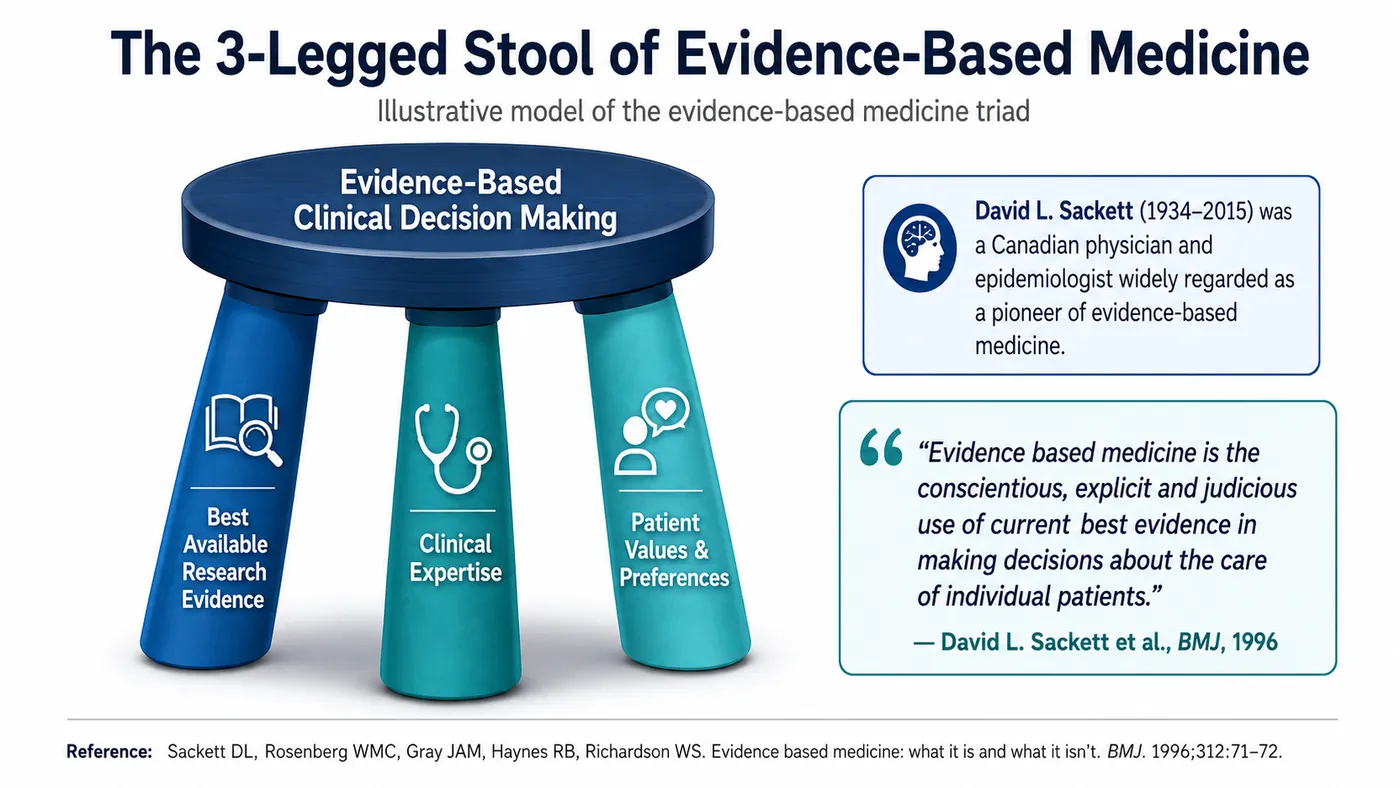
- The evidence-based-medicine triad — and the US quirk it explains: guidelines inform decisions here; they do not mandate them.
- A working read on US-style feedback, and the habit of asking for it.
- Language and moves for the bias moments — the in-the-moment response, the allyship asked for and offered, the documentation, the routes — and a working reframe for the prove-it-twice feeling.
- Names and structures for the life half: the cumulative weight of cultural change, cultural roots deliberately recreated here, the balance with home ties, the household’s own logistics — and where support actually lives.
The team, decoded
The hierarchy is flatter than it looks and steeper than it says. Attendings go by first names in some programs and titles in others; either way, the intern is expected to propose plans, not await instructions — deference that reads as respect in many training cultures reads as passivity here. Nurses may call you by your first name, will page you directly with concerns, and can decline to carry out an order they believe unsafe — and as the nursing-collaboration session teaches, that is a safety system working, not a challenge to your authority. Pharmacists, therapists, case managers: each has real, independent standing, and using their expertise well is read as strength.
Disagreement is expected — voiced in a particular register. Silence in rounds reads as agreement, not politeness. The move is respectful, data-first, and direct: “I wonder about X — the creatinine came back at 2.1, does that change our plan?” Attendings in this culture generally want the intern who catches their error; the intern who saw it and said nothing is the one who worries them.
Asking early is competence — and this may be the deepest inversion. In many training cultures, asking for help signals weakness and invites consequences. Here it is literally the top-ranked skill program directors want in a new intern (the evidence), and the whole of the cross-cover session is built on it. Say the inversion out loud in the room, because knowing the rule intellectually and trusting it at 3 a.m. are different things — and the IMG seniors co-leading can testify to the night they learned to trust it.
The formats — a translation problem, not a knowledge problem
The oral presentation is a format with rigid local conventions — the one-liner, the ordered HPI, pertinent negatives, the assessment that commits to a leading diagnosis, the plan by problem. An IMG often arrives with excellent knowledge and a narrative style that reads as disorganized to US ears; that mismatch is a format problem, and formats are fixable in an afternoon of reps. Practice one full presentation in this session, get the structure feedback, and treat the first month’s presentations as deliberate practice rather than verdicts.
The other formats have templates too: the escalation call is SBAR with a specific ask (the cross-cover session); the consult is QUESTION → DATA → URGENCY → ASK (the consult session); the handoff is I-PASS (the handoff session); the note follows the local template (the EMR session). The bootcamp’s frameworks are, for an IMG, precisely the translation layer — learn the format and your existing medicine flows through it.
And the sentence to rehearse until it is easy: “I don’t know — I’ll find out.” In this culture it is a professional sentence that builds trust. Its counterfeit — the guessed answer delivered confidently — is the fastest way to lose it. So is saying yes to instructions you did not fully catch: idiom, speed, and accents make “yes” dangerous, and “let me repeat that back” is the professional fix — closed-loop communication dressed as a clarification.
Patients and families
The default here is patient autonomy: the patient is told their diagnosis directly — including serious ones — and decides for themselves, sometimes explicitly excluding family. Interns from family-centered decision cultures, where diagnoses are softened or routed through relatives, should expect this to feel abrupt at first; the serious-news session’s structure is the bridge, and when a patient or family requests a family-centered approach, that request itself becomes part of the documented plan rather than an assumption.
Behind that autonomy default sits a deeper quirk of the US system: evidence guides care here — it does not mandate it. US medicine calls itself evidence-based, and the canonical definition of that term — Sackett’s, from the 1996 BMJ editorial that named the discipline — makes research evidence only one leg of a three-legged stool, integrated with the clinician’s own expertise and with this patient’s values and preferences.1 The consequences run through daily ward life. A guideline is a strong default, not an order from above: attendings deviate from guidelines with documented reasoning, two attendings may manage the same problem differently and both be defensible, and rounds run on reasoning rather than citation — you will be asked not only what the guideline says but whether it fits this patient, this kidney function, this goals-of-care conversation. And patients decline guideline-directed treatment every week; that is their right, and the response is a documented informed refusal and a preserved relationship, not a failure or an escalation. Interns arriving from systems where the protocol, the formulary, or the professor’s word is effectively binding should expect all of this to feel strangely loose at first. It is not looseness — it is the model working as designed, and knowing the stool’s three legs by name lets you hear “why?” on rounds as the system’s core question rather than a challenge to your training.
Consent is a conversation, not a signature — risks, alternatives, and the real option of no. The interpreter rule is strict and works in your favor: a qualified interpreter for any language barrier — family only through the narrow exceptions your language-access policy defines, an immediate emergency or the patient’s own documented request (the interpreter session states them precisely) — and the rule holds even when, especially when, you happen to share the patient’s language: your fluency is for rapport; the interpreter is for the record. And small talk is not wasted time: the thirty seconds about the grandchildren or the ballgame is, in US bedside culture, how trust is built — idiom will come with exposure, and asking a patient what an expression means is charming, not diminishing.
Feedback, US-style
Feedback here is frequent, direct, and often disguised as a question — “what else could it be?” usually means your differential is too narrow, not idle curiosity. Calibrate in both directions: feedback that sounds brutal may be routine coaching, and silence is not approval — a quiet attending may simply be saving it for the written evaluation, which is why the move is to ask, mid-rotation, in exactly these words: “What is one thing I should do differently for the rest of this rotation?” Asked early, that question converts the end-of-rotation surprise into a fixable Tuesday. Receiving it well — without defense, with a change visible by Thursday — is itself scored, everywhere, on every evaluation you will ever get.
Bias, microaggressions, and professional identity
Name what happens, because unnamed it gets absorbed as personal failure. Accent bias — the patient who wants “a doctor I can understand,” the colleague who quietly equates accent with ability. The competence assumptions — “where did you really train?”, the surprise at a strong answer, the double-take at the badge. Being passed over — for the committee seat, the teaching award nomination, the leadership conversation that somehow finds the same people every year. And underneath, the frustration many IMGs describe: the sense of having to prove competence twice — once as a physician, once as a foreign one — while the clinical skills were never the question. If this is your experience, hear this section’s premise clearly: it is an experience of the environment, not evidence about you.
The responses are learnable, and they are plural:
- In the moment: brief, composed, and aimed at the question rather than the insinuation — state the credential once, plainly, and return to the patient’s potassium. You owe nobody your biography at the bedside, and composure repeated is more corrosive to bias than any comeback.
- Allyship, asked for and offered: the bystander moves from the mistreatment session — interrupt, redirect, check in afterward — work laterally between co-interns; ask your class for them explicitly in this session, and give them as freely.
- Documentation: patterns need paper — dates, words, witnesses — because “that’s just how he is” dies on contact with a contemporaneous record.
- The routes: patient prejudice and team bias both have named program-level responses — the mistreatment session maps them, and the programs section below states whose problem this is to fix. Using the routes is professionalism, not fragility.
Then reframe the imposter arithmetic, because bias and imposter feelings feed each other. The match was not charity and the badge is not provisional: you cleared every bar this system sets, in a second language, in someone else’s system — that is the evidence, and it is already in. Keep a private record of the wins — the catch, the thank-you, the evaluation line — for the 2 a.m. self-audit that only ever prosecutes. And know that the assets you carry are real and documentable — breadth of pathology seen, languages, cross-cultural skill, resourcefulness — the site’s Perspective on what IMG experience is worth maps how to evidence them without performing them.
Two subtler boxes, named so they lose their grip. The “model minority” expectation — tireless, uncomplaining, endlessly technically capable — is also a cage: it flattens individuals into a stereotype and quietly discourages exactly the help-seeking this culture ranks first; the asking-early inversion above is the counter, and it applies doubly to anyone being cast as the resident who never needs anything. And “IMG” is not one culture: training norms differ between countries of origin as much as any of them differ from the US — hierarchy, feedback, family roles, all of it — so assume nothing about the IMG beside you, and let the cohort’s real diversity become the resource it is when it is named instead of averaged.
The life half — the second transition, with no orientation anywhere
Name the arc first, because it surprises people from inside. Most IMGs arrive excited and energized — the goal of years, achieved; everything new and interesting. Then, somewhere in the following months, the missing begins: the traditions that structured your year, the people and relationships that structured your days, the activities, the humor, even the food. No single difference is large. The persistent change is what adds up — a cumulative load with no acute moment to point to, which is exactly why it goes unnamed and untreated. Say it in the room: if the excitement has faded and an ache has replaced it, that is not weakness or regret — it is the normal physiology of a whole life transplanted.
The response has two halves, and holding both is the difficult balance. First: recreate your cultural roots here, deliberately, to the degree that makes you happy. The foods cooked and hunted down, the traditions kept on their real dates — not skipped because the rotation calendar ignores them — the language spoken somewhere weekly, the diaspora and cultural and faith communities that exist in more American cities than new arrivals expect. This is not nostalgia; it is infrastructure. Second: keep adapting to the culture here — you chose to live and work in it, and the adaptation is part of honoring that choice. Neither half alone works: full assimilation that abandons your roots hollows you out slowly, and a life lived entirely inside the past never lands here. The balance point is personal, it shifts over time, and finding it is ongoing work — worth doing consciously rather than by drift.
Home stays real, and so do its expectations. Sometimes traveling back is feasible — plan those trips early around the schedule and the visa realities the site’s IMG resources cover — and sometimes it is not, for stretches longer than anyone likes. Either way: stay engaged with home to the degree that feels important to you — do not abandon your friends, your family, or the responsibilities people are counting on you for — while balancing the transition to your own life and priorities here. Both loyalties are legitimate, they will sometimes pull against each other — the family event you miss for a ward month, the remittance conversation, the sick parent eleven time zones away, the calls that collide with pre-rounds — and the balance is yours to set deliberately, and to reset as life changes. A standing call home, on the calendar, defended like the sustainable-intern session’s weekly ritual, carries more than its minutes suggest.
The household carries the transition too — and its logistics deserve the same deliberateness the clinical half gets:
- A partner’s life here is its own transition, often the harder one: no ward team, no built-in colleagues, and work rights that depend on visa category — the dated specifics live in the resources below. Their community-building needs a plan of its own, and the diaspora networks above serve them as much as you.
- Children: childcare waitlists and school enrollment run on local timelines that ignore the academic-medicine calendar — the program’s coordinator and its resident families know them; ask in the first weeks, not the last.
- Elder care from eleven time zones: name it as a load before it becomes a crisis — the communication rhythm, the contingency conversation with siblings and family, and what you realistically can and cannot do from here, decided in daylight rather than at 3 a.m.
- Money, without the guilt: remittances home, pay that lands lower than the expectations that traveled with you, and loans on either side of the border — budget the remittance as a line item, not a moral test, and use the money session, which is built for resident pay and carries an IMG-specific note on which of its machinery applies.
- Dating and relationships in a new cultural context: the norms differ, the scripts differ, and finding it confusing is not a personal deficiency — community first, honesty about what you want, and the same supports the sustainable-intern session maps apply to loneliness of every kind.
And be practical about the near ground: build community here fast and deliberately — the co-intern class first (this bootcamp’s stable small groups are a head start), then the communities above, then the co-resident who becomes family. Know that the program’s support structures — chiefs, wellness resources, the PD’s door — are for exactly this, not only for clinical trouble; the struggling-colleague session’s resources card applies to homesickness too. The logistics of arriving — visas, licensure, banking — live in the site’s IMG resources; this session is about the life that starts after.
For programs and co-interns — acculturation runs both ways
A session like this works best in a program that meets it halfway. For program leadership: explicit norms beat absorbed ones — every unwritten rule this session states is a rule the program could simply state, in orientation, to everyone. The program also owns its half of the transition: names pronounced correctly and asked about rather than guessed, and bias, xenophobia, or patient prejudice named as the program’s problem to address — never the intern’s to absorb. For US-graduate co-interns: the classmate whose presentation style differs is not behind — they are translating in real time, and the fastest acculturation tool ever invented is a co-intern who says “want to run the list together before rounds?” The bootcamp’s stable small groups exist partly for this. And for everyone: the traffic is two-way — IMG colleagues bring training experiences, languages, and clinical exposures the team does not otherwise have; a program that only teaches assimilation is leaving half the value on the table.
Pocket card
- Asking early is competence here. Trust the inversion — especially at 3 a.m.
- Silence reads as agreement. Disagree with data, respectfully, out loud.
- The presentation is a format, not a verdict. Formats are fixable in an afternoon.
- “I don’t know — I’ll find out.” · “Let me repeat that back.” Rehearse both.
- Feedback: ask mid-rotation — “what’s one thing I should change?” Silence ≠ approval.
- Guidelines inform; they don’t mandate. Evidence + expertise + this patient’s values — expect defensible variation, and ask for the reasoning.
- The persistent change adds up. Recreate your roots here — deliberately — while adapting to the culture you chose.
- Stay engaged with home to the degree that matters to you; set the balance on purpose, not by drift.
- Bias is the environment, not evidence about you: respond briefly, document patterns, use the routes, recruit the allies.
- “IMG” is not one culture — and neither box, deficit or model minority, gets to define you.
Notes
The honest caveat from the introduction stands: nobody has studied this need at scale, so this session should listen harder than it lectures.
This page is a facilitation framework for small-group teaching. Cultural norms vary by program and region; visa, licensure, and employment specifics live in the site’s IMG resources and change frequently — verify current facts there and with your institution. Last reviewed July 2026.
Sources
- Sackett, D. L., Rosenberg, W. M. C., Gray, J. A. M., Haynes, R. B., & Richardson, W. S. (1996). Evidence based medicine: What it is and what it isn’t. BMJ, 312(7023), 71–72. https://pubmed.ncbi.nlm.nih.gov/8555924/ ↩