
Cardiology
The trials every internist should be able to quote — from the aspirin-in-MI era to the SGLT2 revolution. Thirty-six landmark studies across six domains of cardiovascular care, each linked to its primary paper with a brief, plain-language summary of what it showed and why it changed practice.
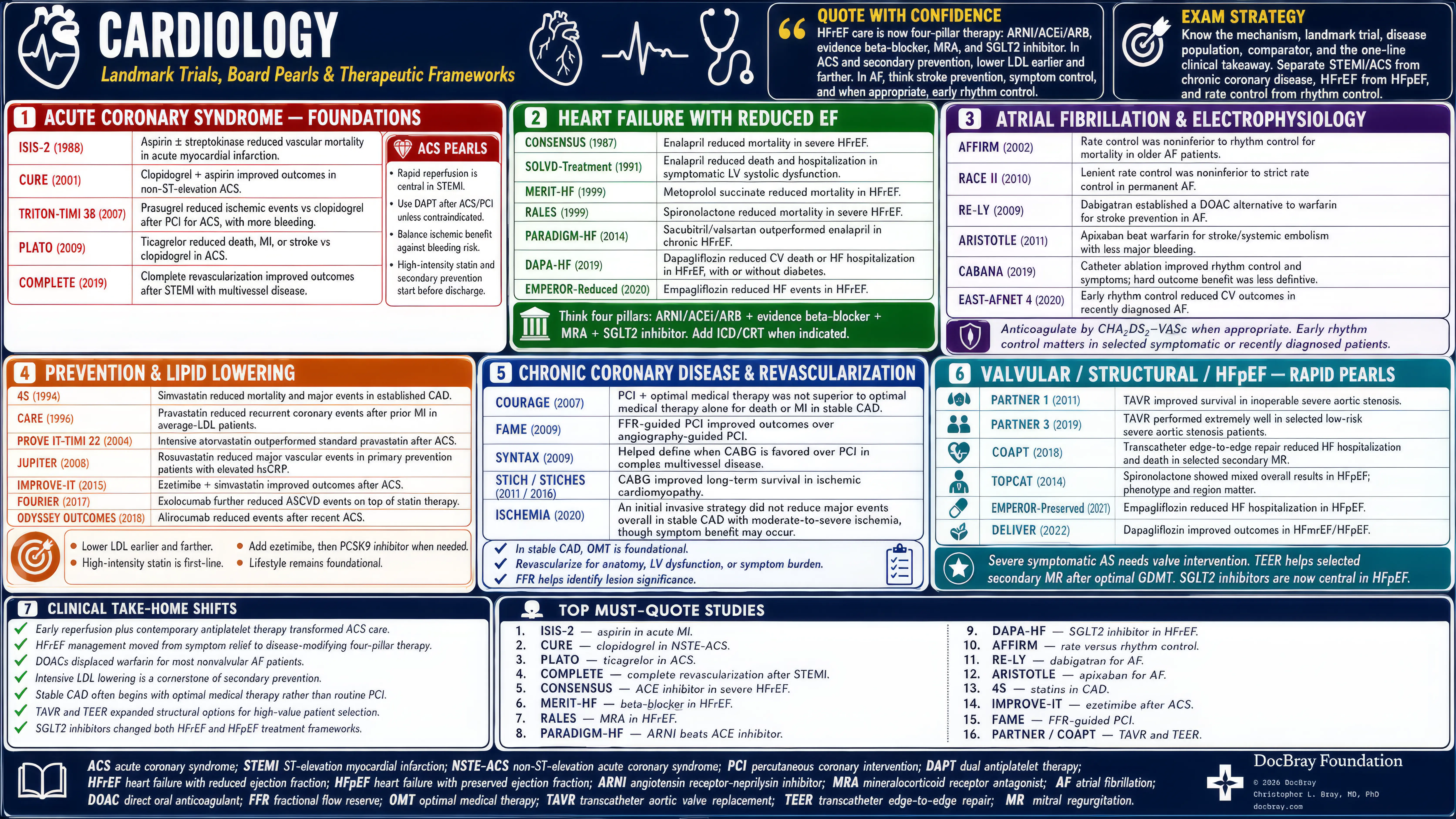
Panel 1 — Acute coronary syndrome: foundations
- ISIS-21988
Factorial RCT of 17,187 patients within 24 hours of suspected acute MI, randomized to IV streptokinase, oral aspirin, both, or neither. Aspirin alone cut 5-week vascular mortality by ~23% and streptokinase alone by ~25%; the combination reduced it by ~42% with additive benefit and no excess of major bleeding from aspirin. This trial established aspirin as standard, life-saving therapy in acute MI and validated fibrinolysis, anchoring the modern reperfusion-plus-antiplatelet approach to STEMI.
ISIS-2 Collaborative Group. Lancet. 1988;2(8607):349–360. PMID 2899772 →
- CURE2001
RCT of 12,562 patients with non–ST-elevation ACS randomized to clopidogrel plus aspirin versus aspirin alone for 3–12 months. Dual therapy reduced the composite of cardiovascular death, MI, or stroke from 11.4% to 9.3% (RR 0.80), at the cost of more major bleeding but no significant increase in life-threatening bleeds. CURE established dual antiplatelet therapy as the foundation of NSTE-ACS management and shaped guideline recommendations for adding a P2Y12 inhibitor to aspirin.
Yusuf S, et al. (CURE Investigators). N Engl J Med. 2001;345(7):494–502. PMID 11519503 →
- TRITON-TIMI 382007
RCT of 13,608 ACS patients undergoing PCI, randomized to prasugrel versus clopidogrel. Prasugrel reduced the primary composite of cardiovascular death, MI, or stroke from 12.1% to 9.9% (HR 0.81), driven by fewer MIs and less stent thrombosis, but caused more major and fatal bleeding. Net harm occurred in patients with prior stroke/TIA, age ≥75, or weight <60 kg. The trial defined prasugrel's efficacy–bleeding trade-off and its contraindication after prior cerebrovascular events.
Wiviott SD, et al. N Engl J Med. 2007;357(20):2001–2015. PMID 17982182 →
- PLATO2009
RCT of 18,624 patients with ACS (with or without ST elevation) randomized to ticagrelor versus clopidogrel. Ticagrelor reduced the composite of vascular death, MI, or stroke from 11.7% to 9.8% (HR 0.84) and lowered all-cause mortality, without an increase in overall major bleeding (though more non–CABG-related bleeding). PLATO established ticagrelor, a reversible P2Y12 inhibitor, as a preferred antiplatelet in ACS and the first shown to reduce mortality versus clopidogrel.
Wallentin L, et al. N Engl J Med. 2009;361(11):1045–1057. PMID 19717846 →
- COMPLETE2019
RCT of 4,041 STEMI patients with multivessel disease after successful culprit-lesion PCI, randomized to complete revascularization of non-culprit lesions versus culprit-only PCI. Complete revascularization reduced cardiovascular death or MI from 10.5% to 7.8% (HR 0.74) over a median 3 years, with benefit whether staged in-hospital or after discharge. COMPLETE established routine non-culprit revascularization as beneficial in stable STEMI patients with significant multivessel disease.
Mehta SR, et al. N Engl J Med. 2019;381(15):1411–1421. PMID 31475795 →
Panel 2 — Heart failure with reduced ejection fraction
- CONSENSUS1987
RCT of 253 patients with severe (NYHA class IV) congestive heart failure randomized to enalapril or placebo added to standard therapy. Enalapril reduced 6-month mortality by 40% and 1-year mortality by 31%, with benefit driven by reduced death from progressive heart failure. CONSENSUS was the first trial to show an ACE inhibitor improves survival in heart failure, launching neurohormonal blockade as the cornerstone of HFrEF therapy.
CONSENSUS Trial Study Group. N Engl J Med. 1987;316(23):1429–1435. PMID 2883575 →
- SOLVD-Treatment1991
RCT of 2,569 patients with symptomatic heart failure and ejection fraction ≤35% randomized to enalapril or placebo. Enalapril reduced mortality from 39.7% to 35.2% (RR 0.84) over ~41 months and lowered heart-failure hospitalizations, extending the CONSENSUS survival benefit to patients with milder, chronic HFrEF. Together the SOLVD and CONSENSUS trials made ACE inhibitors mandatory across the spectrum of reduced-EF heart failure.
SOLVD Investigators. N Engl J Med. 1991;325(5):293–302. PMID 2057034 →
- MERIT-HF1999
RCT of 3,991 patients with NYHA II–IV heart failure and EF ≤40% randomized to metoprolol succinate (CR/XL) or placebo on background ACE inhibitor therapy. Metoprolol reduced all-cause mortality from 11.0% to 7.2% per year (RR 0.66), prompting early trial termination. MERIT-HF confirmed that beta-blockade — historically thought contraindicated in heart failure — substantially reduces mortality, establishing evidence-based beta-blockers as a core HFrEF pillar.
MERIT-HF Study Group. Lancet. 1999;353(9169):2001–2007. PMID 10376614 →
- RALES1999
RCT of 1,663 patients with severe (NYHA III–IV) heart failure and EF ≤35% randomized to spironolactone 25 mg or placebo added to ACE inhibitor and loop diuretic. Spironolactone reduced mortality from 46% to 35% (RR 0.70) and cut hospitalizations, with gynecomastia the main adverse effect and low rates of serious hyperkalemia under trial monitoring. RALES established mineralocorticoid receptor antagonists as core therapy for advanced HFrEF.
Pitt B, et al. N Engl J Med. 1999;341(10):709–717. PMID 10471456 →
- PARADIGM-HF2014
RCT of 8,442 patients with NYHA II–IV heart failure and EF ≤40% randomized to sacubitril/valsartan (ARNI) versus enalapril. The ARNI reduced the composite of cardiovascular death or heart-failure hospitalization from 26.5% to 21.8% (HR 0.80) and lowered all-cause mortality, with more hypotension but less renal impairment and hyperkalemia than enalapril. The trial was stopped early for benefit and established ARNI as preferred over ACE inhibitors in HFrEF.
McMurray JJV, et al. N Engl J Med. 2014;371(11):993–1004. PMID 25176015 →
- DAPA-HF2019
RCT of 4,744 patients with NYHA II–IV heart failure and EF ≤40% randomized to dapagliflozin or placebo on top of guideline therapy. Dapagliflozin reduced worsening heart failure or cardiovascular death from 21.2% to 16.3% (HR 0.74), with consistent benefit regardless of diabetes status. DAPA-HF extended SGLT2 inhibitors beyond glycemic control and made them a fourth foundational pillar of HFrEF therapy.
McMurray JJV, et al. N Engl J Med. 2019;381(21):1995–2008. PMID 31535829 →
- EMPEROR-Reduced2020
RCT of 3,730 patients with NYHA II–IV heart failure and EF ≤40% randomized to empagliflozin or placebo. Empagliflozin reduced cardiovascular death or heart-failure hospitalization from 24.7% to 19.4% (HR 0.75) and slowed eGFR decline, with benefit independent of diabetes. Confirming DAPA-HF with a second SGLT2 inhibitor, EMPEROR-Reduced cemented the class as a core component of four-pillar guideline-directed HFrEF therapy.
Packer M, et al. N Engl J Med. 2020;383(15):1413–1424. PMID 32865377 →
Panel 3 — Atrial fibrillation & electrophysiology
- AFFIRM2002
RCT of 4,060 mostly older patients with atrial fibrillation and stroke-risk factors randomized to rhythm control versus rate control (both with anticoagulation). There was no mortality difference (a nonsignificant trend favoring rate control), and rhythm control caused more hospitalizations and drug adverse effects. AFFIRM established that rate control is a reasonable, often preferable strategy in older AF patients and that anticoagulation must continue regardless of rhythm.
Wyse DG, et al. (AFFIRM Investigators). N Engl J Med. 2002;347(23):1825–1833. PMID 12466506 →
- RACE II2010
RCT of 614 patients with permanent atrial fibrillation randomized to lenient rate control (resting heart rate <110 bpm) versus strict control (<80 bpm at rest). Lenient control was noninferior for the composite of cardiovascular death, hospitalization, and arrhythmic events at 3 years, while being far easier to achieve. RACE II showed a relaxed heart-rate target is adequate for most patients with permanent AF, simplifying management.
Van Gelder IC, et al. N Engl J Med. 2010;362(15):1363–1373. PMID 20231232 →
- RE-LY2009
RCT of 18,113 patients with atrial fibrillation randomized to dabigatran (110 or 150 mg twice daily) versus warfarin. Dabigatran 150 mg reduced stroke/systemic embolism versus warfarin (1.11% vs 1.69%/year) with similar major bleeding; the 110-mg dose was noninferior with less bleeding. RE-LY was the landmark trial establishing a direct oral anticoagulant as an effective, fixed-dose alternative to warfarin for stroke prevention in nonvalvular AF, without routine INR monitoring.
Connolly SJ, et al. (RE-LY Investigators). N Engl J Med. 2009;361(12):1139–1151. PMID 19717844 →
- ARISTOTLE2011
RCT of 18,201 patients with atrial fibrillation randomized to apixaban versus warfarin. Apixaban reduced stroke or systemic embolism (1.27% vs 1.60%/year, HR 0.79), major bleeding (HR 0.69), and all-cause mortality (HR 0.89). ARISTOTLE was notable for beating warfarin on efficacy, safety, and mortality simultaneously, reinforcing DOACs as first-line for stroke prevention in nonvalvular AF and often favoring apixaban in bleeding-prone patients.
Granger CB, et al. (ARISTOTLE Investigators). N Engl J Med. 2011;365(11):981–992. PMID 21870978 →
- CABANA2019
RCT of 2,204 patients with atrial fibrillation randomized to catheter ablation versus antiarrhythmic drug therapy. Ablation did not significantly reduce the primary composite of death, disabling stroke, serious bleeding, or cardiac arrest in the intention-to-treat analysis, though high crossover complicated interpretation; ablation improved AF recurrence and quality of life. CABANA positioned ablation as an effective rhythm/symptom strategy without a clearly proven hard-outcome mortality benefit.
Packer DL, et al. JAMA. 2019;321(13):1261–1274. PMID 30874766 →
- EAST-AFNET 42020
RCT of 2,789 patients with atrial fibrillation diagnosed within the prior year and cardiovascular risk factors, randomized to early rhythm control (antiarrhythmics or ablation) versus usual care. Early rhythm control reduced the composite of cardiovascular death, stroke, or hospitalization for heart failure/ACS (HR 0.79), with acceptable safety. EAST-AFNET 4 shifted practice toward early rhythm control in recently diagnosed, symptomatic or high-risk AF patients.
Kirchhof P, et al. N Engl J Med. 2020;383(14):1305–1316. PMID 32865375 →
Panel 4 — Prevention & lipid lowering
- 4S1994
RCT of 4,444 patients with coronary heart disease and elevated cholesterol randomized to simvastatin or placebo. Over ~5 years, simvastatin reduced all-cause mortality from 12% to 8% (RR 0.70) and major coronary events by 34%. 4S was the first trial to prove that statin-based LDL lowering saves lives in established CAD, launching the modern era of secondary-prevention lipid therapy.
Scandinavian Simvastatin Survival Study Group. Lancet. 1994;344(8934):1383–1389. PMID 7968073 →
- CARE1996
RCT of 4,159 post-MI patients with "average" cholesterol (LDL 115–174 mg/dL) randomized to pravastatin or placebo. Pravastatin reduced fatal coronary events or nonfatal MI from 13.2% to 10.2% (RR 0.76) and lowered stroke. CARE extended statin benefit to patients without markedly elevated LDL, broadening secondary prevention to the large population with near-normal cholesterol after myocardial infarction.
Sacks FM, et al. (CARE Investigators). N Engl J Med. 1996;335(14):1001–1009. PMID 8801446 →
- PROVE IT-TIMI 222004
RCT of 4,162 patients after ACS randomized to intensive (atorvastatin 80 mg, LDL ~62 mg/dL) versus moderate (pravastatin 40 mg, LDL ~95 mg/dL) statin therapy. Intensive therapy reduced the composite of death and major cardiovascular events by 16% over 2 years. PROVE IT established the "lower is better" principle and made high-intensity statin therapy standard after acute coronary syndromes.
Cannon CP, et al. N Engl J Med. 2004;350(15):1495–1504. PMID 15007110 →
- JUPITER2008
RCT of 17,802 apparently healthy people with LDL <130 mg/dL but elevated hs-CRP (≥2 mg/L), randomized to rosuvastatin or placebo. Rosuvastatin cut the composite of MI, stroke, revascularization, unstable angina, or cardiovascular death by 44% (HR 0.56), stopping the trial early. JUPITER expanded statin primary prevention to patients selected by inflammatory risk rather than by LDL alone.
Ridker PM, et al. (JUPITER Study Group). N Engl J Med. 2008;359(21):2195–2207. PMID 18997196 →
- IMPROVE-IT2015
RCT of 18,144 post-ACS patients randomized to ezetimibe plus simvastatin versus simvastatin alone. Adding ezetimibe lowered LDL further (54 vs 70 mg/dL) and modestly reduced the composite of cardiovascular events (32.7% vs 34.7%, HR 0.94) over ~6 years. IMPROVE-IT was the first trial to show a non-statin LDL-lowering agent adds cardiovascular benefit, validating LDL as a causal target and endorsing ezetimibe as add-on therapy.
Cannon CP, et al. (IMPROVE-IT Investigators). N Engl J Med. 2015;372(25):2387–2397. PMID 26039521 →
- FOURIER2017
RCT of 27,564 patients with atherosclerotic disease on statin therapy randomized to the PCSK9 inhibitor evolocumab or placebo. Evolocumab lowered LDL to a median 30 mg/dL and reduced the composite of cardiovascular events by 15% (HR 0.85) over ~2.2 years, without increasing serious adverse events. FOURIER showed PCSK9 inhibition safely drives LDL to very low levels with added benefit atop maximal statins.
Sabatine MS, et al. N Engl J Med. 2017;376(18):1713–1722. PMID 28304224 →
- ODYSSEY OUTCOMES2018
RCT of 18,924 patients 1–12 months after ACS on high-intensity statin therapy, randomized to the PCSK9 inhibitor alirocumab or placebo. Alirocumab reduced major adverse cardiovascular events (9.5% vs 11.1%, HR 0.85) and showed a possible all-cause mortality benefit, with the largest absolute gains in patients with the highest baseline LDL. It confirmed PCSK9 inhibition improves outcomes after recent ACS.
Panel 5 — Chronic coronary disease & revascularization
- COURAGE2007
RCT of 2,287 patients with stable coronary disease and objective ischemia randomized to PCI plus optimal medical therapy versus optimal medical therapy alone. Over ~4.6 years there was no difference in death or nonfatal MI; PCI provided earlier angina relief that narrowed over time. COURAGE established that routine PCI does not reduce hard events in stable CAD, supporting a medical-therapy-first strategy.
Boden WE, et al. (COURAGE Research Group). N Engl J Med. 2007;356(15):1503–1516. PMID 17387127 →
- FAME2009
RCT of 1,005 patients with multivessel coronary disease undergoing PCI, randomized to fractional flow reserve (FFR)-guided versus angiography-guided stenting. FFR guidance (stenting only lesions with FFR ≤0.80) reduced the 1-year composite of death, MI, and repeat revascularization from 18.3% to 13.2% while using fewer stents. FAME established physiology-guided PCI, treating only functionally significant lesions, as superior to an angiography-only approach.
Tonino PAL, et al. (FAME Investigators). N Engl J Med. 2009;360(3):213–224. PMID 19144937 →
- SYNTAX2009
RCT of 1,800 patients with three-vessel or left main coronary disease randomized to CABG versus PCI with drug-eluting stents. At 1 year, PCI failed noninferiority: major adverse cardiac/cerebrovascular events were higher with PCI (17.8% vs 12.4%), driven by repeat revascularization, though PCI had fewer strokes. SYNTAX and its anatomic complexity score helped define when CABG is favored over PCI in complex multivessel disease.
Serruys PW, et al. (SYNTAX Investigators). N Engl J Med. 2009;360(10):961–972. PMID 19228612 →
- STICH2011
RCT of 1,212 patients with coronary disease and EF ≤35% randomized to CABG plus medical therapy versus medical therapy alone. At the primary analysis (median 56 months), CABG did not significantly reduce all-cause mortality by intention-to-treat (HR 0.86, P=0.12), though it reduced cardiovascular death and death-or-hospitalization. STICH raised questions about surgical benefit in ischemic cardiomyopathy that its long-term follow-up (STICHES) later resolved.
Velazquez EJ, et al. (STICH Investigators). N Engl J Med. 2011;364(17):1607–1616. PMID 21463150 →
- STICHES2016
Extended follow-up of the STICH cohort (1,212 patients, ischemic cardiomyopathy with EF ≤35%) to a median of 9.8 years. With longer observation, CABG plus medical therapy significantly reduced all-cause mortality versus medical therapy alone (58.9% vs 66.1%, HR 0.84) and cardiovascular death. STICHES established a durable long-term survival benefit of CABG in ischemic cardiomyopathy, reversing the neutral primary STICH result.
Velazquez EJ, et al. (STICHES Investigators). N Engl J Med. 2016;374(16):1511–1520. PMID 27040723 →
- ISCHEMIA2020
RCT of 5,179 patients with stable coronary disease and moderate-to-severe ischemia randomized to an initial invasive strategy (angiography plus revascularization) versus optimal medical therapy alone. Over ~3.2 years there was no reduction in cardiovascular events with the invasive strategy, though it improved angina-related quality of life. ISCHEMIA reinforced medical therapy first for stable CAD, reserving routine revascularization for symptom control rather than event prevention.
Maron DJ, et al. (ISCHEMIA Research Group). N Engl J Med. 2020;382(15):1395–1407. PMID 32227755 →
Panel 6 — Valvular / structural / HFpEF
- PARTNER 1 (Cohort B / A)2010 / 2011
The inoperable arm (Cohort B) of PARTNER randomized 358 patients with severe aortic stenosis unsuitable for surgery to transcatheter aortic-valve replacement (TAVR) versus standard therapy (often balloon valvuloplasty). TAVR reduced 1-year all-cause mortality from 50.7% to 30.7% (HR 0.55), establishing TAVR as life-saving for inoperable severe AS. The companion high-risk surgical arm (Cohort A; Smith CR, et al. N Engl J Med. 2011;364(23):2187–2198, PMID 21639811) showed TAVR noninferior to surgery.
Leon MB, et al. (PARTNER Investigators). N Engl J Med. 2010;363(17):1597–1607. PMID 20961243 →
- PARTNER 32019
RCT of 1,000 patients with severe aortic stenosis at low surgical risk randomized to transcatheter (balloon-expandable) versus surgical aortic-valve replacement. TAVR reduced the 1-year composite of death, stroke, or rehospitalization from 15.1% to 8.5% (HR 0.54), with shorter hospital stays and less new atrial fibrillation. PARTNER 3 extended TAVR from high-risk to low-risk patients, transforming management of severe aortic stenosis across the risk spectrum.
Mack MJ, et al. (PARTNER 3 Investigators). N Engl J Med. 2019;380(18):1695–1705. PMID 30883058 →
- COAPT2018
RCT of 614 patients with heart failure and moderate-to-severe secondary (functional) mitral regurgitation despite maximal medical therapy, randomized to transcatheter edge-to-edge repair (MitraClip) plus medical therapy versus medical therapy alone. Repair reduced 2-year heart-failure hospitalizations (35.8% vs 67.9% per patient-year, HR 0.53) and all-cause mortality. COAPT established transcatheter mitral repair for carefully selected secondary MR after optimized guideline-directed therapy.
Stone GW, et al. (COAPT Investigators). N Engl J Med. 2018;379(24):2307–2318. PMID 30280640 →
- TOPCAT2014
RCT of 3,445 patients with heart failure and preserved ejection fraction (EF ≥45%) randomized to spironolactone or placebo. The primary composite of cardiovascular death, aborted cardiac arrest, or heart-failure hospitalization was not significantly reduced overall, though heart-failure hospitalizations fell and marked regional variation (better outcomes in the Americas) suggested the neutral result was partly driven by enrollment issues in Russia/Georgia. TOPCAT left a nuanced, guideline-influencing signal for MRAs in HFpEF.
Pitt B, et al. (TOPCAT Investigators). N Engl J Med. 2014;370(15):1383–1392. PMID 24716680 →
- EMPEROR-Preserved2021
RCT of 5,988 patients with heart failure and EF >40% randomized to empagliflozin or placebo. Empagliflozin reduced the composite of cardiovascular death or heart-failure hospitalization from 17.1% to 13.8% (HR 0.79), driven mainly by fewer hospitalizations, with benefit regardless of diabetes status. EMPEROR-Preserved was the first trial to show a clearly effective pharmacologic therapy in HFpEF, establishing SGLT2 inhibitors across the ejection-fraction spectrum.
- DELIVER2022
RCT of 6,263 patients with heart failure and EF >40% (mildly reduced or preserved) randomized to dapagliflozin or placebo. Dapagliflozin reduced worsening heart failure or cardiovascular death from 19.5% to 16.4% (HR 0.82), with consistent benefit across ejection fraction and diabetes status. Confirming EMPEROR-Preserved with a second SGLT2 inhibitor, DELIVER solidified this class as foundational therapy for HFmrEF and HFpEF.
Solomon SD, et al. (DELIVER Investigators). N Engl J Med. 2022;387(12):1089–1098. PMID 36027570 →
Preparing for boards, teaching residents, or building your own trial file? Dr. Bray mentors trainees and early-career physicians at no cost.
Get in touch →