
Endocrinology & Diabetes
The landmark Endocrinology and Diabetes trials every internist should be able to quote — 28 studies across 5 evidence panels, each linked to its primary paper with a brief, plain-language summary of what it showed and why it changed practice.
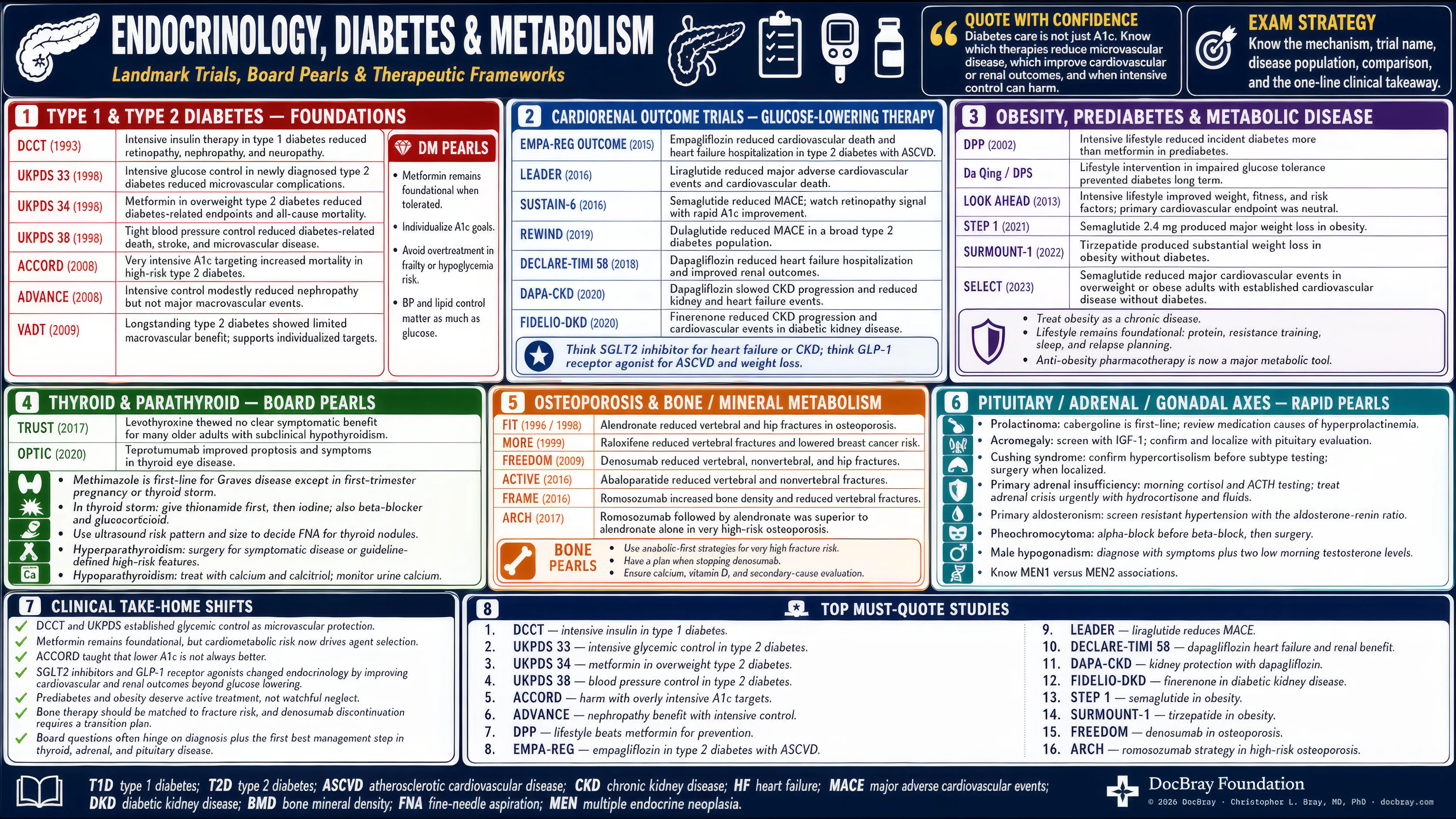
Panel 1 — Type 1 & Type 2 Diabetes: Foundations
- DCCT1993
Randomized trial of ~1,441 patients with type 1 diabetes comparing intensive insulin therapy (aiming for near-normal glucose) with conventional therapy. Intensive control reduced the risk of clinically meaningful retinopathy by ~76% in primary prevention, and also lowered progression of nephropathy and neuropathy, at the cost of roughly a threefold increase in severe hypoglycemia. DCCT established tight glycemic control as the foundation of microvascular protection in type 1 diabetes and, through the later EDIC follow-up, underpins the concept of metabolic memory.
DCCT Research Group (Nathan DM et al). N Engl J Med. 1993;329(14):977-986. PMID 8366922 →
- UKPDS 331998
In newly diagnosed type 2 diabetes, intensive glucose control with sulfonylureas or insulin (median HbA1c 7.0% vs 7.9%) reduced any diabetes-related endpoint by ~12%, driven almost entirely by a ~25% reduction in microvascular complications (chiefly retinal photocoagulation). Macrovascular events were not significantly reduced. UKPDS 33 confirmed that better glycemic control prevents microvascular disease in type 2 diabetes and set the paradigm of glycemic control as primarily microvascular protection.
UK Prospective Diabetes Study (UKPDS) Group. Lancet. 1998;352(9131):837-853. PMID 9742976 →
- UKPDS 341998
Overweight patients with type 2 diabetes randomized to intensive control with metformin had significant reductions in any diabetes-related endpoint (~32%), diabetes-related death (~42%), and all-cause mortality (~36%) versus conventional therapy, with less weight gain and hypoglycemia than sulfonylurea/insulin. This trial established metformin as first-line pharmacotherapy in type 2 diabetes and the only agent in UKPDS to reduce macrovascular outcomes and mortality.
UK Prospective Diabetes Study (UKPDS) Group. Lancet. 1998;352(9131):854-865. PMID 9742977 →
- UKPDS 381998
In hypertensive patients with type 2 diabetes, tight blood-pressure control (mean 144/82 vs 154/87 mmHg) reduced any diabetes-related endpoint by ~24%, diabetes-related death by ~32%, stroke by ~44%, and microvascular disease by ~37%. The benefit of BP lowering was at least as large as that of glucose lowering, cementing aggressive blood-pressure management as a core pillar of diabetes care.
UK Prospective Diabetes Study Group. BMJ. 1998;317(7160):703-713. PMID 9732337 →
- ACCORD2008
In ~10,000 high-cardiovascular-risk type 2 patients, targeting HbA1c <6.0% versus 7.0–7.9% did not reduce major cardiovascular events and unexpectedly increased all-cause mortality (HR 1.22), prompting early termination of the intensive arm. ACCORD is the landmark cautionary trial showing that overly intensive glycemic targets can be harmful in older, high-risk patients, and it drives individualized, less aggressive A1c goals.
ACCORD Study Group (Gerstein HC et al). N Engl J Med. 2008;358(24):2545-2559. PMID 18539917 →
- ADVANCE2008
Intensive glucose control (gliclazide-based, target HbA1c ≤6.5%) in type 2 diabetes reduced the combined micro/macrovascular endpoint by ~10%, driven by a ~21% reduction in nephropathy, with no significant effect on major macrovascular events or mortality. Unlike ACCORD, ADVANCE showed no excess mortality. Together with ACCORD and VADT it established that intensive control yields modest renal/microvascular benefit but not clear macrovascular gain.
ADVANCE Collaborative Group (Patel A et al). N Engl J Med. 2008;358(24):2560-2572. PMID 18539916 →
- VADT2009
In ~1,791 veterans with longstanding, poorly controlled type 2 diabetes, intensive glucose control (median HbA1c 6.9% vs 8.4%) did not significantly reduce major cardiovascular events or mortality over ~5.6 years. A neutral trial reinforcing that in patients with advanced, longstanding diabetes, intensive glycemic control offers limited macrovascular benefit and supporting individualized rather than uniformly aggressive targets.
Duckworth W et al (VADT Investigators). N Engl J Med. 2009;360(2):129-139. PMID 19092145 →
Panel 2 — Cardiorenal Outcome Trials: Glucose-Lowering Therapy
- EMPA-REG OUTCOME2015
In type 2 diabetes with established atherosclerotic cardiovascular disease, the SGLT2 inhibitor empagliflozin reduced the primary 3-point MACE by ~14%, cardiovascular death by ~38%, all-cause mortality by ~32%, and hospitalization for heart failure by ~35% versus placebo. The first cardiovascular outcome trial to show a glucose-lowering drug improves cardiovascular survival, launching SGLT2 inhibitors as cardioprotective agents.
Zinman B et al. N Engl J Med. 2015;373(22):2117-2128. PMID 26378978 →
- LEADER2016
In type 2 diabetes at high cardiovascular risk, the GLP-1 receptor agonist liraglutide reduced 3-point MACE by ~13% and cardiovascular death by ~22% versus placebo over 3.8 years. LEADER established GLP-1 receptor agonists as a second class of glucose-lowering drugs with proven atherosclerotic cardiovascular benefit.
Marso SP et al (LEADER Steering Committee). N Engl J Med. 2016;375(4):311-322. PMID 27295427 →
- SUSTAIN-62016
Subcutaneous semaglutide reduced 3-point MACE by ~26% (largely driven by nonfatal stroke and MI) versus placebo in high-risk type 2 diabetes. A pre-specified caution: semaglutide was associated with a significantly higher rate of diabetic retinopathy complications (HR 1.76), attributed to rapid glucose lowering — the board-relevant "watch the retinopathy signal" caveat.
Marso SP et al. N Engl J Med. 2016;375(19):1834-1844. PMID 27633186 →
- REWIND2019
Weekly dulaglutide reduced MACE by ~12% versus placebo in a broad type 2 diabetes population in which the majority had no established cardiovascular disease (primary prevention). REWIND extended GLP-1 receptor agonist cardiovascular benefit beyond secondary-prevention populations to lower-risk patients with cardiovascular risk factors.
Gerstein HC et al (REWIND Investigators). Lancet. 2019;394(10193):121-130. PMID 31189511 →
- DECLARE-TIMI 582018
In a broad type 2 diabetes population (majority primary prevention), dapagliflozin did not significantly reduce MACE (met noninferiority) but did reduce the co-primary composite of cardiovascular death or heart-failure hospitalization by ~17%, driven by fewer heart-failure hospitalizations, with a favorable renal signal. Neutral for atherosclerotic events but confirming the SGLT2-inhibitor heart-failure and renal benefit even in lower-risk patients.
Wiviott SD et al. N Engl J Med. 2019;380(4):347-357. PMID 30415602 →
- DAPA-CKD2020
In chronic kidney disease with or without diabetes, dapagliflozin reduced the primary composite of sustained eGFR decline ≥50%, end-stage kidney disease, or renal/cardiovascular death by ~39%, and lowered all-cause mortality. Extended SGLT2-inhibitor renal protection to non-diabetic CKD, making these drugs foundational disease-modifying therapy for proteinuric kidney disease.
- FIDELIO-DKD2020
The nonsteroidal mineralocorticoid-receptor antagonist finerenone reduced a composite kidney outcome (kidney failure, sustained ≥40% eGFR decline, renal death) by ~18% and a secondary cardiovascular composite by ~14% in diabetic kidney disease already on maximized RAS blockade. Hyperkalemia was more frequent. FIDELIO established finerenone as a distinct cardiorenal-protective option in diabetic kidney disease.
Bakris GL et al (FIDELIO-DKD Investigators). N Engl J Med. 2020;383(23):2219-2229. PMID 33264825 →
Panel 3 — Obesity, Prediabetes & Metabolic Disease
- DPP — Diabetes Prevention Program2002
In adults with impaired glucose tolerance, intensive lifestyle intervention (≥7% weight loss, ≥150 min/week activity) reduced incident type 2 diabetes by 58%, while metformin reduced it by 31% — lifestyle clearly outperformed metformin. The defining prevention trial: lifestyle beats metformin for delaying progression from prediabetes to diabetes.
- Da Qing / DPSDiabetes Prevention Studies
Two lifestyle-prevention trials in impaired glucose tolerance. Da Qing (China) randomized communities to diet and/or exercise and showed ~31–46% lower diabetes incidence over 6 years, with long-term follow-up demonstrating durable reductions in diabetes and later cardiovascular events and mortality. The Finnish DPS showed intensive diet-and-exercise counseling cut progression to diabetes by 58% at ~3 years, matching the DPP. Together they establish that lifestyle intervention in prediabetes prevents diabetes and the benefit persists for years.
Pan XR et al. The Da Qing IGT and Diabetes Study. Diabetes Care. 1997;20(4):537-544. PMID 9096977 →
- LOOK AHEAD2013
In overweight/obese adults with type 2 diabetes, an intensive lifestyle intervention produced greater weight loss and improved fitness and cardiovascular risk factors but did NOT reduce the primary cardiovascular endpoint versus diabetes support/education; the trial was stopped early for futility. A key neutral result: intentional weight loss via lifestyle improves risk factors and fitness but did not lower cardiovascular events in this population.
Look AHEAD Research Group (Wing RR et al). N Engl J Med. 2013;369(2):145-154. PMID 23796131 →
- STEP 12021
In adults with overweight or obesity without diabetes, once-weekly semaglutide 2.4 mg plus lifestyle produced ~14.9% mean body-weight loss versus ~2.4% with placebo over 68 weeks. STEP 1 established GLP-1 receptor agonists as a major, clinically meaningful pharmacologic tool for obesity.
Wilding JPH et al (STEP 1 Study Group). N Engl J Med. 2021;384(11):989-1002. PMID 33567185 →
- SURMOUNT-12022
In adults with obesity (without diabetes), the dual GIP/GLP-1 receptor agonist tirzepatide produced dose-dependent weight loss up to ~20.9% at the 15 mg dose over 72 weeks versus ~3.1% with placebo. SURMOUNT-1 demonstrated tirzepatide's substantial, near-bariatric-range weight reduction, advancing incretin-based obesity therapy.
Jastreboff AM et al (SURMOUNT-1 Investigators). N Engl J Med. 2022;387(3):205-216. PMID 35658024 →
- SELECT2023
In adults with overweight/obesity and established cardiovascular disease but WITHOUT diabetes, once-weekly semaglutide 2.4 mg reduced the primary MACE composite by ~20% versus placebo over ~40 months. The first trial to show an anti-obesity/GLP-1 agent reduces cardiovascular events independent of diabetes, redefining obesity as a treatable cardiovascular risk factor.
Lincoff AM et al (SELECT Trial Investigators). N Engl J Med. 2023;389(24):2221-2232. PMID 37952131 →
Panel 4 — Thyroid & Parathyroid: Board Pearls
- TRUST2017
Randomized placebo-controlled trial of levothyroxine in older adults (≥65) with persistent subclinical hypothyroidism. Levothyroxine normalized TSH but produced no benefit in hypothyroid symptoms or tiredness scores versus placebo. A neutral trial supporting a conservative, watchful approach and cautioning against routine levothyroxine for mild subclinical hypothyroidism in older adults.
Stott DJ et al (TRUST Study Group). N Engl J Med. 2017;376(26):2534-2544. PMID 28402245 →
- OPTIC2020
In active thyroid eye disease (Graves orbitopathy), the anti-IGF-1-receptor monoclonal antibody teprotumumab significantly improved proptosis (~83% vs 10% had ≥2 mm reduction) and diplopia versus placebo over 24 weeks. OPTIC established teprotumumab as the first medical (non-surgical, non-steroid) therapy to meaningfully reverse proptosis in thyroid eye disease.
Douglas RS et al. N Engl J Med. 2020;382(4):341-352. PMID 31971679 →
Panel 5 — Osteoporosis & Bone / Mineral Metabolism
- FIT — Fracture Intervention Trial1996 / 1998
Two arms of the Fracture Intervention Trial testing alendronate. The 1996 Lancet arm, in women with prevalent vertebral fractures, showed alendronate roughly halved new vertebral fractures and reduced hip fractures by ~51%. The 1998 JAMA arm, in women with low bone density but no vertebral fracture, reduced clinical fractures in the subset with osteoporosis-range femoral-neck density. Together FIT established bisphosphonate therapy as first-line for reducing vertebral and hip fractures in postmenopausal osteoporosis.
- MORE1999
In postmenopausal women with osteoporosis, the selective estrogen-receptor modulator raloxifene reduced the risk of new vertebral fractures by ~30–50% over 3 years but did not significantly reduce non-vertebral or hip fractures. A widely cited secondary finding was a reduced incidence of invasive (ER-positive) breast cancer. Positions raloxifene as a vertebral-fracture and breast-risk option rather than broad-spectrum fracture protection.
Ettinger B et al (MORE Investigators). JAMA. 1999;282(7):637-645. PMID 10517716 →
- FREEDOM2009
In postmenopausal women with osteoporosis, the RANK-ligand inhibitor denosumab (60 mg SC every 6 months) reduced new vertebral fractures by ~68%, hip fractures by ~40%, and non-vertebral fractures by ~20% over 3 years versus placebo. FREEDOM established denosumab as a potent broad-spectrum antiresorptive; board-relevant caveat: discontinuation causes rapid bone loss and rebound vertebral fractures, requiring a transition plan.
Cummings SR et al (FREEDOM Trial). N Engl J Med. 2009;361(8):756-765. PMID 19671655 →
- ACTIVE2016
In postmenopausal women at high fracture risk, the PTH-related-protein analog abaloparatide reduced new vertebral fractures by ~86% and nonvertebral fractures versus placebo over 18 months, with efficacy comparable to teriparatide and less hypercalcemia. ACTIVE established abaloparatide as an anabolic (bone-forming) option for high-risk osteoporosis.
- FRAME2016
In postmenopausal osteoporosis, the sclerostin inhibitor romosozumab (monthly for 12 months, then denosumab) reduced new vertebral fractures by ~73% versus placebo at 12 months, with continued benefit after transition to denosumab, and markedly increased bone mineral density. FRAME introduced romosozumab as a dual-action (bone-forming and antiresorptive) anabolic agent.
Cosman F et al. N Engl J Med. 2016;375(16):1532-1543. PMID 27641143 →
- ARCH2017
In postmenopausal women with osteoporosis and prior fracture (very high risk), 12 months of romosozumab followed by alendronate reduced new vertebral fractures by ~48% and clinical/hip fractures versus alendronate alone. A cardiovascular safety signal (more serious cardiac events with romosozumab) was observed. ARCH supports an anabolic-first ("romosozumab then antiresorptive") strategy for very-high-risk osteoporosis, with cardiovascular caution.
Saag KG et al (ARCH Study Group). N Engl J Med. 2017;377(15):1417-1427. PMID 28892457 →
Preparing for boards, teaching residents, or building your own trial file? Dr. Bray mentors trainees and early-career physicians at no cost.
Get in touch →