
Gastroenterology & Hepatology
The landmark Gastroenterology and Hepatology trials every internist should be able to quote — 33 studies across 6 evidence panels, each linked to its primary paper with a brief, plain-language summary of what it showed and why it changed practice.
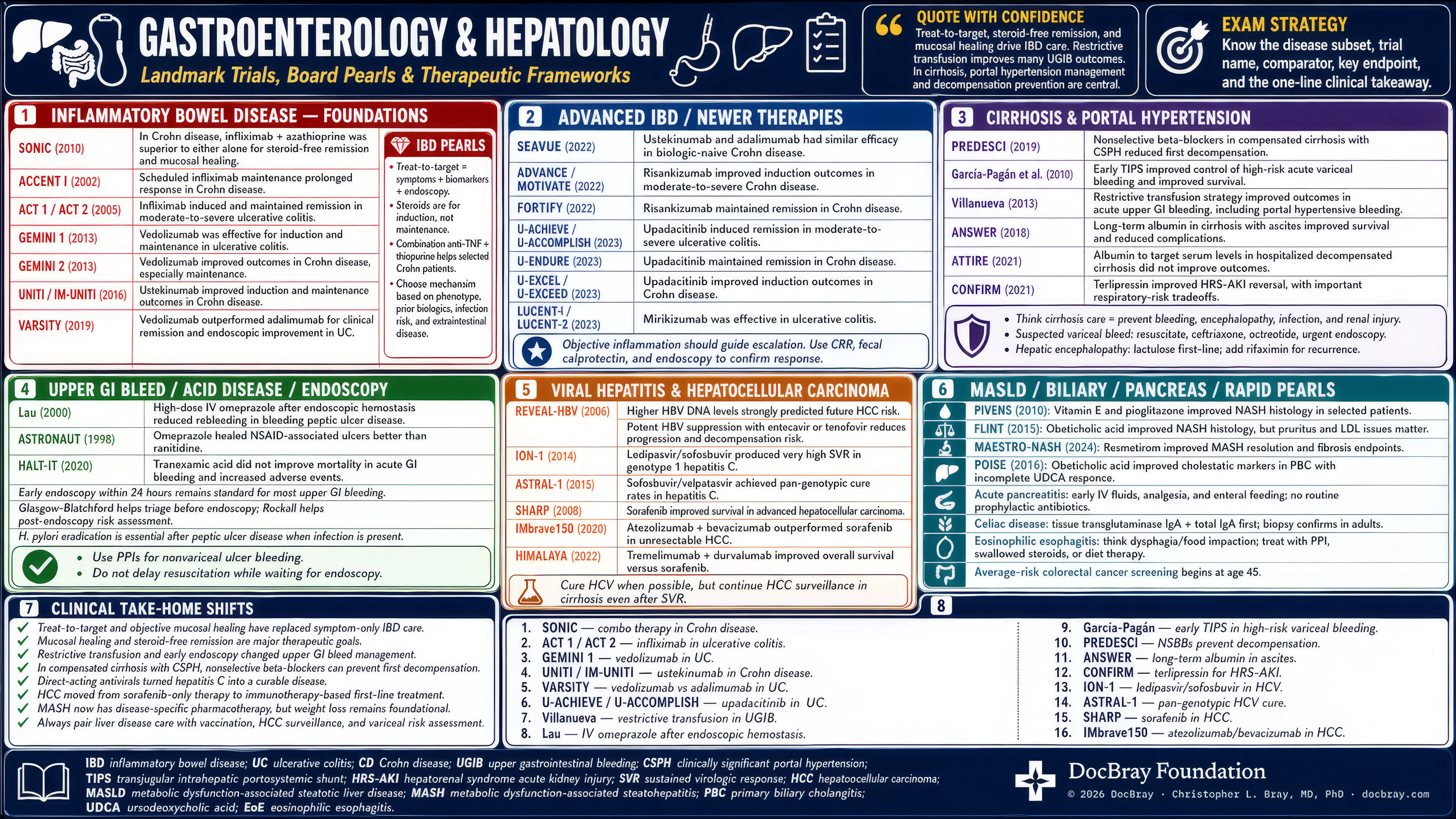
Panel 1 — Inflammatory Bowel Disease: Foundations
- SONIC2010
Randomized trial of 508 immunosuppressant-naive patients with moderate-to-severe Crohn disease comparing infliximab monotherapy, azathioprine monotherapy, and the combination. At week 26, corticosteroid-free clinical remission was significantly higher with combination therapy (56.8%) than infliximab alone (44.4%) or azathioprine alone (30.0%), and combination therapy produced more mucosal healing. SONIC established combination anti-TNF plus thiopurine as superior to either drug alone for steroid-free remission and healing, and it underpins the modern preference for combination induction in appropriately selected Crohn patients. Board takeaway: combination beats monotherapy for steroid-free remission and mucosal healing.
- ACCENT I2002
Landmark trial of 573 patients with active Crohn disease who received a single infliximab infusion; week-2 responders were randomized to scheduled maintenance infliximab or placebo. Scheduled every-8-week infliximab prolonged clinical response and remission and reduced steroid use compared with episodic/placebo dosing. ACCENT I established scheduled maintenance dosing (rather than episodic on-demand infusions) as the standard for sustaining response in Crohn disease. Board takeaway: scheduled maintenance anti-TNF, not episodic dosing, maintains remission.
- ACT 1 / ACT 22005
Two parallel randomized placebo-controlled trials (ACT 1 and ACT 2, ~728 patients total) of infliximab in moderate-to-severe ulcerative colitis. Infliximab induced and maintained clinical response and remission and promoted mucosal healing more effectively than placebo through weeks 30–54. These trials extended anti-TNF therapy from Crohn disease into ulcerative colitis and remain the foundational evidence for infliximab in UC. Board takeaway: infliximab induces and maintains remission in moderate-to-severe UC.
- GEMINI 12013
Randomized trial of the gut-selective α4β7 integrin antibody vedolizumab in moderate-to-severe ulcerative colitis. Vedolizumab was superior to placebo for both induction (week 6 response 47.1% vs 25.5%) and maintenance of clinical remission at week 52. GEMINI 1 introduced gut-selective integrin blockade as an effective, well-tolerated UC therapy with a favorable systemic safety profile. Board takeaway: vedolizumab is an effective gut-selective option for induction and maintenance in UC.
- GEMINI 22013
Companion trial to GEMINI 1 evaluating vedolizumab in moderate-to-severe Crohn disease. Vedolizumab improved maintenance of clinical remission at week 52 versus placebo; induction results were more modest than in UC, with benefit more evident over time. GEMINI 2 supports vedolizumab in Crohn disease, especially for maintenance, and is often cited for its comparatively slower onset in Crohn than in UC. Board takeaway: vedolizumab works in Crohn disease, with maintenance benefit especially notable.
- UNITI / IM-UNITI2016
Integrated report of the UNITI-1 (anti-TNF failures), UNITI-2 (conventional-therapy failures) induction trials and the IM-UNITI maintenance trial of the IL-12/23 p40 antibody ustekinumab in moderate-to-severe Crohn disease. IV ustekinumab induction was superior to placebo across populations, and subcutaneous maintenance sustained remission through week 44. These trials established ustekinumab as an effective option in Crohn disease, including anti-TNF–refractory patients. Board takeaway: ustekinumab induces and maintains Crohn remission, including after anti-TNF failure.
- VARSITY2019
First head-to-head biologic comparison trial in IBD: 769 patients with moderate-to-severe UC randomized to vedolizumab or adalimumab. Vedolizumab was superior for the primary endpoint of clinical remission at week 52 (31.3% vs 22.5%) and for endoscopic improvement, though corticosteroid-free remission favored adalimumab. VARSITY positioned vedolizumab ahead of adalimumab for clinical and endoscopic remission in UC. Board takeaway: in moderate-to-severe UC, vedolizumab outperformed adalimumab for clinical remission and mucosal healing.
Panel 2 — Advanced IBD / Newer Therapies
- SEAVUE2022
Head-to-head phase 3b trial of ustekinumab versus adalimumab in 386 biologic-naive patients with moderate-to-severe Crohn disease. The two agents had similar efficacy: clinical remission at week 52 was 65% (ustekinumab) vs 61% (adalimumab), with no significant difference and comparable safety. SEAVUE showed that in biologic-naive Crohn disease, ustekinumab and adalimumab perform similarly, so choice can hinge on safety, comorbidity, and patient factors rather than expected efficacy. Board takeaway: ustekinumab and adalimumab were essentially equivalent in biologic-naive Crohn disease (neutral head-to-head).
- ADVANCE / MOTIVATE2022
Two phase 3 induction trials of the IL-23 p19 antibody risankizumab in moderate-to-severe Crohn disease — ADVANCE (bio-naive and bio-exposed) and MOTIVATE (biologic-refractory). Both doses (600 mg and 1200 mg IV) were superior to placebo for clinical remission and endoscopic response at week 12. These trials established selective IL-23 blockade as effective induction therapy across treatment-experienced Crohn populations. Board takeaway: risankizumab induction improves clinical remission and endoscopic response in Crohn disease, including anti-TNF failures.
- FORTIFY2022
Randomized withdrawal maintenance trial: risankizumab induction responders were re-randomized to continued subcutaneous risankizumab (180 mg or 360 mg) or withdrawal to placebo. Continued risankizumab maintained clinical and endoscopic remission at week 52 significantly better than withdrawal. FORTIFY completes the risankizumab Crohn program, supporting ongoing IL-23 maintenance to preserve induction gains. Board takeaway: continued risankizumab maintains remission in Crohn disease; stopping leads to relapse.
- U-ACHIEVE / U-ACCOMPLISH2022
Integrated primary report of the two upadacitinib induction trials (U-ACHIEVE induction and U-ACCOMPLISH) plus U-ACHIEVE maintenance in moderate-to-severe ulcerative colitis. The oral selective JAK1 inhibitor upadacitinib (45 mg induction, 15 or 30 mg maintenance) was markedly superior to placebo for clinical remission at week 8 and week 52 and for endoscopic and histologic endpoints. This established upadacitinib as a potent oral advanced therapy for UC. Board takeaway: oral upadacitinib induces and maintains remission in moderate-to-severe UC (note class boxed warnings for JAK inhibitors).
- U-ENDURE2023
U-ENDURE is the phase 3 maintenance trial of upadacitinib in Crohn disease (reported jointly with the U-EXCEED and U-EXCEL induction trials). Induction responders re-randomized to upadacitinib 15 mg or 30 mg maintained clinical and endoscopic remission at week 52 far better than placebo. U-ENDURE is specifically the Crohn's disease maintenance trial; the dedicated ulcerative-colitis maintenance data come from the U-ACHIEVE Maintenance program above (Vermeire S, et al. Lancet Gastroenterol Hepatol. 2023 Nov; PMID 37683686). Board takeaway: upadacitinib maintenance sustains remission — U-ENDURE in Crohn disease specifically.
- U-EXCEL / U-EXCEED2023
U-EXCEL and U-EXCEED are the two phase 3 induction trials of upadacitinib in moderate-to-severe Crohn disease (U-EXCEED enrolled patients with prior biologic failure; U-EXCEL enrolled a broader population), published together with the U-ENDURE maintenance trial. Upadacitinib 45 mg induced significantly higher clinical remission and endoscopic response at week 12 than placebo across both trials. This established upadacitinib as an effective oral induction therapy in Crohn disease, including anti-TNF–experienced patients. Board takeaway: upadacitinib induction improves remission and endoscopic outcomes in Crohn disease. *(Same primary publication as U-ENDURE.)*
- LUCENT-1 / LUCENT-22023
Phase 3 program of the IL-23 p19 antibody mirikizumab in moderate-to-severe ulcerative colitis: LUCENT-1 (12-week induction) and LUCENT-2 (40-week maintenance of induction responders). Mirikizumab was superior to placebo for clinical remission at week 12 (24.2% vs 13.3%) and at week 52 among induction responders, with improvements in symptoms and endoscopy. This made mirikizumab the first IL-23–specific agent approved for UC. Board takeaway: mirikizumab induces and maintains remission in moderate-to-severe UC.
Panel 3 — Cirrhosis & Portal Hypertension
- PREDESCI2019
Randomized trial of 201 patients with compensated cirrhosis and clinically significant portal hypertension (CSPH, HVPG ≥10 mmHg) assigned to nonselective beta-blockers (propranolol for acute HVPG-responders, carvedilol for non-responders) versus placebo. Beta-blockers reduced the primary composite of decompensation or death, driven mainly by fewer episodes of ascites. PREDESCI shifted NSBB use earlier — from purely variceal-bleeding prophylaxis toward preventing first decompensation in compensated cirrhosis with CSPH. Board takeaway: NSBBs prevent first decompensation (chiefly ascites) in compensated cirrhosis with CSPH.
- García-Pagán et al. (2010) — Early TIPS
Randomized trial in high-risk cirrhotic patients (Child-Pugh C or B with active bleeding) with acute variceal hemorrhage comparing early (within 72 h) covered TIPS versus standard drug plus endoscopic therapy. Early TIPS significantly reduced treatment failure/rebleeding and improved 1-year survival without increasing hepatic encephalopathy. This trial established "early/pre-emptive TIPS" for high-risk acute variceal bleeding. Board takeaway: consider early TIPS within 72 h in high-risk variceal bleeders to improve rebleeding control and survival.
- Villanueva et al. (2013) — Restrictive Transfusion
Randomized trial of 921 patients with acute upper GI bleeding comparing a restrictive transfusion threshold (transfuse at Hb <7 g/dL) with a liberal threshold (<9 g/dL). The restrictive strategy improved 6-week survival, reduced rebleeding and adverse events, and — importantly for cirrhotics — avoided the portal-pressure rise associated with over-transfusion; benefit was pronounced in Child-Pugh A/B patients. Board takeaway: use a restrictive Hb <7 g/dL transfusion threshold in acute upper GI bleeding, including portal hypertensive bleeding.
- ANSWER2018
Open-label randomized trial of 431 patients with decompensated cirrhosis and uncomplicated ascites on diuretics, comparing standard medical therapy plus long-term weekly IV human albumin versus standard therapy alone. Long-term albumin improved 18-month survival, reduced the incidence of refractory ascites, paracenteses, and complications including hepatorenal syndrome and infections. Board takeaway: long-term albumin added to diuretics improved survival and reduced complications in decompensated cirrhosis with ascites (contrast with the neutral inpatient ATTIRE trial).
- ATTIRE2021
Randomized trial of 777 hospitalized patients with decompensated cirrhosis and hypoalbuminemia comparing targeted daily albumin infusions (to raise serum albumin ≥30 g/L) versus standard care. Targeted albumin did not reduce the composite of infection, renal dysfunction, or death, and was associated with more severe/pulmonary adverse events. ATTIRE showed that albumin given simply to correct a serum level in unselected inpatients is not beneficial. Board takeaway: do not infuse albumin merely to hit a serum-albumin target in hospitalized cirrhotics (neutral/negative trial); reserve albumin for evidence-based indications.
- CONFIRM2021
North American phase 3 randomized trial of 300 patients with hepatorenal syndrome type 1 (HRS-AKI) comparing terlipressin plus albumin versus placebo plus albumin. Terlipressin significantly increased HRS reversal (verified HRS reversal 32% vs 17%), but with notable respiratory-failure and ischemic adverse events and no overall survival benefit. CONFIRM supported FDA approval of terlipressin for HRS-AKI while highlighting the respiratory-risk tradeoff and careful patient selection. Board takeaway: terlipressin plus albumin improves HRS-AKI reversal but carries meaningful respiratory-failure risk.
Panel 4 — Upper GI Bleed / Acid Disease / Endoscopy
- Lau et al. (2000) — High-dose IV Omeprazole After Endoscopy
Randomized trial in patients with bleeding peptic ulcers who achieved endoscopic hemostasis, comparing high-dose IV omeprazole (80 mg bolus then 8 mg/h infusion for 72 h) versus placebo. High-dose PPI infusion significantly reduced recurrent bleeding at 30 days (6.7% vs 22.5%) and the need for repeat endoscopic therapy. This established high-dose IV PPI after successful endoscopic hemostasis as standard care for high-risk bleeding ulcers. Board takeaway: give high-dose IV PPI after endoscopic hemostasis of a bleeding peptic ulcer to prevent rebleeding.
- ASTRONAUT1998
Randomized trial in NSAID users with ulcers/erosions comparing omeprazole with ranitidine for ulcer healing and maintenance while NSAIDs continued. Omeprazole produced higher rates of ulcer healing and lower relapse than ranitidine, cementing proton-pump inhibition (over H2-blockers) as the preferred therapy for NSAID-associated ulcers. Board takeaway: PPIs beat H2-blockers for healing and preventing NSAID-associated ulcers.
- HALT-IT2020
Large international randomized trial of 12,009 patients with acute upper or lower GI bleeding comparing high-dose tranexamic acid (TXA) versus placebo. TXA did not reduce death from bleeding and was associated with a significant increase in venous thromboembolic events and seizures. HALT-IT argues against routine antifibrinolytic therapy in acute GI bleeding. Board takeaway: do not use tranexamic acid routinely in acute GI bleeding — no mortality benefit and increased thromboembolic/seizure harm (negative trial).
Panel 5 — Viral Hepatitis & Hepatocellular Carcinoma
- REVEAL-HBV2006
Prospective community-based cohort (REVEAL-HBV, ~3,653 HBsAg-positive Taiwanese followed long-term) showing a strong dose-response relationship between baseline serum HBV DNA level and subsequent risk of hepatocellular carcinoma, independent of HBeAg, ALT, and cirrhosis. Higher viral load predicted markedly higher HCC incidence. REVEAL-HBV provided the epidemiologic rationale for viral-load–based risk stratification and antiviral suppression to reduce HCC. Board takeaway: higher HBV DNA level is an independent, graded predictor of future HCC — a rationale for viral suppression.
- ION-12014
Phase 3 trial of fixed-dose ledipasvir/sofosbuvir (with or without ribavirin, 12 or 24 weeks) in 865 treatment-naive patients with genotype 1 chronic hepatitis C. Sustained virologic response (SVR12) rates were very high (~97–99%) with an all-oral, interferon-free, well-tolerated regimen; ribavirin and 24-week duration added no benefit in this population. ION-1 helped usher in short-course, highly effective, interferon-free HCV cure. Board takeaway: ledipasvir/sofosbuvir achieves ~98% cure in treatment-naive genotype 1 HCV.
- ASTRAL-12015
Phase 3 placebo-controlled trial of the pan-genotypic fixed-dose sofosbuvir/velpatasvir for 12 weeks in 740 patients with HCV genotypes 1, 2, 4, 5, and 6, including compensated cirrhotics. Overall SVR12 was 99%, uniformly high across genotypes. ASTRAL-1 established sofosbuvir/velpatasvir as a single-tablet, pan-genotypic regimen that simplified HCV therapy by removing the need for genotype-specific drug selection. Board takeaway: sofosbuvir/velpatasvir gives ~99% pan-genotypic HCV cure in a single regimen.
- SHARP2008
Phase 3 placebo-controlled trial (SHARP) of the oral multikinase inhibitor sorafenib in 602 patients with advanced hepatocellular carcinoma and preserved (Child-Pugh A) liver function. Sorafenib significantly prolonged median overall survival (10.7 vs 7.9 months) and time to radiologic progression. SHARP was the first systemic therapy to improve survival in advanced HCC and defined sorafenib as the standard of care for over a decade. Board takeaway: sorafenib was the first agent to extend survival in advanced HCC (now supplanted by immunotherapy first-line). *(Not to be confused with the CKD/lipid SHARP trial.)*
- IMbrave1502020
Phase 3 trial of 501 patients with unresectable HCC comparing atezolizumab (anti–PD-L1) plus bevacizumab versus sorafenib. The combination improved overall survival and progression-free survival (12-month OS 67.2% vs 54.6%) and patient-reported outcomes. IMbrave150 dethroned sorafenib and established atezolizumab–bevacizumab as first-line therapy for unresectable HCC (with EGD screening for varices before bevacizumab). Board takeaway: atezolizumab + bevacizumab is preferred first-line over sorafenib for unresectable HCC.
- HIMALAYA2022
Phase 3 trial in unresectable HCC evaluating the STRIDE regimen — a single priming dose of tremelimumab (anti–CTLA-4) plus durvalumab (anti–PD-L1) — versus sorafenib (durvalumab monotherapy was also non-inferior to sorafenib). STRIDE improved overall survival versus sorafenib and offered a chemotherapy-free, bevacizumab-free dual-immunotherapy option (useful when anti-VEGF is contraindicated, e.g., high bleeding risk). Board takeaway: tremelimumab + durvalumab (STRIDE) is an effective first-line immunotherapy alternative in unresectable HCC.
Panel 6 — MASLD / Biliary / Pancreas / Rapid Pearls
- PIVENS2010
Randomized placebo-controlled trial of 247 nondiabetic adults with biopsy-proven NASH comparing vitamin E, pioglitazone, and placebo over 96 weeks. Vitamin E significantly improved NASH histology (the primary endpoint) versus placebo; pioglitazone improved several histologic features and steatosis/inflammation but with weight gain and did not meet the primary endpoint threshold. PIVENS supports vitamin E for selected nondiabetic NASH patients. Board takeaway: vitamin E improves histology in nondiabetic NASH; pioglitazone helps steatohepatitis but causes weight gain.
- FLINT2015
Randomized placebo-controlled trial of the FXR agonist obeticholic acid in 283 patients with non-cirrhotic NASH. Obeticholic acid improved liver histology (the primary endpoint), but caused pruritus and increased total/LDL cholesterol with decreased HDL. FLINT showed histologic benefit tempered by lipid and itch concerns that complicate its NASH use. Board takeaway: obeticholic acid improves NASH histology but worsens pruritus and the lipid profile — a key tradeoff.
- MAESTRO-NASH2024
Phase 3 trial of the liver-directed oral thyroid hormone receptor-β agonist resmetirom in 966 patients with biopsy-confirmed NASH/MASH and fibrosis (stages F1B–F3). Both resmetirom doses (80 mg, 100 mg) were superior to placebo for the dual endpoints of NASH resolution without fibrosis worsening and fibrosis improvement without NASH worsening at 52 weeks. MAESTRO-NASH supported the first FDA-approved drug for NASH/MASH. Board takeaway: resmetirom achieves NASH resolution and fibrosis improvement — the first disease-specific approved MASH pharmacotherapy.
- POISE2016
Phase 3 randomized trial of obeticholic acid in 216 patients with primary biliary cholangitis and an inadequate response to (or intolerance of) ursodeoxycholic acid. Obeticholic acid significantly improved the biochemical composite endpoint (alkaline phosphatase and total bilirubin) versus placebo, with dose-dependent pruritus as the main adverse effect. POISE supported obeticholic acid as second-line therapy for PBC with incomplete UDCA response. Board takeaway: add obeticholic acid for PBC with inadequate UDCA response; expect pruritus. *(Not the perioperative-metoprolol POISE cardiology trial.)*
Preparing for boards, teaching residents, or building your own trial file? Dr. Bray mentors trainees and early-career physicians at no cost.
Get in touch →