
Hematology
The landmark Hematology trials every internist should be able to quote — 30 studies across 6 evidence panels, each linked to its primary paper with a brief, plain-language summary of what it showed and why it changed practice.
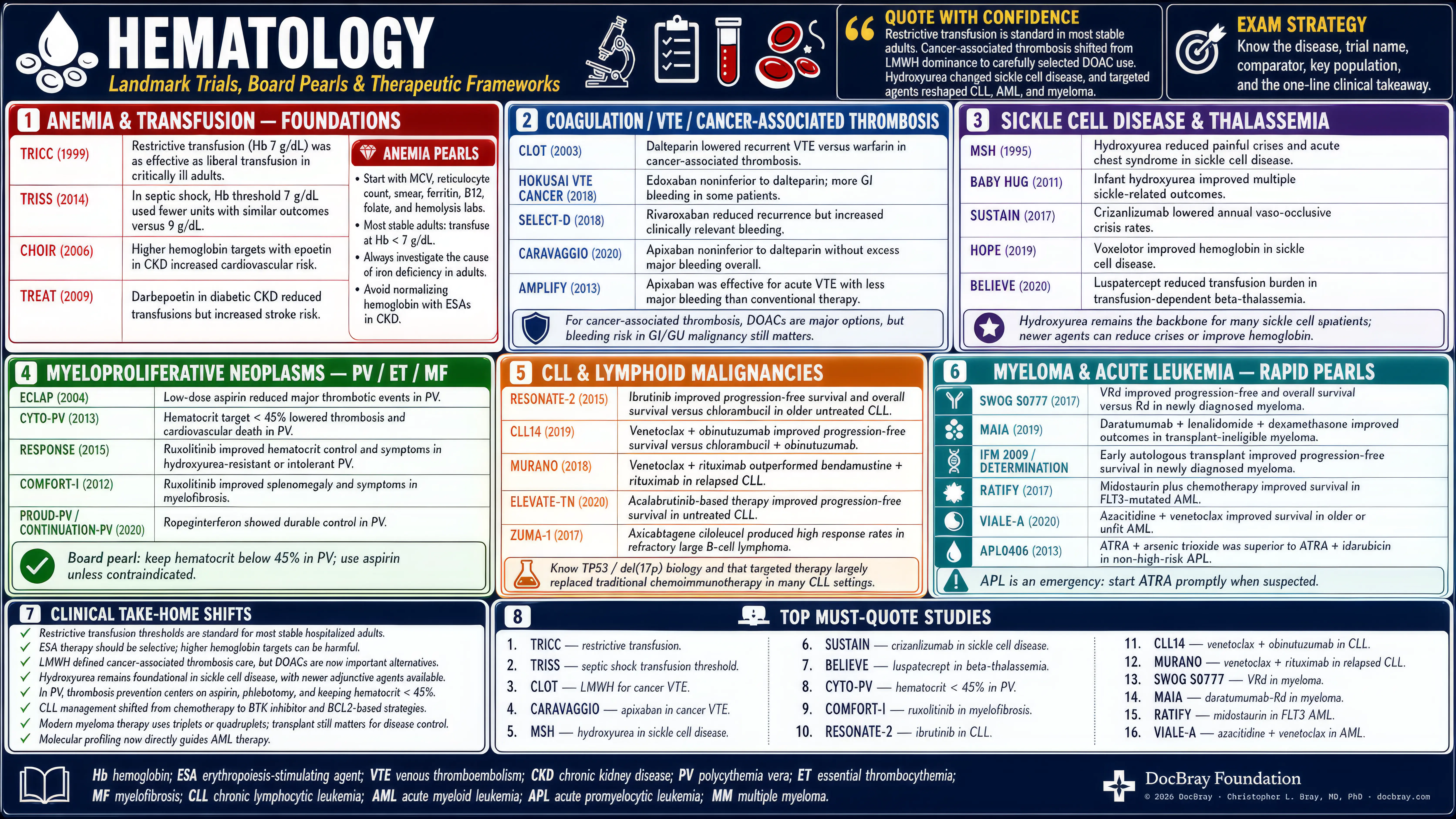
Panel 1 — Anemia & Transfusion: Foundations
- TRICC1999
RCT of 838 euvolemic critically ill adults comparing a restrictive transfusion strategy (transfuse at Hb <7 g/dL, target 7–9) versus a liberal strategy (transfuse at Hb <10 g/dL, target 10–12). 30-day mortality was not significantly different overall (18.7% restrictive vs 23.3% liberal, p=0.11) and was significantly lower with the restrictive strategy in younger and less acutely ill patients. In-hospital mortality favored restriction. Takeaway: a restrictive threshold (Hb 7 g/dL) is at least as safe as a liberal one in most stable critically ill adults — the foundational transfusion-threshold trial and a perennial board favorite.
- TRISS2014
Multicenter RCT of 998 ICU patients with septic shock comparing a transfusion threshold of Hb ≤7 g/dL versus ≤9 g/dL. 90-day mortality was nearly identical (43.0% vs 45.0%; RR 0.94, p=0.44), with no difference in ischemic events or use of life support, while the lower-threshold group received about half as many transfusions. Takeaway: in septic shock, a restrictive Hb 7 g/dL threshold gives similar outcomes to a liberal 9 g/dL threshold while using fewer units — extends TRICC's restrictive principle into sepsis. Neutral (non-inferiority-type) result.
- CHOIR2006
RCT of 1,432 non-dialysis CKD patients with anemia randomized to a higher hemoglobin target (13.5 g/dL) versus a lower target (11.3 g/dL) using epoetin alfa. The higher-target group had a significantly increased risk of the composite of death, MI, heart failure hospitalization, and stroke (HR 1.34, p=0.03) with no improvement in quality of life. Takeaway: targeting near-normal hemoglobin with ESAs in CKD causes harm — anchors the "don't fully normalize Hb with ESAs" board pearl.
- TREAT2009
Placebo-controlled RCT of 4,038 patients with type 2 diabetes, CKD, and anemia; darbepoetin alfa targeted Hb ~13 g/dL versus placebo (rescue only). Darbepoetin did not reduce the primary composite of death or cardiovascular events, nor death or renal events, and it roughly doubled the risk of fatal or nonfatal stroke (HR 1.92, p<0.001) while modestly reducing transfusions. Takeaway: ESA therapy to normalize Hb in diabetic CKD offers no cardiorenal benefit and increases stroke risk — reinforces selective, conservative ESA use.
Panel 2 — Coagulation / VTE / Cancer-Associated Thrombosis
- CLOT2003
RCT of 672 cancer patients with acute VTE comparing dalteparin (LMWH) for 6 months versus dalteparin bridge to an oral coumarin (warfarin). Dalteparin reduced recurrent VTE from 17% to 9% (HR 0.48, p=0.002) without increasing major bleeding. Takeaway: established LMWH as the standard for cancer-associated thrombosis for over a decade and the comparator against which later DOAC trials were judged.
- HOKUSAI VTE CANCER2018
Randomized open-label noninferiority trial of 1,050 cancer patients with VTE comparing oral edoxaban (after ≥5 days LMWH) versus subcutaneous dalteparin. Edoxaban was noninferior for the composite of recurrent VTE or major bleeding (12.8% vs 13.5%, HR 0.97). Recurrent VTE was numerically lower with edoxaban, but major bleeding was significantly higher (6.9% vs 4.0%), driven largely by upper-GI bleeds in GI-cancer patients. Takeaway: DOACs are effective for cancer VTE but carry higher GI bleeding risk, especially with GI malignancies.
- SELECT-D2018
Randomized pilot trial (n=406) of cancer patients with VTE comparing rivaroxaban versus dalteparin for 6 months. Rivaroxaban reduced 6-month recurrent VTE (4% vs 11%; HR 0.43) but increased clinically relevant non-major bleeding (13% vs 4%) with a numerical rise in major bleeding. Takeaway: rivaroxaban lowers recurrence at the cost of more (particularly GI/GU) bleeding — echoes the DOAC efficacy/bleeding trade-off in cancer-associated thrombosis.
- CARAVAGGIO2020
Randomized open-label noninferiority trial of 1,170 cancer patients with VTE comparing oral apixaban versus subcutaneous dalteparin for 6 months. Apixaban was noninferior for recurrent VTE (5.6% vs 7.9%, HR 0.63) with no excess major bleeding (3.8% vs 4.0%) and — unlike edoxaban/rivaroxaban — no significant increase in GI bleeding. Takeaway: apixaban is an effective oral option for cancer-associated VTE without the bleeding penalty seen with other DOACs, broadening acceptable DOAC use.
- AMPLIFY2013
Double-blind RCT of 5,395 patients with acute VTE comparing apixaban monotherapy versus enoxaparin-to-warfarin. Apixaban was noninferior for recurrent VTE or VTE-related death (2.3% vs 2.7%, RR 0.84) and significantly reduced major bleeding (0.6% vs 1.8%; RR 0.31, p<0.001). Takeaway: apixaban is as effective as conventional anticoagulation for acute VTE with markedly less major bleeding — a pivotal DOAC trial for the general (non-cancer) VTE population.
Panel 3 — Sickle Cell Disease & Thalassemia
- MSH1995
Placebo-controlled RCT of 299 adults with moderate-to-severe sickle cell anemia (≥3 crises/year). Hydroxyurea reduced the median annual rate of painful crises (2.5 vs 4.5), roughly halved episodes of acute chest syndrome, and reduced transfusions and hospitalizations. Takeaway: the trial that established hydroxyurea as disease-modifying therapy and the backbone of sickle cell disease management.
- BABY HUG2011
Placebo-controlled RCT of 193 infants (9–18 months) with sickle cell anemia treated with hydroxyurea for 2 years, regardless of severity. The co-primary endpoints (spleen and kidney function) were not significantly improved, but hydroxyurea significantly reduced pain crises and dactylitis, with supportive trends toward fewer acute chest syndrome episodes, hospitalizations, and transfusions, and acceptable toxicity. Takeaway: supports safe, effective early hydroxyurea use in very young children — expanded use into infancy despite neutral organ-function endpoints.
- SUSTAIN2017
Phase 2 placebo-controlled RCT of 198 sickle cell patients comparing the anti–P-selectin antibody crizanlizumab (high dose 5 mg/kg) versus placebo. High-dose crizanlizumab lowered the median annual rate of vaso-occlusive crises by ~45% (1.63 vs 2.98, p=0.01) and increased the proportion of crisis-free patients, with a favorable safety profile. Takeaway: introduced targeted anti-adhesion therapy as an adjunct to reduce pain crises in sickle cell disease.
- HOPE2019
Phase 3 placebo-controlled RCT of 274 sickle cell patients comparing the hemoglobin-oxygen affinity modulator voxelotor (1500 mg) versus placebo. At 24 weeks, 51% of the 1500-mg group achieved a hemoglobin increase >1 g/dL versus 7% with placebo (p<0.001), with reduced hemolysis markers. The trial was not powered to show a reduction in vaso-occlusive crises. Takeaway: voxelotor durably raises hemoglobin by inhibiting HbS polymerization — a hemoglobin/hemolysis-directed agent (note: voxelotor was later withdrawn from the market in 2024 over safety signals; the HOPE efficacy result stands).
- BELIEVE2020
Phase 3 placebo-controlled RCT of 336 adults with transfusion-dependent β-thalassemia comparing the erythroid-maturation agent luspatercept versus placebo. Significantly more luspatercept patients achieved ≥33% reduction in transfusion burden over weeks 13–24 (21.4% vs 4.5%, p<0.001). Takeaway: luspatercept reduces transfusion requirements in transfusion-dependent β-thalassemia — a novel mechanism distinct from ESAs.
Panel 4 — Myeloproliferative Neoplasms: PV / ET / MF
- ECLAP2004
Double-blind placebo-controlled RCT of 518 polycythemia vera patients (no clear indication for/contraindication to aspirin) comparing low-dose aspirin (100 mg/day) versus placebo. Aspirin reduced the primary composite of nonfatal MI, nonfatal stroke, PE, major venous thrombosis, or cardiovascular death (RR 0.40, p=0.03) without a significant increase in major bleeding. Takeaway: established low-dose aspirin as standard thromboprophylaxis in PV unless contraindicated.
- CYTO-PV2013
RCT of 365 PV patients randomized to a hematocrit target of <45% versus 45–50%. The lower-hematocrit group had a significantly reduced rate of cardiovascular death or major thrombosis (2.7% vs 9.8%; HR 3.91 for the higher target, p=0.007). Takeaway: provided the evidence for the <45% hematocrit target central to PV management.
- RESPONSE2015
Phase 3 RCT of 222 PV patients resistant to or intolerant of hydroxyurea comparing the JAK1/2 inhibitor ruxolitinib versus best available therapy. Ruxolitinib achieved the composite of hematocrit control plus ≥35% spleen-volume reduction far more often (21% vs 1%, p<0.001) and improved disease-related symptoms. Takeaway: ruxolitinib is effective second-line therapy for hydroxyurea-resistant/intolerant PV.
- COMFORT-I2012
Phase 3 placebo-controlled RCT of 309 patients with intermediate-2 or high-risk myelofibrosis comparing ruxolitinib versus placebo. Significantly more ruxolitinib patients achieved ≥35% reduction in spleen volume at 24 weeks (41.9% vs 0.7%, p<0.001) with substantial improvement in symptom burden and quality of life. Takeaway: first JAK inhibitor approved for myelofibrosis — established ruxolitinib for splenomegaly and constitutional symptoms.
- PROUD-PV / CONTINUATION-PV2020
Randomized phase 3 noninferiority trial (PROUD-PV, n=257) with open-label extension (CONTINUATION-PV) comparing ropeginterferon alfa-2b versus hydroxyurea/best available therapy in PV. Ropeginterferon did NOT meet the pre-specified composite noninferiority endpoint at 12 months (21% vs 28%), but by 36 months showed higher durable complete hematologic response with disease-modification (JAK2 allele-burden reduction). Takeaway: supports ropeginterferon as durable, disease-modifying cytoreduction in PV, especially for long-term control.
Panel 5 — CLL & Lymphoid Malignancies
- RESONATE-22015
Phase 3 RCT of 269 previously untreated CLL/SLL patients aged ≥65 comparing the BTK inhibitor ibrutinib versus chlorambucil. Ibrutinib significantly prolonged progression-free survival (median not reached vs 18.9 months; HR 0.16) and overall survival (24-month OS 98% vs 85%) with higher response rates. Takeaway: established BTK inhibition as a chemotherapy-free frontline option for older untreated CLL.
- CLL142019
Phase 3 RCT of 432 previously untreated CLL patients with coexisting conditions comparing fixed-duration venetoclax + obinutuzumab versus chlorambucil + obinutuzumab. The venetoclax arm significantly improved progression-free survival (24-month PFS 88.2% vs 64.1%; HR 0.35) with higher rates of undetectable minimal residual disease. Takeaway: established time-limited BCL2-inhibitor–based therapy as a frontline standard for CLL.
- MURANO2018
Phase 3 RCT of 389 patients with relapsed/refractory CLL comparing fixed-duration venetoclax + rituximab versus bendamustine + rituximab. Venetoclax-rituximab markedly improved 2-year progression-free survival (84.9% vs 36.3%; HR 0.17, p<0.001) with higher undetectable-MRD rates. Takeaway: established chemo-free, time-limited venetoclax-based therapy in the relapsed/refractory CLL setting.
- ELEVATE-TN2020
Three-arm phase 3 RCT of 535 treatment-naive CLL patients comparing acalabrutinib + obinutuzumab, acalabrutinib monotherapy, and chlorambucil + obinutuzumab. Both acalabrutinib arms significantly prolonged progression-free survival versus chemoimmunotherapy (estimated 24-month PFS 93% and 87% vs 47%). Takeaway: supports the second-generation BTK inhibitor acalabrutinib as effective, well-tolerated frontline CLL therapy.
- ZUMA-12017
Single-arm phase 2 trial of 101 patients with refractory large B-cell lymphoma treated with the anti-CD19 CAR T-cell product axicabtagene ciloleucel. The objective response rate was 82% with a 54% complete response rate; ~40% remained in ongoing response at ~15 months. Grade ≥3 cytokine release syndrome (13%) and neurologic events (28%) were notable. Takeaway: a pivotal CAR T-cell trial establishing durable responses in otherwise refractory aggressive B-cell lymphoma.
Panel 6 — Myeloma & Acute Leukemia: Rapid Pearls
- SWOG S07772017
Phase 3 RCT of 525 newly diagnosed myeloma patients (no immediate transplant intent) comparing triplet VRd (bortezomib + lenalidomide + dexamethasone) versus doublet Rd. VRd significantly improved progression-free survival (median 43 vs 30 months; HR 0.71) and overall survival (median 75 vs 64 months). Takeaway: established the VRd triplet as a frontline standard over lenalidomide-dexamethasone alone.
- MAIA2019
Phase 3 RCT of 737 transplant-ineligible newly diagnosed myeloma patients comparing daratumumab + lenalidomide + dexamethasone (D-Rd) versus Rd. Adding daratumumab reduced progression or death (30-month PFS 71% vs 56%; HR 0.56, p<0.001) with deeper responses and higher MRD-negativity. Takeaway: established the anti-CD38 antibody daratumumab in frontline therapy for transplant-ineligible myeloma.
- IFM 2009 / DETERMINATION2017 / 2022
Two linked phase 3 RCTs testing early autologous stem-cell transplant with VRd induction versus VRd alone (with transplant reserved) in newly diagnosed myeloma. IFM 2009 (n=700): early transplant improved progression-free survival (median 50 vs 36 months; HR 0.65) but showed no overall-survival difference. DETERMINATION (n=722), the US counterpart with lenalidomide maintenance until progression, confirmed a large PFS benefit with transplant (median 67.5 vs 46.2 months; HR 1.53 for RVd-alone vs transplant, i.e. ~0.65 favoring transplant) but again no overall-survival difference. Takeaway: early autologous transplant deepens response and prolongs PFS, but has not shown an OS advantage in the modern novel-agent era — transplant timing remains individualized.
- RATIFY2017
Phase 3 placebo-controlled RCT (CALGB 10603/RATIFY) of 717 adults (18–59) with FLT3-mutated AML adding the multi-kinase/FLT3 inhibitor midostaurin to standard 7+3 induction and consolidation. Midostaurin significantly improved overall survival (median 74.7 vs 25.6 months; HR 0.78, p=0.009) and event-free survival. Takeaway: established FLT3-targeted therapy added to chemotherapy as standard for FLT3-mutated AML — a key example of molecular profiling guiding AML treatment.
- VIALE-A2020
Phase 3 placebo-controlled RCT of 431 previously untreated AML patients ineligible for intensive chemotherapy comparing azacitidine + venetoclax versus azacitidine + placebo. The combination improved median overall survival (14.7 vs 9.6 months; HR 0.66, p<0.001) and composite complete remission (66% vs 28%). Takeaway: established azacitidine + venetoclax as the standard of care for older/unfit AML patients.
- APL04062013
Phase 3 noninferiority RCT of 162 patients with low-to-intermediate-risk acute promyelocytic leukemia comparing ATRA + arsenic trioxide (chemotherapy-free) versus ATRA + idarubicin chemotherapy. The ATRA-ATO arm was noninferior and superior: 2-year event-free survival 97% vs 86% and overall survival 99% vs 91%, with less hematologic toxicity. Takeaway: established a chemotherapy-free ATRA + arsenic trioxide regimen as standard for non-high-risk APL. (Board pearl: APL is an emergency — start ATRA promptly when suspected.)
Preparing for boards, teaching residents, or building your own trial file? Dr. Bray mentors trainees and early-career physicians at no cost.
Get in touch →