
Infectious Diseases
The landmark Infectious Diseases trials every internist should be able to quote — 28 studies across 6 evidence panels, each linked to its primary paper with a brief, plain-language summary of what it showed and why it changed practice.
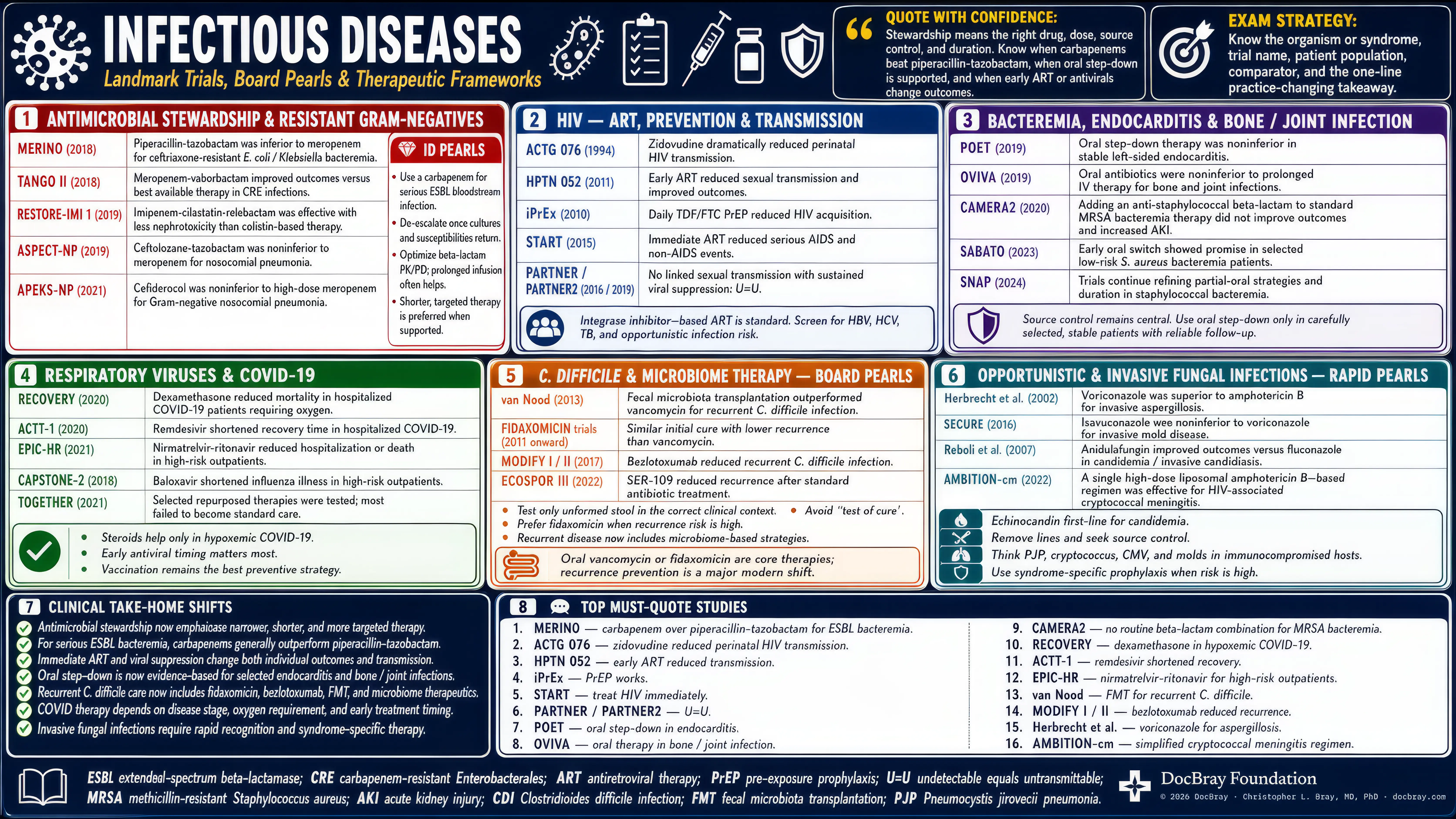
Panel 1 — Antimicrobial Stewardship & Resistant Gram-Negatives
- MERINO2018
Open-label noninferiority RCT of 391 patients with ceftriaxone-resistant (largely ESBL-producing) *E. coli* or *Klebsiella* bloodstream infection randomized to piperacillin-tazobactam versus meropenem. 30-day mortality was 12.3% with piperacillin-tazobactam versus 3.7% with meropenem — piperacillin-tazobactam failed to meet noninferiority (risk difference 8.6%). The result overturned the practice of using piperacillin-tazobactam for ESBL bacteremia. Board takeaway: for serious ESBL Enterobacterales bloodstream infection, use a carbapenem, not piperacillin-tazobactam, even when in vitro susceptibility appears favorable.
- TANGO II2018
Phase 3 open-label RCT in patients with confirmed/suspected carbapenem-resistant Enterobacteriaceae (CRE) infections comparing meropenem-vaborbactam monotherapy with best available therapy (often combination regimens including polymyxins). Meropenem-vaborbactam yielded higher clinical cure, lower 28-day mortality, and fewer nephrotoxic adverse events. Trial was small and stopped early. Board takeaway: meropenem-vaborbactam is a preferred, less nephrotoxic option for KPC-type CRE infections versus older polymyxin/aminoglycoside-based "best available therapy."
- RESTORE-IMI 12020
Small double-blind RCT (~47 patients) in imipenem-nonsusceptible gram-negative infections (HABP/VABP, cIAI, cUTI) comparing imipenem-cilastatin/relebactam with colistin plus imipenem. Favorable clinical response was similar between arms, but the relebactam combination had markedly lower nephrotoxicity (10% vs 56%) and numerically lower 28-day mortality. Board takeaway: imipenem/relebactam is an effective, less nephrotoxic alternative to colistin-based regimens for imipenem-nonsusceptible gram-negative infections.
- ASPECT-NP2019
Double-blind phase 3 noninferiority RCT of 726 mechanically ventilated patients with ventilated HABP or VABP randomized to high-dose (3 g) ceftolozane-tazobactam versus meropenem. 28-day mortality (24.0% vs 25.3%) and clinical cure met noninferiority criteria. Board takeaway: high-dose ceftolozane-tazobactam is a noninferior option to meropenem for gram-negative nosocomial/ventilated pneumonia, useful when resistant *Pseudomonas* is a concern.
- APEKS-NP2021
Double-blind phase 3 noninferiority RCT of 300 patients with gram-negative nosocomial pneumonia comparing the siderophore cephalosporin cefiderocol with high-dose, extended-infusion meropenem. 14-day all-cause mortality was similar (12.4% vs 11.6%), meeting noninferiority. Board takeaway: cefiderocol is noninferior to meropenem for gram-negative nosocomial pneumonia and is a key option for carbapenem-resistant/difficult-to-treat gram-negatives (e.g., *Acinetobacter*, metallo-β-lactamase producers).
Panel 2 — HIV: ART, Prevention & Transmission
- ACTG 0761994
Landmark placebo-controlled RCT (Pediatric AIDS Clinical Trials Group Protocol 076) of 363 HIV-positive pregnant women randomized to a three-part zidovudine (ZDV) regimen (antepartum, intrapartum, neonatal) versus placebo. ZDV reduced perinatal HIV transmission from 25.5% to 8.3% — roughly a two-thirds relative reduction. Board takeaway: this trial established antiretroviral prophylaxis in pregnancy as standard of care and launched the entire prevention-of-mother-to-child-transmission field.
- HPTN 0522011
Multinational RCT of 1,763 HIV-serodiscordant couples (mostly heterosexual) randomizing the infected partner to immediate versus delayed ART. Early ART reduced linked HIV transmission by 96% and also reduced clinical events in the treated partner. Board takeaway: this is the foundational "Treatment as Prevention" trial — viral suppression prevents sexual transmission, supporting immediate ART for all regardless of CD4 count.
- iPrEx2010
Placebo-controlled RCT of 2,499 HIV-negative men (and transgender women) who have sex with men, randomized to daily oral tenofovir-emtricitabine (TDF/FTC) versus placebo. PrEP reduced HIV acquisition by 44% overall, with efficacy strongly tied to adherence (>90% reduction with detectable drug). Board takeaway: iPrEx established daily oral TDF/FTC pre-exposure prophylaxis as an effective HIV prevention tool; adherence drives efficacy.
- START2015
RCT of 4,685 ART-naïve HIV-positive adults with CD4 >500 randomized to immediate ART versus deferral until CD4 ≤350. Immediate ART reduced the composite of serious AIDS-related and non-AIDS events by 57%. Board takeaway: START provided definitive evidence to start ART immediately at diagnosis regardless of CD4 count, cementing universal "treat everyone" guidelines.
- PARTNER / PARTNER22016 / 2019
Two prospective observational cohorts of serodifferent couples having condomless sex where the HIV-positive partner had suppressed viral load (<200 copies/mL). Across thousands of couple-years and ~77,000 condomless sex acts, there were zero phylogenetically linked HIV transmissions. PARTNER2 extended this to gay male couples. Board takeaway: these studies are the evidence base for U=U (Undetectable = Untransmittable) — durable viral suppression eliminates sexual transmission risk.
Panel 3 — Bacteremia, Endocarditis & Bone/Joint Infection
- POET2019
Randomized noninferiority trial of 400 stable patients with left-sided endocarditis (streptococci, *E. faecalis*, *S. aureus*, coagulase-negative staph) who, after initial IV therapy, were randomized to continue IV or switch to oral antibiotics. The oral step-down arm was noninferior for the composite of death, embolic events, unplanned surgery, and relapse. Board takeaway: in carefully selected, stabilized left-sided endocarditis patients, oral step-down antibiotics are noninferior to full-course IV therapy.
- OVIVA2019
Randomized noninferiority trial of 1,054 patients with bone or joint infection who, within 7 days of surgery or antibiotic start, were assigned to oral versus IV antibiotics for the first 6 weeks. Treatment failure at 1 year was 13.2% (oral) versus 14.6% (IV) — oral was noninferior. Board takeaway: early oral antibiotics are noninferior to prolonged IV for bone and joint infection, reducing line complications and hospital stay.
- CAMERA22020
Open-label RCT of 352 patients with MRSA bacteremia randomized to standard therapy (vancomycin or daptomycin) with or without an added antistaphylococcal β-lactam. The combination did not improve the 90-day composite outcome and was stopped early for increased acute kidney injury (23% vs 6%). Board takeaway: do NOT routinely add a β-lactam to standard therapy for MRSA bacteremia — no benefit and more nephrotoxicity.
- SABATO2024
Open-label noninferiority RCT of low-risk *S. aureus* (MSSA/MRSA) bacteremia patients randomized after 5–7 days of IV therapy to early oral switch versus continued IV. In low-risk patients (no endocarditis, no deep foci, no prosthetic material), early oral switch was noninferior for the 90-day composite of complications. Board takeaway: in carefully selected low-risk *S. aureus* bacteremia, early oral step-down is a reasonable, noninferior strategy — a shift from the traditional all-IV dogma.
- SNAP — backbone2026
SNAP is a large international Bayesian adaptive platform trial in *S. aureus* bacteremia, testing multiple domains (antibiotic backbone, adjunctive therapy, early oral switch). Its 2026 backbone results are practice-shaping. In methicillin-susceptible *S. aureus* bacteremia, cefazolin was noninferior to antistaphylococcal penicillins (flucloxacillin/cloxacillin) for 90-day mortality (15.0% vs 17.0%; adjusted OR 0.81, 99.2% probability of noninferiority) and caused significantly less acute kidney injury (13.9% vs 19.6%; adjusted OR 0.67) — N Engl J Med 2026. In penicillin-susceptible *S. aureus* bacteremia, benzylpenicillin had a high probability of mortality noninferiority with markedly less AKI, and the antistaphylococcal-penicillin arm was stopped early for excess AKI, favoring benzylpenicillin (Lancet 2026, PMID 42309115). Board takeaway: for MSSA bacteremia, cefazolin is a noninferior, less-nephrotoxic backbone; for true PSSA, narrow-spectrum penicillin is preferred. (Early-oral-switch domain protocol: PMID 37921609; SNAP results review: Goodman AL, et al. J Antimicrob Chemother 2026, PMID 42396858.)
Panel 4 — Respiratory Viruses & COVID-19
- RECOVERY — Dexamethasone2021
Large pragmatic open-label platform RCT of 6,425 hospitalized COVID-19 patients randomized to dexamethasone 6 mg daily versus usual care. Dexamethasone reduced 28-day mortality in patients requiring oxygen (23% vs 26%) or mechanical ventilation (29% vs 41%), but showed no benefit — and a trend toward harm — in patients not needing oxygen. Board takeaway: dexamethasone reduces mortality only in hypoxemic/ventilated COVID-19; avoid steroids in non-hypoxemic patients.
- ACTT-1 — Remdesivir2020
Double-blind placebo-controlled RCT of 1,062 hospitalized COVID-19 patients randomized to remdesivir versus placebo. Remdesivir shortened median time to recovery from 15 to 10 days; the mortality benefit was not statistically significant. Board takeaway: remdesivir shortens recovery time in hospitalized COVID-19 (greatest benefit in those needing supplemental oxygen but not mechanical ventilation), supporting its use in selected hospitalized patients.
- EPIC-HR — Nirmatrelvir-Ritonavir2022
Double-blind RCT of 2,246 unvaccinated, nonhospitalized adults at high risk for severe COVID-19 randomized to nirmatrelvir-ritonavir (Paxlovid) versus placebo within 5 days of symptom onset. Treatment reduced COVID-19-related hospitalization or death by ~89% (0.8% vs 7.0% in those treated within 3 days). Board takeaway: early nirmatrelvir-ritonavir markedly reduces progression in high-risk outpatients — early treatment timing is essential.
- CAPSTONE-2 — Baloxavir2020
Double-blind phase 3 RCT of 2,184 high-risk outpatients with influenza randomized to single-dose baloxavir marboxil, oseltamivir, or placebo. Baloxavir shortened time to improvement of symptoms versus placebo (median 73 vs 102 hours) and reduced complications, with efficacy comparable to oseltamivir. Board takeaway: single-dose oral baloxavir shortens influenza illness in high-risk outpatients.
- TOGETHER2022
TOGETHER was an adaptive platform RCT in high-risk COVID-19 outpatients (Brazil) that tested numerous repurposed therapies. This representative publication showed fluvoxamine modestly reduced a composite of emergency observation/hospitalization. Across the platform, most repurposed agents (e.g., ivermectin [PMID 35353979], hydroxychloroquine, metformin, lopinavir) failed to show meaningful benefit. Board takeaway: the TOGETHER platform rigorously tested repurposed COVID-19 therapies and most did not work — reinforcing evidence over enthusiasm.
Panel 5 — C. difficile & Microbiome Therapy
- van Nood — FMT2013
Open-label RCT (stopped early for efficacy) comparing donor fecal microbiota transplantation via duodenal infusion (after brief vancomycin) versus a standard vancomycin course for recurrent *C. difficile* infection. FMT cured 81% after one infusion (94% overall) versus ~31% with vancomycin alone. Board takeaway: this landmark trial established fecal microbiota transplantation as highly effective for recurrent *C. difficile* — the proof-of-concept that reshaped recurrence management.
- FIDAXOMICIN trials2011
Double-blind noninferiority RCT of 629 patients with *C. difficile* infection comparing fidaxomicin with oral vancomycin. Initial clinical cure was similar (~88% vs 86%), but fidaxomicin significantly reduced recurrence (15% vs 25%) and improved sustained cure. Board takeaway: fidaxomicin achieves similar initial cure with fewer recurrences than vancomycin — now guideline-preferred for CDI, especially when recurrence risk is high.
- MODIFY I / II — Bezlotoxumab2017
Two double-blind RCTs (MODIFY I and II) of patients receiving standard-of-care CDI antibiotics randomized to a single infusion of the anti-toxin B monoclonal antibody bezlotoxumab versus placebo. Bezlotoxumab reduced recurrent CDI (~17% vs ~28%) over 12 weeks; actoxumab added no benefit. Board takeaway: bezlotoxumab is an adjunct to standard CDI antibiotics that reduces recurrence, particularly in high-risk patients (caution with heart failure).
- ECOSPOR III — SER-1092022
Double-blind placebo-controlled RCT of 182 patients with recurrent *C. difficile* infection who, after standard antibiotics, received oral SER-109 (a purified live-bacterial spore microbiome therapeutic) versus placebo. SER-109 reduced recurrence at 8 weeks (12% vs 40%). Board takeaway: SER-109 (now FDA-approved as an oral microbiome therapy) prevents recurrent CDI after standard antibiotic treatment — part of the modern shift toward microbiome-based recurrence prevention.
Panel 6 — Opportunistic & Invasive Fungal Infections
- Herbrecht et al. — Voriconazole for Aspergillosis2002
Randomized unblinded trial of 277 patients (mostly hematologic) with invasive aspergillosis comparing initial voriconazole with conventional amphotericin B deoxycholate. Voriconazole produced better successful outcomes at 12 weeks (53% vs 32%), improved survival (71% vs 58%), and fewer severe drug toxicities. Board takeaway: voriconazole is first-line therapy for invasive aspergillosis — a practice-defining trial.
- SECURE — Isavuconazole2016
Double-blind phase 3 noninferiority RCT of 527 patients with invasive mold disease (predominantly aspergillosis) comparing isavuconazole with voriconazole. All-cause 42-day mortality was noninferior (19% vs 20%), and isavuconazole had fewer drug-related adverse events (notably hepatobiliary, ocular, and skin). Board takeaway: isavuconazole is noninferior to voriconazole for invasive mold disease with a better tolerability profile and more predictable pharmacokinetics (no routine level monitoring).
- Reboli et al. — Anidulafungin2007
Double-blind RCT of 245 patients with invasive candidiasis/candidemia comparing the echinocandin anidulafungin with fluconazole. Anidulafungin achieved higher treatment success at end of IV therapy (76% vs 60%) and met noninferiority (with a trend to superiority). Board takeaway: echinocandins are first-line for candidemia/invasive candidiasis, outperforming fluconazole — this trial helped establish that standard.
- AMBITION-cm2022
Phase 3 noninferiority RCT (sub-Saharan Africa) of ~844 patients with HIV-associated cryptococcal meningitis comparing a single high-dose (10 mg/kg) liposomal amphotericin B (plus flucytosine and fluconazole) with the WHO-standard 7-day amphotericin course. 10-week mortality was noninferior (24.8% vs 28.7%) with fewer adverse events. Board takeaway: a single high-dose liposomal amphotericin B regimen simplifies and de-toxifies induction therapy for HIV-associated cryptococcal meningitis (now WHO-recommended).
Preparing for boards, teaching residents, or building your own trial file? Dr. Bray mentors trainees and early-career physicians at no cost.
Get in touch →