
Nephrology
The landmark Nephrology trials every internist should be able to quote — 28 studies across 5 evidence panels, each linked to its primary paper with a brief, plain-language summary of what it showed and why it changed practice.
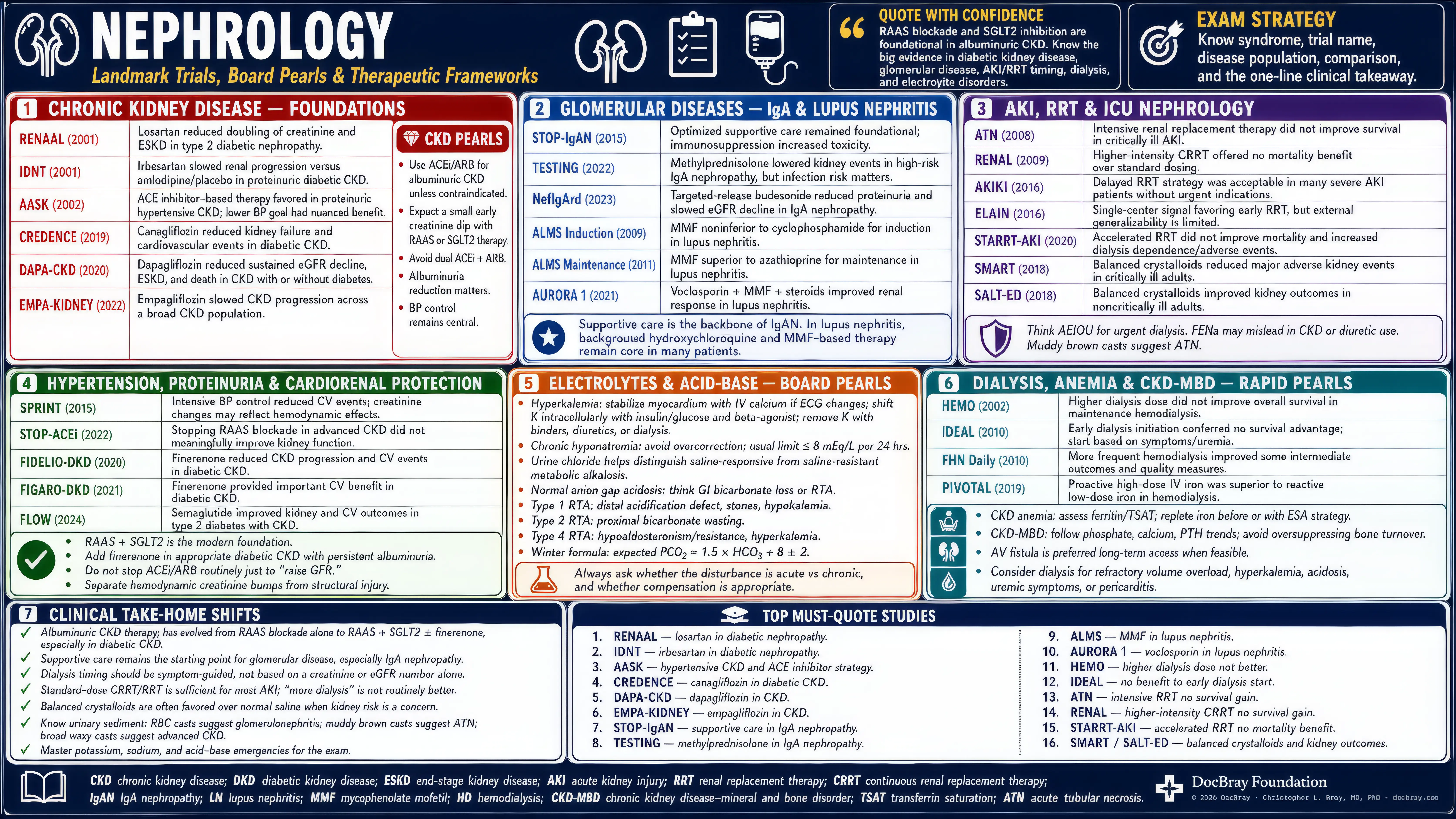
Panel 1 — Chronic Kidney Disease: Foundations
- RENAAL2001
RCT of 1,513 patients with type 2 diabetes and nephropathy (proteinuria, elevated creatinine) randomized to the ARB losartan versus placebo, both on conventional antihypertensives. Losartan reduced the composite of doubling of serum creatinine, ESRD, or death by 16%, driven by a 25% relative reduction in creatinine doubling and a 28% reduction in progression to ESRD, independent of blood-pressure effect. Board takeaway: ARBs are renoprotective in proteinuric type 2 diabetic kidney disease, cementing RAAS blockade as foundational therapy for albuminuric CKD.
- IDNT2001
Three-arm RCT of 1,715 hypertensive patients with type 2 diabetic nephropathy comparing irbesartan (ARB), amlodipine (calcium-channel blocker), and placebo. Irbesartan reduced the risk of the composite renal endpoint (doubling of creatinine, ESRD, or death) by 20% versus placebo and 23% versus amlodipine, an effect independent of achieved blood pressure. Amlodipine was not renoprotective versus placebo. Board takeaway: an ARB is preferred over a dihydropyridine CCB for slowing progression in proteinuric diabetic CKD; published alongside RENAAL.
- AASK2002
Factorial RCT in 1,094 Black adults with hypertensive nephrosclerosis testing a lower versus usual mean-arterial-pressure goal and three initial agents (ramipril [ACE inhibitor], metoprolol, amlodipine). The lower BP goal did not slow GFR decline overall. However, the ACE inhibitor ramipril was superior to both metoprolol and amlodipine in reducing clinical renal endpoints, particularly in those with baseline proteinuria. Board takeaway: ACE inhibitor–based therapy is favored in proteinuric hypertensive CKD; aggressive BP lowering alone had nuanced/limited additional benefit.
- CREDENCE2019
RCT of 4,401 patients with type 2 diabetes and albuminuric CKD (eGFR 30–90, urine ACR >300) on RAAS blockade, randomized to the SGLT2 inhibitor canagliflozin versus placebo; stopped early for efficacy. Canagliflozin reduced the primary composite (ESRD, doubling of creatinine, or renal/CV death) by 30%, with reductions in kidney failure and cardiovascular events. Board takeaway: first dedicated renal-outcome SGLT2-inhibitor trial—established SGLT2 inhibition as disease-modifying in diabetic kidney disease atop RAAS blockade.
- DAPA-CKD2020
RCT of 4,304 patients with CKD (eGFR 25–75, elevated albuminuria), with or without type 2 diabetes, randomized to dapagliflozin versus placebo; stopped early for efficacy. Dapagliflozin reduced the composite of sustained eGFR decline ≥50%, ESRD, or renal/CV death by 39%, with lower all-cause mortality. Benefit was consistent regardless of diabetes status. Board takeaway: extended SGLT2-inhibitor kidney protection beyond diabetes to non-diabetic CKD, broadening the treatable population.
- EMPA-KIDNEY2022
Large RCT of 6,609 patients across a broad CKD spectrum (eGFR 20–45, or 45–90 with albuminuria), with and without diabetes—including lower eGFR and normoalbuminuric patients under-represented in prior trials. Empagliflozin reduced the composite of kidney-disease progression or CV death by 28%. Board takeaway: reinforced an SGLT2-inhibitor class effect on kidney protection across a wider CKD population, supporting broad use in CKD regardless of diabetes or albuminuria level.
Panel 2 — Glomerular Diseases: IgA & Lupus Nephritis
- STOP-IgAN2015
RCT in which 162 patients with IgA nephropathy underwent a 6-month optimized supportive-care run-in, then those with persistent proteinuria were randomized to add immunosuppression (corticosteroids ± cyclophosphamide/azathioprine) versus continued supportive care alone. Adding immunosuppression did not meaningfully improve eGFR outcomes and increased adverse events (infections, weight gain, impaired glucose tolerance). Board takeaway: optimized supportive care (RAAS blockade, BP control) is the foundation of IgA nephropathy management; routine added immunosuppression carries toxicity without clear benefit.
- TESTING2022
International RCT of 503 patients with IgA nephropathy and proteinuria ≥1 g/day despite RAAS blockade, randomized to oral methylprednisolone versus placebo (dose reduced after early excess serious infections). Steroids reduced the composite of ≥40% eGFR decline, kidney failure, or renal death (HR ~0.53) but increased serious adverse events, chiefly infection. Board takeaway: corticosteroids can slow progression in high-risk IgA nephropathy, but the benefit must be weighed against real infection/toxicity risk—reason routine use stays contentious.
- NefIgArd2023
Phase 3 RCT of 364 patients with primary IgA nephropathy at risk of progression, randomized to 9 months of targeted-release (gut-directed) budesonide versus placebo, then followed to 2 years. Budesonide reduced proteinuria and slowed eGFR decline versus placebo, with benefit persisting after treatment stopped and a favorable safety profile relative to systemic steroids. Board takeaway: gut-targeted budesonide (Nefecon) is a disease-directed IgA-nephropathy therapy that limits systemic corticosteroid exposure—basis for its approval.
- ALMS Induction2009
Large international RCT (Aspreva Lupus Management Study, n=370) comparing mycophenolate mofetil (MMF) with intravenous cyclophosphamide, each with corticosteroids, for 24-week induction in active class III–V lupus nephritis. Response rates were similar between arms (a superiority trial that did not meet its primary endpoint; response rates comparable); efficacy did not differ overall, though subgroup patterns favored MMF in some non-White/Hispanic populations. Board takeaway: MMF is an effective alternative to cyclophosphamide for lupus-nephritis induction, offering a non-alkylating option that preserves fertility.
- ALMS Maintenance2011
RCT of 227 lupus-nephritis patients who responded to induction, randomized to maintenance MMF versus azathioprine over 36 months. MMF was superior for the primary endpoint of time to treatment failure (death, ESRD, renal flare, doubling of creatinine, or need for rescue therapy). Board takeaway: MMF is the preferred maintenance agent over azathioprine after successful lupus-nephritis induction—established MMF across the full induction-to-maintenance course.
- AURORA 12021
Phase 3 RCT of 357 patients with active lupus nephritis randomized to the calcineurin inhibitor voclosporin versus placebo, both added to background MMF and low-dose steroids. Voclosporin roughly doubled the rate of complete renal response at 52 weeks (41% vs 23%) with a comparable serious-adverse-event profile. Board takeaway: triple therapy (voclosporin + MMF + glucocorticoids) improves renal response in lupus nephritis—supported voclosporin's approval and the move toward multitarget regimens.
Panel 3 — AKI, RRT & ICU Nephrology
- ATN2008
RCT of 1,124 critically ill patients with AKI randomized to intensive versus less-intensive renal-replacement therapy (higher- vs lower-dose intermittent HD/CRRT/SLED by hemodynamic status). Intensive dosing did not reduce 60-day mortality, improve recovery of kidney function, or lower non-renal organ failure. Board takeaway: more-intensive RRT does not improve survival in AKI—"more dialysis" is not better; a standard delivered dose suffices.
- RENAL2009
Large RCT of 1,508 critically ill patients with AKI randomized to higher-intensity (40 mL/kg/hr) versus lower-intensity (25 mL/kg/hr) continuous venovenous hemodiafiltration. Higher-intensity CRRT provided no mortality benefit at 90 days and did not improve renal recovery, while increasing hypophosphatemia. Board takeaway: parallels ATN—escalating CRRT dose above ~20–25 mL/kg/hr confers no survival advantage; standard effluent dosing is adequate.
- AKIKI2016
RCT of 620 critically ill patients (mostly septic/ischemic AKI, KDIGO stage 3) randomized to an early versus delayed RRT-initiation strategy. There was no mortality difference at 60 days; nearly half of the delayed-strategy patients never required RRT and had more catheter-free days and less catheter-related infection. Board takeaway: a delayed, indication-driven RRT strategy is acceptable in severe AKI without urgent indications and spares many patients dialysis.
- ELAIN2016
Single-center RCT (n=231), largely post-surgical patients with KDIGO stage 2 AKI and elevated NGAL, randomized to early versus delayed CRRT initiation. Early initiation reduced 90-day mortality and improved renal recovery. Board takeaway: a single-center signal favoring earlier RRT—notably at odds with the multicenter AKIKI/STARRT-AKI results; limited external generalizability, so the field leans toward the larger neutral trials.
- STARRT-AKI2020
Large multinational RCT of 3,019 critically ill patients with severe AKI randomized to an accelerated versus standard (indication-driven) RRT-initiation strategy. Accelerated initiation did not reduce 90-day mortality and was associated with more RRT dependence at 90 days and more adverse events. Board takeaway: the definitive trial—early/accelerated RRT does not improve survival and may cause harm (ongoing dialysis dependence); initiate for clear indications, not preemptively.
- SMART2018
Pragmatic cluster-randomized trial of 15,802 ICU adults comparing balanced crystalloids (lactated Ringer's/Plasma-Lyte) with 0.9% saline. Balanced fluids modestly reduced the composite of major adverse kidney events at 30 days (death, new RRT, or persistent renal dysfunction; 14.3% vs 15.4%). Board takeaway: balanced crystalloids are favored over normal saline in critically ill adults when kidney injury is a concern, reflecting the hyperchloremic-acidosis penalty of saline.
- SALT-ED2018
Companion pragmatic trial to SMART in 13,347 non-critically-ill emergency-department adults receiving IV fluids, comparing balanced crystalloids with saline. Hospital-free days were similar, but balanced fluids reduced major adverse kidney events at 30 days. Board takeaway: extends the SMART signal to the non-ICU/ED setting—balanced crystalloids improve kidney outcomes versus saline without a length-of-stay penalty.
Panel 4 — Hypertension, Proteinuria & Cardiorenal Protection
- SPRINT2015
RCT of 9,361 high-cardiovascular-risk, non-diabetic hypertensive adults randomized to an intensive systolic target <120 mm Hg versus <140 mm Hg; stopped early. Intensive control reduced major CV events and all-cause mortality. However, it caused more acute kidney injury and more rapid eGFR decline (largely hemodynamic, not structural). Board takeaway: intensive BP lowering yields cardiovascular/mortality benefit, but expect functional creatinine bumps—distinguish hemodynamic change from true kidney injury.
- STOP-ACEi2022
RCT of 411 patients with advanced, progressive CKD (eGFR <30) randomized to stop versus continue ACE inhibitor/ARB therapy. Stopping RAAS blockade did not improve or preserve eGFR at 3 years and did not delay ESRD; outcomes were similar between groups. Board takeaway: do not routinely discontinue ACEi/ARB in advanced CKD merely to "raise GFR"—stopping offers no meaningful renal benefit and forfeits cardiovascular protection.
- FIDELIO-DKD2020
RCT of 5,734 patients with type 2 diabetes and albuminuric CKD on optimized RAAS blockade, randomized to the nonsteroidal mineralocorticoid-receptor antagonist finerenone versus placebo. Finerenone reduced the primary kidney composite (kidney failure, sustained ≥40% eGFR decline, or renal death) by 18% and lowered CV events, with manageable hyperkalemia. Board takeaway: finerenone adds kidney and CV protection atop RAAS blockade in diabetic CKD—a third pillar alongside RAAS inhibition and SGLT2 inhibitors.
- FIGARO-DKD2021
Companion RCT to FIDELIO-DKD enrolling 7,437 type 2 diabetes patients with CKD skewed toward earlier/less-severe kidney disease (more stage 1–2 albuminuria). Finerenone reduced the primary cardiovascular composite (CV death, MI, stroke, or HF hospitalization), driven largely by fewer heart-failure hospitalizations. Board takeaway: finerenone provides cardiovascular benefit across the CKD spectrum in diabetes; pooled FIDELITY analysis confirms combined cardiorenal protection.
- FLOW2024
RCT of 3,533 patients with type 2 diabetes and CKD randomized to the GLP-1 receptor agonist semaglutide versus placebo; stopped early for efficacy. Semaglutide reduced the primary composite of major kidney events (kidney failure, ≥50% eGFR decline, or renal/CV death) by 24%, with lower CV and all-cause mortality. Board takeaway: GLP-1 receptor agonists confer kidney and cardiovascular benefit in diabetic CKD, adding a fourth evidence-based cardiorenal therapy class.
Panel 5 — Dialysis, Anemia & CKD-MBD: Rapid Pearls
- HEMO2002
Factorial RCT of 1,846 maintenance-hemodialysis patients randomized to standard versus high dialysis dose (Kt/V) and to low- versus high-flux membranes. Neither a higher delivered dose nor high-flux membranes improved overall mortality (the primary endpoint). Board takeaway: increasing thrice-weekly dialysis dose above an adequate target does not improve survival—reinforces that "more dialysis" per se is not better for maintenance HD outcomes.
- IDEAL2010
RCT of 828 patients with stage 5 CKD randomized to start dialysis early (eGFR 10–14) versus late (eGFR 5–7, or when symptomatic). There was no difference in survival or clinical outcomes; most "late" patients started earlier than planned once symptomatic. Board takeaway: dialysis timing should be symptom-guided, not driven by an eGFR threshold alone—early initiation confers no survival advantage.
- FHN Daily2010
RCT of 245 patients randomized to frequent (6×/week) versus conventional (3×/week) in-center hemodialysis. Frequent hemodialysis improved the composite outcomes of death or left-ventricular-mass change and death or physical-health score, and lowered blood pressure and phosphate—but required more vascular-access interventions. Board takeaway: more frequent hemodialysis improves selected intermediate/quality outcomes (LV mass, BP, phosphate control) at the cost of increased access procedures.
- PIVOTAL2019
RCT of 2,141 incident hemodialysis patients randomized to a proactive high-dose IV iron regimen versus a reactive low-dose strategy. The proactive arm was noninferior—and in fact superior—for the composite of death, MI, stroke, or heart-failure hospitalization, and reduced erythropoiesis-stimulating-agent (ESA) requirements, without increased infection. Board takeaway: proactive high-dose IV iron is safe and beneficial in maintenance hemodialysis, lowering ESA needs and cardiovascular events.
Preparing for boards, teaching residents, or building your own trial file? Dr. Bray mentors trainees and early-career physicians at no cost.
Get in touch →