
Oncology
The landmark Oncology trials every internist should be able to quote — 29 studies across 5 evidence panels, each linked to its primary paper with a brief, plain-language summary of what it showed and why it changed practice.
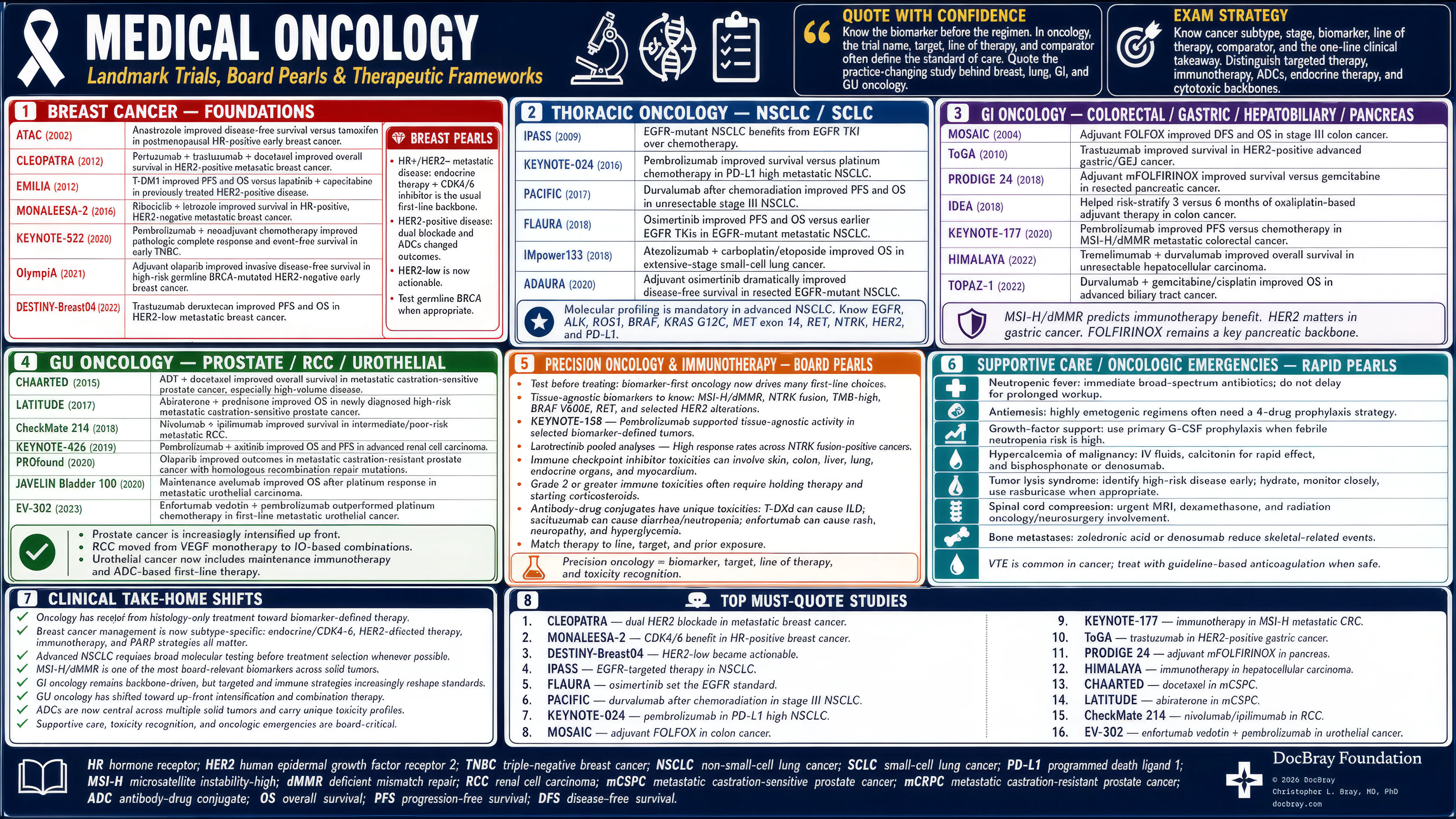
Panel 1 — Breast Cancer: Foundations
- ATAC2002
Large adjuvant RCT (>9,300 postmenopausal women with early breast cancer) comparing the aromatase inhibitor anastrozole, tamoxifen, or both. Anastrozole significantly prolonged disease-free survival versus tamoxifen in hormone-receptor–positive disease, with fewer contralateral cancers and fewer thromboembolic/endometrial events (more arthralgia and fractures). The combination offered no advantage over tamoxifen alone. Board takeaway: ATAC established aromatase inhibitors as preferred adjuvant endocrine therapy for postmenopausal HR-positive early breast cancer.
- CLEOPATRA2012
Phase 3 RCT in HER2-positive metastatic breast cancer comparing docetaxel + trastuzumab with or without pertuzumab. Adding pertuzumab (dual HER2 blockade) significantly improved progression-free survival and, in later follow-up, overall survival, without added cardiotoxicity. Board takeaway: dual HER2 blockade (pertuzumab + trastuzumab + taxane) is first-line standard of care for HER2-positive metastatic breast cancer.
- EMILIA2012
Phase 3 RCT in HER2-positive advanced breast cancer previously treated with trastuzumab and a taxane, comparing the antibody-drug conjugate T-DM1 (trastuzumab emtansine) with lapatinib + capecitabine. T-DM1 significantly improved progression-free and overall survival with less toxicity. Board takeaway: T-DM1 became the standard second-line option for HER2-positive metastatic disease and validated the antibody-drug conjugate strategy in breast cancer.
- MONALEESA-22016
Phase 3 RCT in postmenopausal HR-positive, HER2-negative advanced breast cancer comparing letrozole + ribociclib (a CDK4/6 inhibitor) versus letrozole + placebo. Adding ribociclib significantly prolonged progression-free survival; later follow-up showed an overall survival benefit. Board takeaway: CDK4/6 inhibitors added to endocrine therapy are first-line standard for HR-positive/HER2-negative metastatic breast cancer.
- KEYNOTE-5222020
Phase 3 RCT in early-stage triple-negative breast cancer adding pembrolizumab to neoadjuvant chemotherapy (then adjuvant pembrolizumab). The pembrolizumab arm significantly increased the pathologic complete response rate and improved event-free survival regardless of PD-L1 status. Board takeaway: neoadjuvant chemo-immunotherapy with pembrolizumab is standard for high-risk early TNBC.
- OlympiA2021
Phase 3 RCT of one year of adjuvant olaparib (a PARP inhibitor) versus placebo in high-risk, HER2-negative early breast cancer with germline BRCA1/2 mutations after completing local therapy and chemotherapy. Olaparib significantly improved invasive and distant disease-free survival, with a later overall survival benefit. Board takeaway: test for germline BRCA mutations; adjuvant olaparib is indicated for high-risk gBRCA-mutated HER2-negative early breast cancer.
- DESTINY-Breast042022
Phase 3 RCT in previously treated HER2-low (IHC 1+ or 2+/ISH-negative) metastatic breast cancer comparing the antibody-drug conjugate trastuzumab deruxtecan (T-DXd) with physician's-choice chemotherapy. T-DXd significantly improved progression-free and overall survival. Board takeaway: "HER2-low" is now an actionable category; T-DXd carries a notable risk of interstitial lung disease/pneumonitis.
Panel 2 — Thoracic Oncology: NSCLC / SCLC
- IPASS2009
Phase 3 RCT in East Asian never/light-smoker adenocarcinoma patients comparing first-line gefitinib (EGFR TKI) with carboplatin-paclitaxel. Benefit was driven by EGFR mutation status: mutation-positive patients did markedly better with gefitinib, while EGFR wild-type patients did better with chemotherapy. Board takeaway: IPASS established that EGFR-mutant NSCLC benefits from up-front EGFR TKI therapy and cemented biomarker-driven treatment selection.
- KEYNOTE-0242016
Phase 3 RCT in untreated metastatic NSCLC with PD-L1 tumor proportion score ≥50% and no EGFR/ALK alterations, comparing first-line pembrolizumab with platinum chemotherapy. Pembrolizumab significantly improved progression-free and overall survival with fewer adverse events. Board takeaway: single-agent pembrolizumab is first-line standard for high-PD-L1 (≥50%) advanced NSCLC without a targetable driver.
- PACIFIC2017
Phase 3 RCT in unresectable stage III NSCLC without progression after concurrent chemoradiotherapy, comparing consolidation durvalumab (anti–PD-L1) with placebo. Durvalumab significantly prolonged progression-free survival (and later overall survival). Board takeaway: consolidation durvalumab is standard of care after chemoradiation for unresectable stage III NSCLC.
- FLAURA2018
Phase 3 RCT in untreated EGFR-mutated (exon 19 del/L858R) advanced NSCLC comparing the third-generation EGFR TKI osimertinib with first-generation TKIs (gefitinib/erlotinib). Osimertinib significantly improved progression-free survival and, in the 2020 companion analysis, overall survival, with better CNS activity and tolerability. Board takeaway: osimertinib is the preferred first-line EGFR TKI for EGFR-mutant metastatic NSCLC.
- IMpower1332018
Phase 3 RCT in extensive-stage small-cell lung cancer adding atezolizumab (anti–PD-L1) to first-line carboplatin/etoposide. The immunotherapy arm significantly improved overall and progression-free survival. Board takeaway: chemo-immunotherapy (platinum/etoposide + a PD-L1 inhibitor) became first-line standard for extensive-stage SCLC — the first major advance in decades.
- ADAURA2020
Phase 3 RCT of adjuvant osimertinib versus placebo in resected stage IB–IIIA EGFR-mutated NSCLC. Adjuvant osimertinib dramatically improved disease-free survival (with a large reduction in CNS recurrence); a later analysis showed an overall survival benefit. Board takeaway: adjuvant osimertinib is standard after complete resection of EGFR-mutant NSCLC — reinforcing molecular testing even in early-stage disease.
Panel 3 — GI Oncology: Colorectal / Gastric / Hepatobiliary / Pancreas
- MOSAIC2004
Phase 3 RCT in resected stage II–III colon cancer comparing adjuvant FOLFOX (adding oxaliplatin to 5-FU/leucovorin) with 5-FU/leucovorin alone. FOLFOX significantly improved disease-free survival, with an overall survival benefit in stage III on longer follow-up (at the cost of oxaliplatin-related neuropathy). Board takeaway: MOSAIC established oxaliplatin-based FOLFOX as adjuvant standard for stage III colon cancer.
- ToGA2010
Phase 3 RCT in HER2-positive advanced gastric/GEJ cancer comparing chemotherapy (fluoropyrimidine + cisplatin) with or without trastuzumab. Adding trastuzumab significantly improved overall survival. Board takeaway: test for HER2 in advanced gastric/GEJ cancer; trastuzumab + chemotherapy is first-line standard for HER2-positive disease.
- PRODIGE 242018
Phase 3 RCT (PRODIGE 24/CCTG PA.6) in resected pancreatic ductal adenocarcinoma comparing adjuvant modified FOLFIRINOX with gemcitabine. mFOLFIRINOX significantly improved disease-free and overall survival (median OS ~54 vs ~35 months) in fit patients, with more toxicity. Board takeaway: adjuvant mFOLFIRINOX is preferred after resection for good-performance-status pancreatic cancer.
- IDEA2018
Prospective pooled analysis of six trials testing 3 versus 6 months of adjuvant oxaliplatin-based chemotherapy (FOLFOX/CAPOX) in stage III colon cancer. Non-inferiority of 3 months was not formally met overall, but 3 months was comparable in lower-risk disease (T1-3 N1) — especially with CAPOX — with substantially less neuropathy. Board takeaway: adjuvant duration can be risk-stratified; 3 months is reasonable for lower-risk stage III to limit neurotoxicity.
- KEYNOTE-1772020
Phase 3 RCT in untreated MSI-high/dMMR metastatic colorectal cancer comparing first-line pembrolizumab with chemotherapy. Pembrolizumab roughly doubled progression-free survival with fewer treatment-related adverse events. Board takeaway: first-line pembrolizumab (checkpoint inhibitor) is standard for MSI-H/dMMR metastatic CRC — biomarker testing before treatment is essential.
- HIMALAYA2022
Phase 3 RCT in unresectable hepatocellular carcinoma testing the STRIDE regimen (single priming dose of tremelimumab [anti–CTLA-4] plus durvalumab [anti–PD-L1]) versus sorafenib. STRIDE significantly improved overall survival versus sorafenib; durvalumab monotherapy was non-inferior. Board takeaway: dual immunotherapy (tremelimumab + durvalumab) is a first-line option for unresectable HCC.
- TOPAZ-12022
Phase 3 RCT in advanced/metastatic biliary tract cancer adding durvalumab (anti–PD-L1) to gemcitabine-cisplatin. The immunotherapy arm significantly improved overall survival with a manageable safety profile. Board takeaway: gemcitabine-cisplatin plus durvalumab is a first-line standard for advanced biliary tract cancer — the first major chemo-immunotherapy advance in this setting.
Panel 4 — GU Oncology: Prostate / RCC / Urothelial
- CHAARTED2015
Phase 3 RCT in metastatic hormone-sensitive prostate cancer comparing androgen-deprivation therapy (ADT) with or without early docetaxel. Adding docetaxel significantly improved overall survival, with the largest benefit in high-volume disease. Board takeaway: CHAARTED launched up-front treatment intensification — adding docetaxel to ADT — for metastatic castration-sensitive prostate cancer, especially high-volume disease.
- LATITUDE2017
Phase 3 RCT in newly diagnosed high-risk metastatic castration-sensitive prostate cancer comparing ADT plus abiraterone-prednisone with ADT plus placebo. Adding abiraterone significantly improved overall survival and radiographic progression-free survival. Board takeaway: abiraterone is another effective up-front intensification partner to ADT for high-risk metastatic castration-sensitive prostate cancer.
- CheckMate 2142018
Phase 3 RCT in previously untreated advanced clear-cell renal-cell carcinoma comparing dual immunotherapy (nivolumab + ipilimumab) with sunitinib. In intermediate/poor-risk patients, the immunotherapy combination significantly improved overall survival and response. Board takeaway: nivolumab + ipilimumab is a first-line standard for intermediate/poor-risk advanced RCC — moving the field from VEGF monotherapy to immunotherapy-based combinations.
- KEYNOTE-4262019
Phase 3 RCT in untreated advanced clear-cell RCC comparing pembrolizumab + axitinib (immunotherapy plus VEGF TKI) with sunitinib. The combination significantly improved overall survival, progression-free survival, and response across risk groups. Board takeaway: IO + TKI combinations (e.g., pembrolizumab + axitinib) are first-line standards for advanced RCC.
- PROfound2020
Phase 3 RCT in metastatic castration-resistant prostate cancer with homologous-recombination-repair (HRR) gene alterations, comparing the PARP inhibitor olaparib with enzalutamide or abiraterone after prior therapy. Olaparib improved imaging-based progression-free survival and overall survival, with the greatest benefit in BRCA1/2/ATM-altered tumors. Board takeaway: test for HRR mutations in mCRPC; olaparib is indicated for HRR-mutated (especially BRCA) disease.
- JAVELIN Bladder 1002020
Phase 3 RCT in advanced/metastatic urothelial carcinoma without progression after first-line platinum chemotherapy, comparing maintenance avelumab (anti–PD-L1) plus best supportive care with best supportive care alone. Maintenance avelumab significantly improved overall survival. Board takeaway: switch-maintenance avelumab is standard after response/stability on first-line platinum chemotherapy for advanced urothelial cancer.
- EV-3022024
Phase 3 RCT (EV-302/KEYNOTE-A39) in untreated locally advanced/metastatic urothelial carcinoma comparing enfortumab vedotin (a Nectin-4 antibody-drug conjugate) + pembrolizumab with platinum-based chemotherapy. The combination nearly doubled progression-free and overall survival. Board takeaway: enfortumab vedotin + pembrolizumab displaced platinum chemotherapy as first-line standard for advanced urothelial cancer.
Panel 5 — Precision Oncology & Immunotherapy: Board Pearls
- KEYNOTE-1582020
Prospective biomarker analysis of the multi-cohort phase 2 KEYNOTE-158 basket study evaluating pembrolizumab across advanced solid tumors. Patients with high tissue tumor mutational burden (TMB ≥10 mutations/Mb) had markedly higher objective response rates, supporting tissue-agnostic activity of pembrolizumab in TMB-high tumors. Board takeaway: TMB-high is a tissue-agnostic biomarker for pembrolizumab (alongside MSI-H/dMMR) — this helped establish biomarker-first, tissue-agnostic immunotherapy selection in selected previously treated advanced cancers. (A companion KEYNOTE-158 report, Marabelle et al. J Clin Oncol 2020;38:1-10 [PMID 31682550], addressed MSI-H/dMMR tumors.)
- Larotrectinib pooled analysis2020
Pooled analysis of three phase 1/2 trials of the TRK inhibitor larotrectinib in adults and children with NTRK gene fusion–positive solid tumors spanning many histologies. High, durable objective response rates were seen regardless of tumor type. Board takeaway: NTRK-fusion cancers respond to TRK-targeted therapy tissue-agnostically — an example of biomarker-defined precision oncology. (The original registrational report: Drilon A, et al. N Engl J Med 2018;378:731-739 [PMID 29466156].)
Preparing for boards, teaching residents, or building your own trial file? Dr. Bray mentors trainees and early-career physicians at no cost.
Get in touch →