
Pulmonary & Critical Care
The landmark Pulmonary and Critical Care trials every internist should be able to quote — 23 studies across 4 evidence panels, each linked to its primary paper with a brief, plain-language summary of what it showed and why it changed practice.
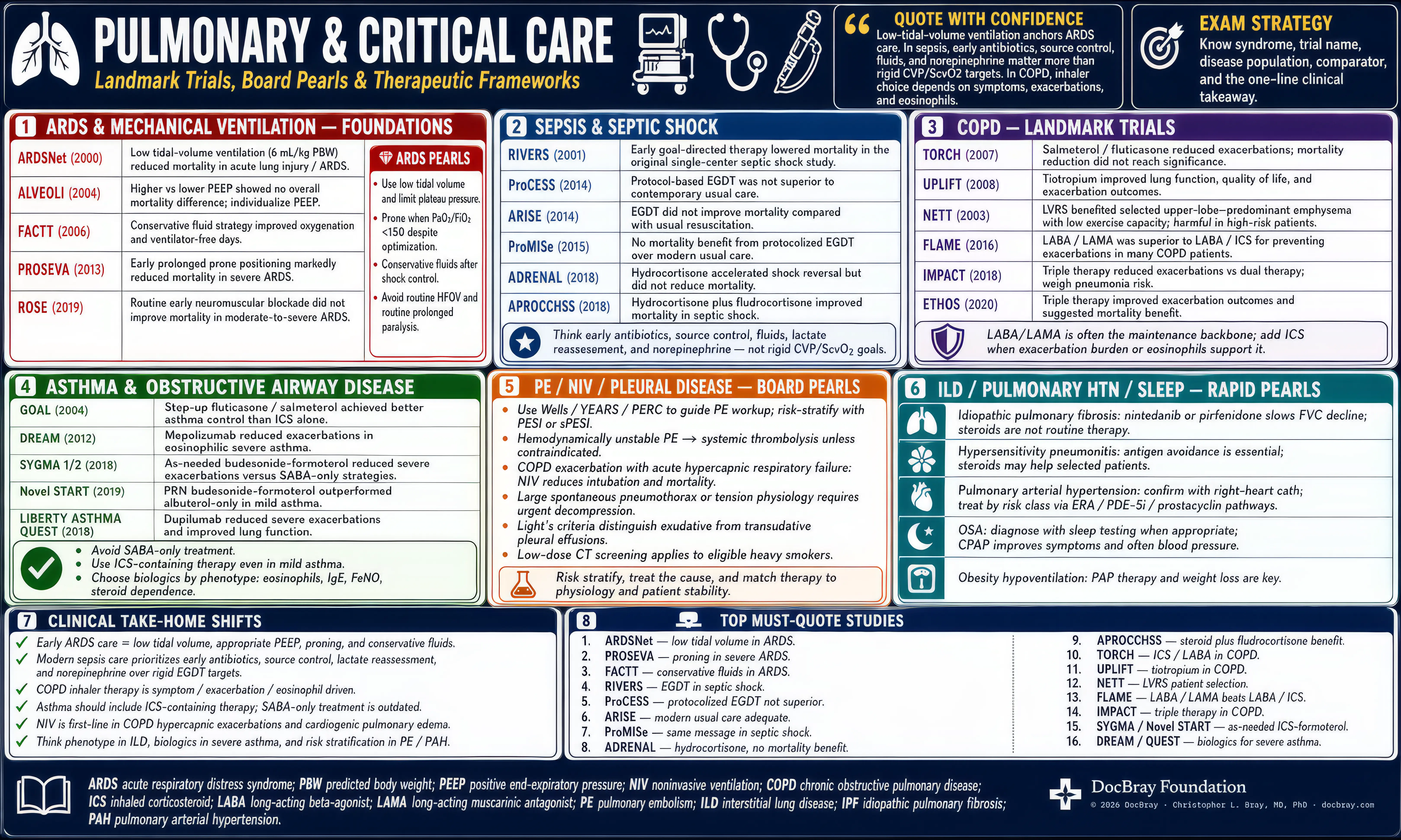
Panel 1 — ARDS & Mechanical Ventilation (Foundations)
- ARDSNet / ARMA2000
Landmark multicenter RCT (861 patients with ALI/ARDS) comparing lung-protective ventilation (6 mL/kg predicted body weight, plateau pressure ≤30 cm H2O) versus traditional tidal volumes (12 mL/kg). The trial was stopped early: lower tidal volumes reduced in-hospital/28-day mortality (31.0% vs 39.8%) and increased ventilator-free days. This established low-tidal-volume, lung-protective ventilation as the standard of care for ARDS. Board takeaway: 6 mL/kg PBW with plateau-pressure limitation is the ventilation foundation for acute lung injury / ARDS.
- ALVEOLI2004
Multicenter RCT (549 patients on low-tidal-volume ventilation) comparing higher versus lower PEEP strategies at matched FiO2. There was no significant difference in in-hospital mortality (24.9% higher-PEEP vs 27.5% lower-PEEP), ventilator-free days, or organ-failure-free days. Neutral result: higher PEEP did not improve outcomes overall. Board takeaway: routine higher PEEP confers no universal mortality benefit; PEEP should be individualized, with any benefit likely concentrated in more severe hypoxemia (as later meta-analyses suggested).
- FACTT2006
Multicenter RCT (1,000 patients with acute lung injury) comparing a conservative versus liberal fluid-management strategy over 7 days. 60-day mortality was not significantly different (25.5% conservative vs 28.4% liberal), but the conservative strategy improved oxygenation index and increased ventilator-free days (14.6 vs 12.1) and ICU-free days without increasing non-pulmonary organ failure or shock. Board takeaway: after resuscitation and shock resolution, a conservative fluid strategy shortens time on the ventilator in ARDS/ALI without a mortality penalty.
- PROSEVA2013
Multicenter RCT (466 patients with severe ARDS, PaO2/FiO2 <150) of early, prolonged prone positioning (≥16 h/day) versus supine. Prone positioning markedly reduced 28-day mortality (16.0% vs 32.8%) and 90-day mortality (23.6% vs 41.0%), without increased complications. A cornerstone positive trial. Board takeaway: in severe ARDS with PaO2/FiO2 <150 despite optimized ventilation, early prolonged proning reduces mortality and is a standard intervention.
- ROSE2019
Multicenter RCT (1,006 patients with moderate-to-severe ARDS, PaO2/FiO2 <150) of early continuous cisatracurium plus deep sedation versus usual care with lighter sedation and higher PEEP. Stopped for futility: 90-day in-hospital mortality did not differ (42.5% vs 42.8%). Neutral result that contrasted with the earlier smaller ACURASYS trial. Board takeaway: routine early neuromuscular blockade is not recommended for all moderate-to-severe ARDS; paralysis is reserved for selected patients (e.g., severe dyssynchrony or refractory hypoxemia).
Panel 2 — Sepsis & Septic Shock
- RIVERS2001
Single-center RCT (263 patients) of 6-hour protocolized early goal-directed therapy (EGDT) targeting CVP, MAP, and central venous oxygen saturation (ScvO2 ≥70%) versus standard care in the emergency department. EGDT reduced in-hospital mortality (30.5% vs 46.5%). This trial catalyzed early aggressive sepsis resuscitation and the surviving-sepsis bundle era. Board takeaway: RIVERS established the principle of early recognition and resuscitation of septic shock — though the specific invasive EGDT targets were later shown unnecessary (see ProCESS/ARISE/ProMISe).
- ProCESS2014
Multicenter U.S. RCT (1,341 patients) comparing protocol-based EGDT, a protocol-based standard therapy, and usual care for early septic shock. There was no significant difference in 60-day mortality across the three groups (21.0% EGDT, 18.2% protocol-standard, 18.9% usual care). Neutral result. Board takeaway: rigid, catheter-driven EGDT (ScvO2/CVP targets) is not superior to good contemporary usual care; early antibiotics and adequate fluids matter more than the specific protocol.
- ARISE2014
Multicenter Australasian RCT (1,600 patients) of EGDT versus usual care in early septic shock. 90-day mortality was nearly identical (18.6% EGDT vs 18.8% usual care), with no difference in survival time, organ support, or length of stay. Neutral result reinforcing ProCESS. Board takeaway: EGDT did not improve mortality over usual resuscitation; contemporary usual care (early antibiotics, fluids, vasopressors as needed) is adequate.
- ProMISe2015
Multicenter UK RCT (1,260 patients) of protocolized EGDT versus usual care for early septic shock. No difference in 90-day mortality (29.5% EGDT vs 29.2% usual care); EGDT increased costs and use of ICU resources without benefit. Neutral result — the third of the trio (with ProCESS and ARISE) that closed the book on invasive EGDT. Board takeaway: protocolized EGDT offers no mortality advantage over modern usual care and is not required.
- ADRENAL2018
Large multicenter RCT (3,800 ventilated patients with septic shock) of a continuous infusion of hydrocortisone 200 mg/day for 7 days versus placebo. No difference in 90-day mortality (27.9% vs 28.8%), but hydrocortisone hastened resolution of shock, shortened time on mechanical ventilation, and reduced blood transfusions. Board takeaway: hydrocortisone accelerates shock reversal but does not reduce mortality on its own; interpret alongside APROCCHSS (different regimen, positive mortality signal).
- APROCCHSS2018
Multicenter French RCT (1,241 patients with severe septic shock) of hydrocortisone 50 mg q6h plus oral fludrocortisone versus placebo. 90-day all-cause mortality was lower with combination steroids (43.0% vs 49.1%), with more vasopressor-free and organ-failure-free days. A positive mortality trial that, together with the neutral ADRENAL result, supports low-dose corticosteroids in refractory/vasopressor-dependent septic shock. Board takeaway: consider hydrocortisone (± fludrocortisone) in septic shock requiring ongoing vasopressors.
Panel 3 — COPD Landmark Trials
- NETT2003
Multicenter RCT (1,218 patients with severe emphysema) of lung-volume-reduction surgery (LVRS) plus medical therapy versus medical therapy alone. Overall mortality was similar, but a high-risk subgroup (FEV1 ≤20% predicted with either homogeneous emphysema or very low DLCO) had increased mortality with surgery. Patients with upper-lobe-predominant emphysema and low baseline exercise capacity gained survival and functional benefit. Board takeaway: LVRS helps a carefully selected phenotype (upper-lobe-predominant, low exercise capacity) and harms the high-risk subgroup — patient selection is everything.
- TORCH2007
Large multicenter RCT (6,112 patients) comparing salmeterol-fluticasone combination, each component alone, and placebo over 3 years in COPD. The primary endpoint — all-cause mortality reduction with combination therapy versus placebo — did not reach statistical significance (12.6% vs 15.2%, p=0.052). Combination therapy did reduce exacerbations and improve lung function and health status, but increased pneumonia risk. Board takeaway: ICS/LABA cuts exacerbations but the mortality benefit was not significant; watch for increased pneumonia.
- UPLIFT2008
Large 4-year multicenter RCT (5,993 patients) of the long-acting muscarinic antagonist tiotropium versus placebo (both on top of other respiratory meds) in COPD. Tiotropium did not significantly slow the rate of FEV1 decline (the co-primary endpoints), but improved lung function, quality of life, and exacerbations throughout the trial and reduced respiratory events. Board takeaway: tiotropium improves symptoms, quality of life, and exacerbation outcomes; it does not clearly alter the long-term slope of lung-function decline.
- FLAME2016
Multicenter RCT (3,362 patients with ≥1 exacerbation in the prior year) comparing LABA/LAMA (indacaterol-glycopyrronium) versus LABA/ICS (salmeterol-fluticasone). LABA/LAMA was superior for the primary endpoint of annual exacerbation rate (non-inferior then superior, 11% relative reduction) and delayed time to first exacerbation, with fewer pneumonias. Board takeaway: for exacerbation prevention in many COPD patients, dual bronchodilation (LABA/LAMA) outperforms LABA/ICS — reinforcing a bronchodilator-first backbone and reserving ICS for eosinophilic/high-exacerbation phenotypes.
- IMPACT2018
Large multicenter RCT (10,355 symptomatic COPD patients with a history of exacerbations) comparing single-inhaler triple therapy (fluticasone furoate/umeclidinium/vilanterol) versus LABA/ICS or LABA/LAMA. Triple therapy reduced the annual rate of moderate-or-severe exacerbations versus both dual regimens and improved lung function and health status, but pneumonia incidence was higher in the ICS-containing arms. Board takeaway: triple therapy reduces exacerbations versus dual therapy — weigh the benefit against increased pneumonia risk.
- ETHOS2020
Large multicenter RCT (8,509 patients) of triple therapy (budesonide/glycopyrrolate/formoterol) at two ICS doses versus two dual therapies (LAMA/LABA and ICS/LABA). Both triple-therapy doses reduced the annual rate of moderate-or-severe exacerbations versus dual therapies, and a prespecified analysis suggested lower all-cause mortality with the higher-ICS-dose triple therapy versus LAMA/LABA. Pneumonia was more frequent with ICS. Board takeaway: triple therapy improves exacerbation outcomes with a suggested mortality signal; balance against pneumonia risk.
Panel 4 — Asthma & Obstructive Airway Disease
- GOAL2004
Stratified, double-blind RCT (3,421 patients with uncontrolled asthma) comparing stepped-up fluticasone-salmeterol versus fluticasone alone, titrated to achieve guideline-defined "totally controlled" or "well controlled" asthma. More patients reached control with the ICS/LABA combination than with ICS alone, and control was achieved at lower ICS doses. Board takeaway: combination ICS/LABA achieves better and more sustained asthma control than escalating ICS monotherapy — supporting controller-plus-LABA step-up when ICS alone is insufficient.
- DREAM2012
Multicenter phase 2b RCT (621 patients with severe eosinophilic asthma and recurrent exacerbations) of the anti-IL-5 monoclonal antibody mepolizumab (three IV doses) versus placebo. Mepolizumab significantly reduced the rate of clinically significant exacerbations (roughly halved) and lowered blood/sputum eosinophils, though it did not significantly change FEV1 or symptom scores. Board takeaway: in severe eosinophilic asthma, anti-IL-5 (mepolizumab) reduces exacerbations — biologic choice should be driven by the eosinophilic phenotype.
- SYGMA 12018
52-week double-blind RCT (3,849 patients with mild asthma) comparing as-needed budesonide-formoterol, as-needed terbutaline (SABA only), and maintenance budesonide plus as-needed terbutaline. As-needed budesonide-formoterol was superior to SABA-only for symptom control and provided most of the exacerbation benefit of maintenance ICS at much lower steroid exposure. Board takeaway: in mild asthma, as-needed ICS-formoterol beats SABA-alone for control and reduces severe exacerbations — a foundation of the anti-inflammatory reliever strategy.
- SYGMA 22018
52-week double-blind RCT (4,215 patients with mild asthma) comparing as-needed budesonide-formoterol versus twice-daily maintenance budesonide plus as-needed terbutaline. As-needed ICS-formoterol was non-inferior to maintenance budesonide for the annualized rate of severe exacerbations, achieved with substantially lower inhaled glucocorticoid exposure, though symptom control slightly favored maintenance ICS. Board takeaway: as-needed ICS-formoterol delivers comparable exacerbation protection to daily ICS in mild asthma with far less steroid burden.
- Novel START2019
52-week open-label pragmatic RCT (668 patients with mild asthma) comparing as-needed albuterol, maintenance budesonide plus as-needed albuterol, and as-needed budesonide-formoterol. As-needed budesonide-formoterol produced a lower rate of asthma exacerbations than albuterol-only and a lower rate of severe exacerbations than both albuterol-only and maintenance-budesonide strategies, with much lower ICS exposure. Board takeaway: PRN budesonide-formoterol outperforms albuterol-only reliever therapy in mild asthma — avoid SABA-only management.
- LIBERTY ASTHMA QUEST2018
Large 52-week phase 3 RCT (1,902 patients with moderate-to-severe uncontrolled asthma) of the anti-IL-4Rα monoclonal antibody dupilumab (two doses) versus placebo added to standard therapy. Dupilumab reduced severe exacerbations (roughly halved) and improved FEV1, with the greatest benefit in patients with higher baseline blood eosinophils or elevated FeNO. Board takeaway: dupilumab reduces severe exacerbations and improves lung function in type-2-high asthma — another phenotype-driven biologic (eosinophils, FeNO).
Preparing for boards, teaching residents, or building your own trial file? Dr. Bray mentors trainees and early-career physicians at no cost.
Get in touch →