
Rheumatology
The landmark Rheumatology trials every internist should be able to quote — 26 studies across 5 evidence panels, each linked to its primary paper with a brief, plain-language summary of what it showed and why it changed practice.
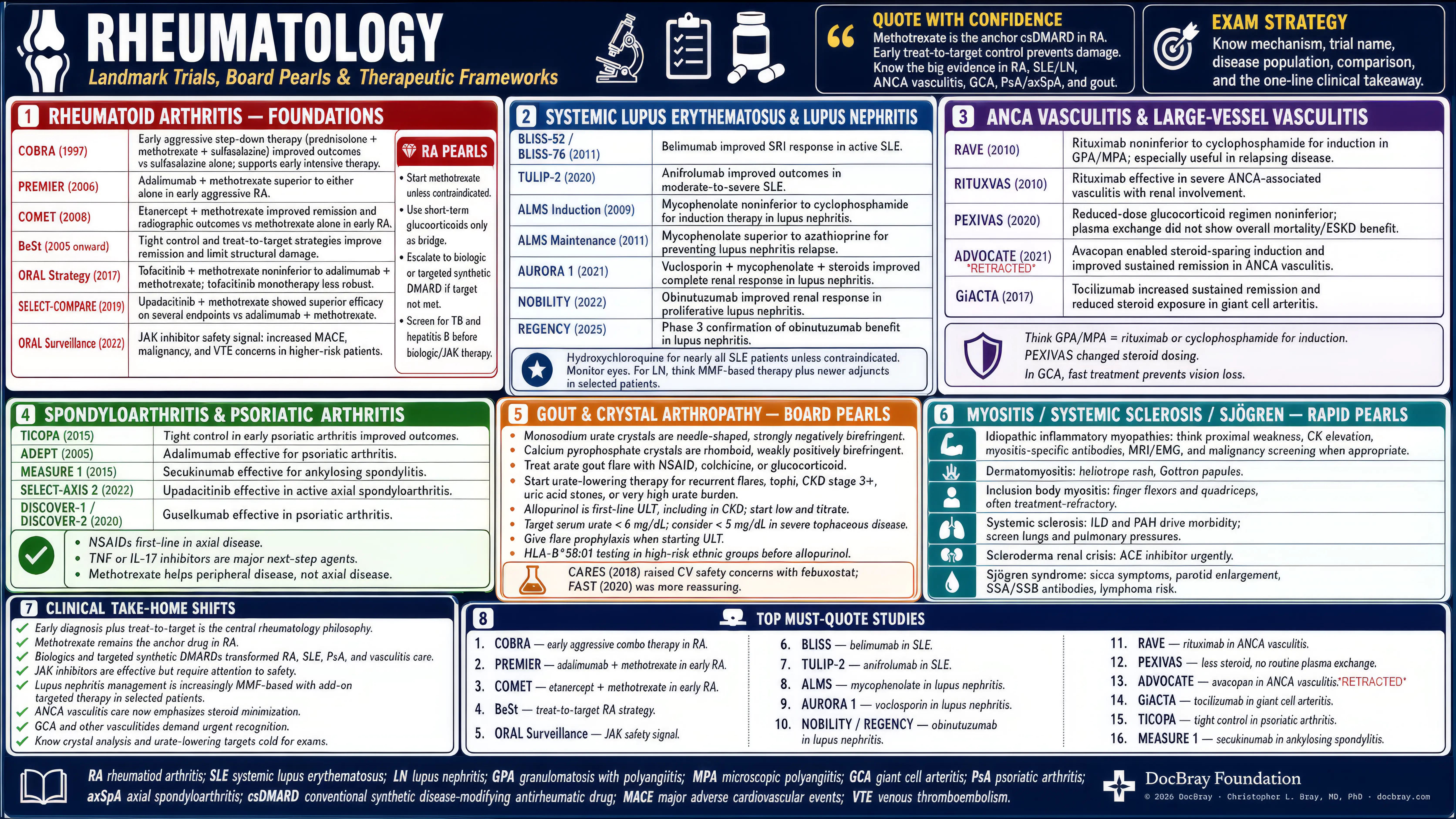
Panel 1 — Rheumatoid Arthritis: Foundations
- COBRA1997
Landmark double-blind RCT (155 patients, early RA) comparing an intensive "step-down" combination — high-dose tapering prednisolone plus methotrexate plus sulfasalazine — against sulfasalazine monotherapy. The combination gave faster, greater clinical improvement and significantly less radiographic joint damage at 28 and 56 weeks. It established that early aggressive combination therapy suppresses disease and structural progression better than sequential monotherapy, seeding the modern treat-early philosophy. Board takeaway: COBRA is the archetype early-aggressive step-down regimen in RA.
- PREMIER2006
Double-blind RCT (799 MTX-naïve patients, early aggressive RA) comparing adalimumab + methotrexate vs each agent alone over 2 years. Combination therapy was superior for clinical remission, radiographic non-progression, and functional outcomes; adalimumab and MTX monotherapy were similar to each other. Established that combining a TNF inhibitor with methotrexate up front beats either alone in early RA. Board takeaway: adalimumab + MTX > monotherapy in early RA.
- COMET2008
Double-blind RCT (542 patients, early moderate-to-severe RA) of etanercept + methotrexate vs methotrexate alone over 52 weeks. Combination therapy roughly doubled clinical remission (DAS28 <2.6, 50% vs 28%) and markedly improved radiographic non-progression. Reinforced that adding a TNF inhibitor to MTX early yields higher remission and less structural damage. Board takeaway: etanercept + MTX improves remission and radiographic outcomes in early RA.
- BeSt2005 onward
Strategy trial (508 patients, early RA) comparing four treatment approaches — sequential monotherapy, step-up combination, initial combination with tapered prednisone, and initial MTX + infliximab — all steered by protocolized DAS-driven adjustment every 3 months. The two initial-combination strategies produced faster functional improvement and less radiographic progression early, while all four converged toward tight-control targets over time. Cornerstone evidence for treat-to-target: outcomes are driven by systematic tight control, not any single drug. Board takeaway: treat-to-target/tight control is the winning RA strategy.
- ORAL Strategy2017
Head-to-head, double-blind RCT (~1,150 patients with MTX-inadequate-response RA) of tofacitinib monotherapy vs tofacitinib + MTX vs adalimumab + MTX. Tofacitinib + MTX was non-inferior to adalimumab + MTX (ACR50 ~46% vs ~44%), but tofacitinib monotherapy did NOT meet non-inferiority vs the combinations. Board takeaway: JAK inhibitor + MTX matches a TNF inhibitor + MTX, but JAK monotherapy is less robust — combination therapy is preferred.
- SELECT-COMPARE2019
Phase III double-blind RCT (1,629 patients, RA with inadequate MTX response, all on background MTX) of upadacitinib 15 mg vs placebo vs adalimumab. Upadacitinib beat placebo and showed superiority to adalimumab on several endpoints (ACR50, DAS28-CRP ≤3.2 and low-disease-activity remission, pain, function). Established upadacitinib as an effective JAK inhibitor that can outperform a TNF inhibitor on select measures. Board takeaway: upadacitinib + MTX showed superior efficacy vs adalimumab + MTX on several endpoints.
- ORAL Surveillance2022
Large post-marketing safety RCT (4,362 RA patients ≥50 with ≥1 cardiovascular risk factor) comparing tofacitinib (5 or 10 mg BID) with a TNF inhibitor. Tofacitinib did NOT meet non-inferiority for the co-primary endpoints: major adverse cardiovascular events and cancers were both higher with tofacitinib; VTE and infections were also increased. This safety signal drove FDA boxed-warning updates for JAK inhibitors. Board takeaway: JAK inhibitors carry increased MACE, malignancy, and VTE risk, especially in older, higher cardiovascular-risk patients — prefer a TNF inhibitor in such patients.
Panel 2 — Systemic Lupus Erythematosus & Lupus Nephritis
- BLISS-52 / BLISS-762011
Two pivotal phase 3 RCTs of belimumab (anti-BLyS/BAFF) added to standard therapy in seropositive, active non-renal SLE. BLISS-52 (867 patients, 52 weeks) and BLISS-76 (819 patients, 76 weeks) both showed higher SLE Responder Index (SRI-4) response with belimumab 10 mg/kg vs placebo (BLISS-52 clearly positive; BLISS-76 met week-52 primary but the difference attenuated by week 76). Together they earned belimumab the first FDA approval for SLE in decades. Board takeaway: belimumab improves SRI response in active autoantibody-positive SLE.
- TULIP-22020
Phase 3 double-blind RCT (362 patients, moderate-to-severe SLE on standard therapy) of the type I interferon-receptor antibody anifrolumab vs placebo. Anifrolumab met the primary endpoint of BICLA response at week 52 (~48% vs ~32%) and enabled glucocorticoid tapering, redeeming the drug after the earlier TULIP-1 trial missed its differently-defined primary endpoint. Supported FDA approval of anifrolumab for SLE. Board takeaway: anifrolumab (anti-IFNAR) improves disease-activity response in moderate-to-severe SLE.
- ALMS Induction2009
Largest lupus-nephritis induction RCT of its era (370 patients, ISN/RPS class III–V) comparing mycophenolate mofetil vs IV cyclophosphamide, each with corticosteroids, over 24 weeks. Response rates were similar (MMF ~56% vs CYC ~53%) — MMF was NOT superior but proved equivalent, with comparable adverse events. Established MMF as a first-line induction alternative to cyclophosphamide, especially valuable for fertility preservation. Board takeaway: MMF is non-inferior to cyclophosphamide for lupus nephritis induction.
- ALMS Maintenance2011
Double-blind maintenance RCT (227 lupus-nephritis patients who responded to induction) comparing mycophenolate mofetil vs azathioprine over 36 months. MMF was superior for the primary endpoint of time to treatment failure (a composite of death, ESRD, renal flare, doubling of creatinine, or rescue therapy), with fewer renal flares. Positioned MMF as the preferred maintenance immunosuppressant. Board takeaway: MMF beats azathioprine for preventing lupus-nephritis relapse in maintenance.
- AURORA 12021
Phase 3 double-blind RCT (357 patients, active lupus nephritis) adding the calcineurin inhibitor voclosporin vs placebo to background MMF plus low-dose steroids. Voclosporin roughly doubled complete renal response at 52 weeks (41% vs 23%) with faster proteinuria reduction and no need for therapeutic drug-level monitoring; adverse-event rates were similar. Supported FDA approval of voclosporin as add-on therapy. Board takeaway: triple therapy (voclosporin + MMF + steroids) improves complete renal response in lupus nephritis.
- NOBILITY2022
Phase 2 double-blind RCT (125 patients, ISN/RPS class III/IV proliferative lupus nephritis) adding the type II anti-CD20 antibody obinutuzumab vs placebo to background MMF and steroids. Obinutuzumab improved complete renal response at week 52 (and durably through week 104) versus placebo, with a comparable safety profile. Provided proof-of-concept that deeper B-cell depletion helps lupus nephritis and set up the confirmatory REGENCY trial. Board takeaway: obinutuzumab improves renal response in proliferative lupus nephritis (phase 2).
- REGENCY2025
Pivotal phase 3 double-blind RCT (271 patients, active class III/IV lupus nephritis) confirming obinutuzumab vs placebo added to standard MMF plus steroids. Obinutuzumab significantly increased complete renal response at week 76 (~46% vs ~33%) with greater proteinuria improvement and a similar safety profile. Confirmed the NOBILITY signal and supported obinutuzumab's regulatory advance in lupus nephritis. Board takeaway: phase 3 confirmation that obinutuzumab improves complete renal response in lupus nephritis.
Panel 3 — ANCA Vasculitis & Large-Vessel Vasculitis
- RAVE2010
Double-blind, double-dummy RCT (197 patients, GPA or MPA) comparing rituximab vs oral cyclophosphamide for remission induction, both with glucocorticoids. Rituximab was non-inferior for remission at 6 months (64% vs 53%) and superior in the subgroup with relapsing disease. Established rituximab as a first-line, cyclophosphamide-sparing induction option, particularly attractive for relapsing disease and fertility preservation. Board takeaway: rituximab is non-inferior to cyclophosphamide for ANCA-vasculitis induction and preferred in relapsing disease.
- RITUXVAS2010
Open-label RCT (44 patients with newly diagnosed ANCA-associated vasculitis and renal involvement) comparing a rituximab-based regimen (plus two CYC pulses) vs standard IV cyclophosphamide, both with steroids. Sustained remission rates (~76% vs 82%) and serious adverse events were similar between arms. Confirmed, in a renal-predominant/severe population, that rituximab-based induction is as effective as cyclophosphamide. Board takeaway: rituximab is effective in severe ANCA-associated vasculitis with renal involvement.
- PEXIVAS2020
Large 2×2 factorial RCT (704 patients, severe ANCA-associated vasculitis with GFR <50 or pulmonary hemorrhage) testing (1) plasma exchange vs none and (2) reduced-dose vs standard-dose glucocorticoids. Plasma exchange did NOT reduce death or ESRD. The reduced-dose steroid regimen was non-inferior for death/ESRD and caused fewer serious infections. Practice-changing: routine plasma exchange abandoned and lower steroid dosing adopted. Board takeaway: PEXIVAS changed steroid dosing (reduced-dose is non-inferior) and showed plasma exchange lacks overall mortality/ESKD benefit.
- ADVOCATE2021
Phase 3 double-blind RCT (331 patients, GPA or MPA) comparing the oral C5a-receptor antagonist avacopan vs a tapering prednisone regimen, both on background rituximab or cyclophosphamide. Avacopan was non-inferior for remission at week 26 and superior for sustained remission at week 52, with better renal recovery and reduced glucocorticoid toxicity. Supported approval of avacopan as a steroid-sparing adjunct. Board takeaway: avacopan enables steroid-sparing induction and improves sustained remission in ANCA vasculitis. ⚠ Retracted (New England Journal of Medicine, June 2026) — kept here on purpose as a teaching case: glowing, practice-shaping, approval-supporting results whose primary publication was later retracted. A reminder to appraise trial integrity — not just the effect size — and to check the current literature before you act on any single trial.
- GiACTA2017
Phase 3 double-blind RCT (251 patients, giant-cell arteritis) of the IL-6 receptor antagonist tocilizumab (weekly or every-other-week) plus a 26-week prednisone taper vs prednisone taper alone (26- or 52-week). Tocilizumab markedly increased sustained glucocorticoid-free remission at 52 weeks (~56% weekly vs ~14–18% with prednisone alone) and lowered cumulative steroid exposure. Established tocilizumab as a steroid-sparing agent in GCA. Board takeaway: tocilizumab increases sustained remission and reduces steroid exposure in GCA.
Panel 4 — Spondyloarthritis & Psoriatic Arthritis
- TICOPA2015
First strategy trial in psoriatic arthritis (206 patients, early PsA) comparing protocolized tight control — 4-weekly review with escalation to a minimal-disease-activity target — vs standard 12-weekly care. Tight control significantly improved joint, skin, and ACR responses at 48 weeks, though with more adverse events from intensified therapy. Extended the treat-to-target concept from RA into PsA. Board takeaway: tight control/treat-to-target improves outcomes in early psoriatic arthritis.
- ADEPT2005
Pivotal double-blind RCT (313 patients, moderate-to-severe psoriatic arthritis) of adalimumab vs placebo over 24 weeks. Adalimumab significantly improved joint disease (ACR20 ~57% vs 15%), skin (PASI), function, and inhibited radiographic progression. Supported FDA approval of adalimumab for PsA and helped establish TNF inhibition as effective across the joint and skin domains of PsA. Board takeaway: adalimumab (TNF inhibitor) is effective for psoriatic arthritis, including structural protection.
- MEASURE 12015
Two phase 3 RCTs of the IL-17A inhibitor secukinumab vs placebo in active ankylosing spondylitis; MEASURE 1 (371 patients) used IV loading then subcutaneous dosing. Secukinumab significantly increased ASAS20 response at week 16 (~61% vs ~29%) with sustained benefit, validating IL-17A blockade as a mechanism in AS beyond TNF inhibition. Supported FDA approval of secukinumab for AS. Board takeaway: secukinumab (anti–IL-17A) is effective in ankylosing spondylitis.
- SELECT-AXIS 22022
The SELECT-AXIS 2 program comprised two phase 3 double-blind RCTs of the JAK inhibitor upadacitinib across the axial spondyloarthritis spectrum: one in non-radiographic axSpA (Lancet) and one in ankylosing spondylitis (radiographic) refractory to biologics (Ann Rheum Dis). In both, upadacitinib 15 mg significantly increased ASAS40 response versus placebo at week 14 with acceptable safety. Together they support upadacitinib across the full axSpA spectrum, including biologic-experienced patients. Board takeaway: upadacitinib is effective in active axial spondyloarthritis (nr-axSpA and AS).
- DISCOVER-1 / DISCOVER-22020
Two phase 3 double-blind RCTs of the IL-23 (p19) inhibitor guselkumab vs placebo in active psoriatic arthritis. DISCOVER-1 (381 patients, included TNF-experienced) and DISCOVER-2 (739 biologic-naïve patients) both met the primary ACR20 endpoint at week 24 with improvements in skin, function, and (DISCOVER-2) radiographic progression. Supported FDA approval of guselkumab for PsA and validated IL-23 blockade in this disease. Board takeaway: guselkumab (anti–IL-23) is effective for psoriatic arthritis.
Panel 5 — Gout & Crystal Arthropathy
- CARES2018
Large randomized cardiovascular-safety non-inferiority trial (6,190 gout patients with cardiovascular disease) comparing febuxostat vs allopurinol. Febuxostat was non-inferior for the primary composite MACE endpoint, but all-cause mortality and cardiovascular mortality were significantly higher with febuxostat. This raised a cardiovascular safety concern and prompted an FDA boxed warning. Board takeaway: CARES flagged higher CV/all-cause death with febuxostat vs allopurinol — a cardiovascular safety signal.
- FAST2020
Large prospective open-label non-inferiority trial (6,128 gout patients ≥60 with a cardiovascular risk factor) comparing febuxostat vs allopurinol. Febuxostat met non-inferiority for the primary composite cardiovascular endpoint, and — unlike CARES — showed NO increase in all-cause or cardiovascular mortality. FAST was reassuring and helped counterbalance the CARES signal, easing febuxostat restrictions in Europe. Board takeaway: FAST was more reassuring on febuxostat cardiovascular safety, contrasting with CARES.
Preparing for boards, teaching residents, or building your own trial file? Dr. Bray mentors trainees and early-career physicians at no cost.
Get in touch →