
Fluids and electrolytes:
correcting it right for the setting
Interns rarely struggle to notice a low potassium. What confuses them — every year, on every service — is the decision that follows: how much, by which route, how fast, checked when, and how all of that changes between the clinic, the ward, and the unit. The same number gets four different correct answers depending on where the patient is, whether they can swallow, whether this is an emergency, and what access exists. This hour teaches the decision, not the value.
Why this hour
Electrolyte repletion is among the most frequent orders an intern writes and among the least deliberately taught — absorbed instead from whatever the last senior did, which is how a clinic-appropriate habit ends up applied to an ICU patient, or an ICU reflex to someone who could have taken a pill. The confusion is not ignorance of physiology; it is the absence of a framework for the four variables that actually decide the order.12 This hour supplies that framework and lets faculty fill it with your institution’s protocols.
The prose here stays at the level of the decision — it names no doses, rates, or thresholds. The quick-reference guide below is the deliberate exception: it gathers the numbers in one place, where a faculty member can check them against current references and against your own order sets before handing it to a class. Those order sets, and your institution’s concentration and rate policies, govern.
What interns leave able to do
- Ask the four questions before any repletion order — setting, route, urgency, access — and explain how each changes the answer.
- Replete the five that confuse people — potassium, magnesium, sodium, phosphorus, calcium — using their institution’s protocols, and say why each has its own rules.
- Recognize the emergencies in the group and the danger of correcting too fast, especially for sodium.3
- Name the check-back: what gets rechecked, when, and what the recheck changes.
- Choose maintenance versus resuscitation fluids deliberately, and re-evaluate rather than let a bag run indefinitely.
The four questions — asked before every repletion order
- Which setting is this patient in? Clinic, ward, or ICU — the same value carries different urgency, different monitoring, and different tolerance for aggressive correction. In the clinic the question is often why is it low before how do I fix it; in the unit the answer may be needed before the cause is known.
- Can the patient take it by mouth? Oral repletion is generally the default when the gut works and the situation allows — it is safer, cheaper, and needs no line. Nothing by mouth, vomiting, ileus, or malabsorption removes that option and changes everything downstream.
- Is this an emergency? The symptomatic patient, the arrhythmia, the seizure, the profoundly low value — emergencies are corrected on a different clock, in a monitored place, with a plan for the recheck. Non-emergent correction is a slower, gentler process, and treating one like the other is the classic harm in both directions.
- What access do you have? Peripheral IV, PICC, or central line — some concentrated preparations require central access and monitoring per policy; peripheral access limits concentration and rate, and a difficult-access patient may change the whole plan (the procedure lab covers the access itself). Ask before you order, not after nursing calls.
And the fifth question that is really the first: why is this abnormal? Repletion without a cause is symptom management — the intake, the losses, the drug, the kidney, the shift. Fix the number and miss the diuretic, the diarrhea, the refeeding, or the drug interaction, and you will replete the same patient every day for a week.
The correction matrix — the shape of the decision
Build this grid with the room, filling it from your own protocols — the point is that every cell is a different answer, and interns who have seen the grid stop applying one habit everywhere.
| Setting | Non-emergent, can take orally | Non-emergent, nothing by mouth | Emergency |
|---|---|---|---|
| Outpatient clinic | Oral repletion with a cause investigated and a recheck interval; dietary and drug review; the follow-up visit is part of the order. | Usually the wrong setting — the patient who cannot take it orally and needs correction generally needs a higher level of care. | Not a clinic problem: recognize, arrange transfer, and communicate the value to the receiving team. |
| Inpatient ward | Oral where the gut works, the pattern most wards under-use; recheck timed to the repletion, not to the morning draw by default. | Intravenous within peripheral limits, rate and concentration per protocol, with the monitoring the policy requires. | Monitored setting, rapid protocol, bedside presence, and an explicit escalation call — and ask whether this patient still belongs on the ward. |
| ICU | Still oral or enteral when the gut works — unit patients often can, and it is easy to forget. | Central access permits concentrations the ward cannot run; continuous monitoring changes the risk calculus. | Protocolized, monitored, frequently rechecked — and the correction itself becomes part of the systems presentation (the ICU session). |
The quick-reference guide
One card holds the operational half of this hour: the intravenous-versus-oral and line-selection logic, the refeeding-syndrome alerts, and then each of the five — sodium, potassium, magnesium, calcium, phosphorus — with its goal, its route and dose examples, and its rate ceiling. It is organized the way the decision actually runs, which is why it pairs with the four questions above rather than replacing them.
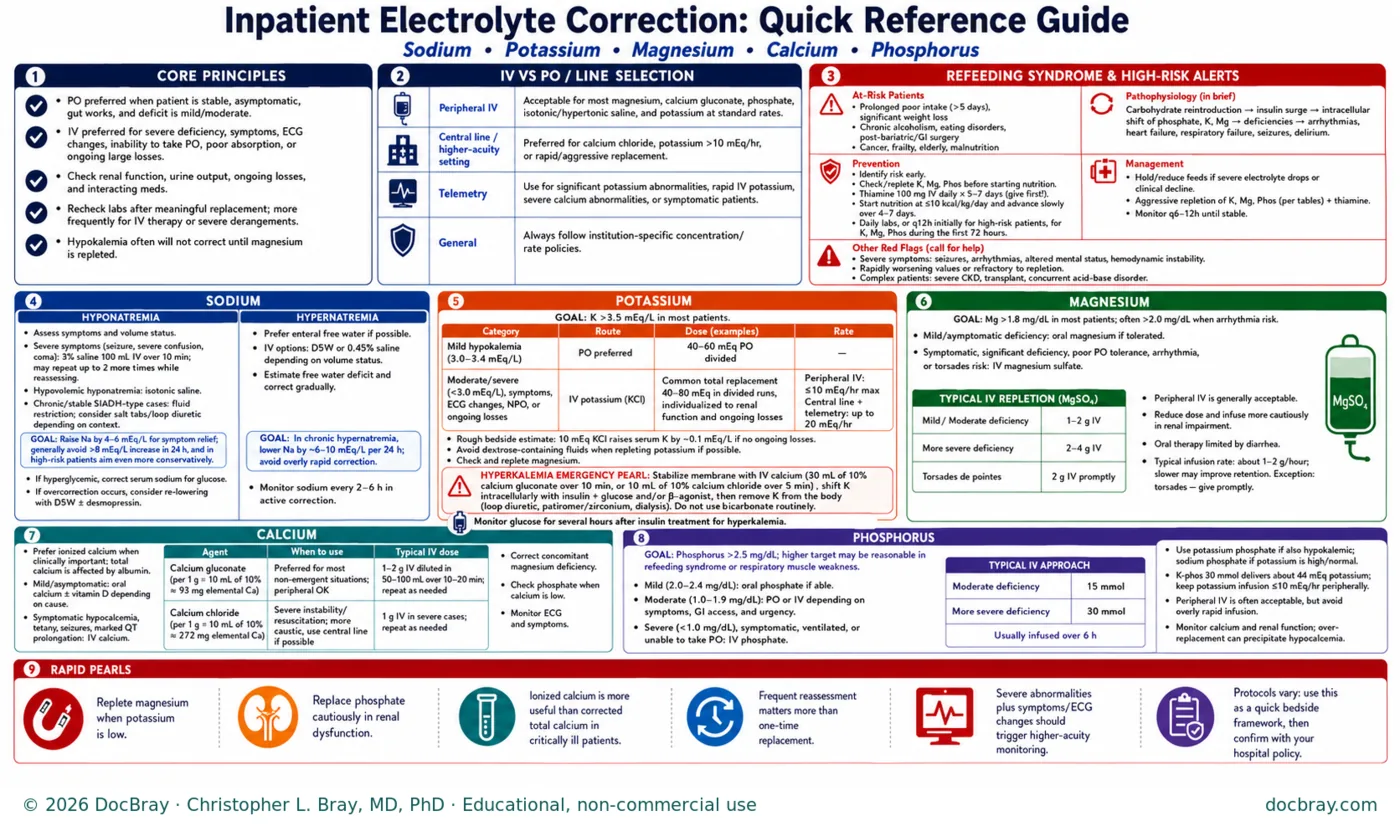
The five, one at a time — what the hour must cover
For each: the causes worth chasing, the symptoms that make it urgent, the repletion decision across the matrix, the recheck, and the one trap that catches interns. Outcomes stated here; the numbers come from your faculty and your protocols.
Potassium. The one ordered most and thought about least. The hour must cover: oral versus intravenous and why oral is under-used; what peripheral access limits; the monitoring that concentrated intravenous repletion requires; the difference between the arrhythmia emergency and the slow drift; and the interaction with kidney function and with the drugs that hold potassium in or push it out. The trap: repleting potassium while the magnesium is low — it will not stay corrected until the magnesium is addressed, which is why the two are taught together.
Magnesium. The quiet enabler behind refractory potassium and calcium abnormalities, and a player in arrhythmia. Cover: when to check it (more often than most interns do), oral tolerance and its gastrointestinal limits, intravenous repletion and the renal-function caution, and its role in the refractory-electrolyte patient. The trap: forgetting to check it at all in the patient whose potassium keeps falling.
Sodium. The one where the correction itself can injure, in both directions.3 Cover: the diagnostic approach before treatment — volume status, the medication list, the studies that classify it — the distinction between the acutely symptomatic patient needing prompt treatment in a monitored setting and the chronic asymptomatic one needing patience, the reason limits on the rate of correction exist and what must be monitored to respect them, and hypernatremia as its own problem with its own free-water arithmetic. The trap: reflex fluids before the diagnosis, and the overnight over-correction nobody was watching for — sodium is the electrolyte where the intern’s job is most often call early and monitor closely.
Phosphorus. Cover: the causes that matter inpatient — refeeding, renal replacement, alcohol use, malnutrition — the symptoms of profound depletion, oral versus intravenous choice, the calcium interaction that constrains repletion, and the outpatient picture where chronic kidney disease inverts the whole problem. The trap: the refeeding patient whose phosphorus falls a day after everyone stopped watching.
Calcium. Cover: correcting for albumin versus measuring the ionized value and when each is right, symptomatic hypocalcemia as an emergency with a monitored correction, the magnesium and phosphorus interactions, and hypercalcemia as a different problem entirely — volume first, cause pursued, and the malignancy question asked. The trap: treating a low total calcium in a patient whose ionized calcium is fine.
Fluids — the order everyone writes and nobody revisits
The hour’s last block covers the intravenous fluid order as a decision with four parts: why (resuscitation, maintenance, replacement of ongoing losses, or a vehicle for something else — they are different indications with different answers), which (the choice of solution, taught from current evidence and your formulary), how much and how fast, and when it stops. That last one is the point: fluids are a drug with a dose and an endpoint, and the classic ward error is not the wrong bag but the right bag left running for three days after the indication ended. Teach the reassessment as part of the order — and pair it with the daily-checklist habit from the ICU session: does this patient still need what is hanging?
Eight challenges for the room
No answers are supplied, deliberately. Each of these has a defensible range rather than one right response, and each turns on the same five decisions the hour is built around: form (which salt or preparation), route (oral, enteral, peripheral, central), quantity, rate, and recheck — when you will know whether it worked. Work them against your own protocols, with your pharmacist in the room; where the group disagrees, the disagreement is the teaching.
1. The clinic potassium that will not stay up. An 81-year-old woman on a thiazide for hypertension and a proton-pump inhibitor for reflux. She lives alone, drives herself, and feels “a bit weak but fine.” This is the third low potassium in four months; each time she was given a short oral course and it drifted back down.
BMP Na 139 · K 3.1 · Cl 100 · HCO3− 28 · BUN 20 · Cr 1.0 · Mg 1.4 · glucose 96
- Form: which preparation, and does the magnesium change what you give first?
- Route and setting: is this a clinic problem at all, or does something here send her to an emergency department today?
- Quantity and duration: a course, or a standing dose — and for how long?
- The cause: what is each of her medications contributing — they are not doing the same thing — and does changing one of them beat repleting indefinitely?
- Recheck: when, where, and who is responsible for seeing the result — she lives alone and drives to appointments.
2. The high potassium in a patient you do not want to stop treating. A 64-year-old with stage 4 chronic kidney disease and heart failure, on an ACE inhibitor and a mineralocorticoid receptor antagonist — both of which are helping his heart and his kidneys. He feels well. The result reaches you at 4:40 p.m.; your clinic has no electrocardiogram available today.
BMP Na 137 · K 6.1 · Cl 106 · HCO3− 19 · BUN 48 · Cr 2.8 · Ca 8.6 · glucose 104
Three months ago K 5.2 · Cr 2.6
- Disposition first: what has to happen in the next hour, and what would make you send him in rather than manage this by phone?
- The drugs: stop, reduce, or continue — and what do you lose by stopping the agents with outcome benefit?
- Form and route: if you treat outside the hospital, with what — and what does that agent actually do to total-body potassium?
- Diet and other contributors: what else is adding potassium, including the low bicarbonate?
- Recheck: how soon, and what result would change the plan again?
3. The refeeding decision. A 22-year-old with anorexia nervosa, seen in clinic with her mother, weight down further since last month. She has agreed to start eating more, and the outpatient team wants to begin nutrition today. She is bradycardic and orthostatic but alert and cooperative.
BMP Na 136 · K 3.3 · Cl 98 · HCO3− 26 · BUN 12 · Cr 0.7 · Phos 2.2 · Mg 1.5 · Ca 8.4 · albumin 3.4
- The setting question that comes first: is it safe to begin refeeding her as an outpatient at all?
- Sequence: what gets repleted before nutrition starts, and why does the order matter here more than the doses?
- Form and route: oral for all three, or does anything need to be intravenous in a cooperative patient who is eating?
- Rate: what governs how quickly nutrition advances — and what would make you slow it?
- Recheck: how often, for how many days, and which value will fall last?
4. Nothing by mouth, one small vein, and it is midnight. A 68-year-old two days after bowel surgery, nasogastric tube draining, nothing by mouth. He has a single 22-gauge peripheral cannula in the forearm and no telemetry. Nursing pages you the evening chemistry.
BMP Na 138 · K 2.8 · Cl 96 · HCO3− 32 · BUN 22 · Cr 1.1 · Mg 1.6 · Ca 8.5
- Route: the gut is unavailable — what does a single small peripheral cannula permit, and what does it forbid?
- Form and quantity: which salt, given that his bicarbonate is high and his chloride is low from the suction?
- Rate: what limits it here, and what would have to change (access, monitoring, location) to go faster?
- The magnesium: does it get treated first, alongside, or not tonight?
- Recheck: when — and is the morning draw good enough, or does this need a level before then?
5. The sodium of 118, and nobody knows how long. A 79-year-old brought in by her daughter for two weeks of “not herself” — slower, unsteady, one fall. She takes a thiazide and was started on a selective serotonin reuptake inhibitor five weeks ago. She is confused but rousable, has not seized, and her last recorded sodium was normal eight months ago.
BMP Na 118 · K 3.4 · Cl 84 · HCO3− 26 · BUN 9 · Cr 0.6 · glucose 92 · uric acid low
Other serum osmolality 248 · urine osmolality 420 · urine Na 58
- Acute or chronic — and how much does the answer change what you do? What in this history bears on it, and what do you do when the chronicity is genuinely unknown?
- Form and route: what does the confusion without seizure justify, and what would make you reach for something more aggressive?
- Rate: what is the ceiling over the first day, what governs it, and which mistake is the more dangerous one here?
- Volume status: nothing above tells you whether she is dry, euvolemic, or overloaded — what would you examine and measure, and how does each answer change the plan?
- Overshoot: what could make her sodium rise faster than you intended once the thiazide and the drug are stopped — and note the potassium of 3.4: what does repleting it do to her sodium, and who on the team knows that?
- Recheck: how often in the first twelve hours, and who is watching the trend overnight?
6. Tingling on the first night after surgery. A 44-year-old woman twelve hours after total thyroidectomy reports numbness around the mouth and cramping in both hands. She is anxious, speaking normally, and her airway is comfortable. Her chart notes a peripheral cannula and no central access.
Labs Ca 6.9 · albumin 3.6 · ionized Ca 0.84 · Mg 1.7 · Phos 4.6 · K 4.1 · Cr 0.8
- Which number are you treating — the total calcium, the albumin-corrected value, or the ionized one, and why does it matter here?
- Form: the two intravenous calcium salts are not interchangeable — what differs, and what does that mean for a peripheral cannula?
- Route and setting: does symptomatic hypocalcemia at this level belong on a ward bed, and what monitoring does giving it require?
- Rate and what follows: after the acute correction, what maintains her — and what does the magnesium have to do with it?
- Recheck: how often overnight, and what trajectory would tell you this is going to be a long-term problem?
7. The potassium falling through the floor on an insulin drip. A 34-year-old in the unit for diabetic ketoacidosis, six hours into an insulin infusion and doing well by every other measure. Central line in place, continuous monitoring. The potassium has moved 5.2 → 4.3 → 3.4 over those six hours.
Now Na 138 · K 3.4 · Cl 108 · HCO3− 16 · BUN 18 · Cr 0.9 · glucose 210 · Phos 1.4 · Mg 1.8
- The insulin itself: does it continue unchanged while you replete, and what would make you hold it?
- Rate and route: what does central access permit that a peripheral line does not — and does having the option mean using it?
- Form: with a phosphorus of 1.4 alongside, does the choice of potassium salt change?
- Quantity: how do you replete a moving target when insulin is still driving potassium into cells?
- Recheck: how frequently, and at what point does the frequency itself become the problem?
8. Four electrolytes moving at once on continuous dialysis. A 57-year-old on continuous renal replacement therapy with regional citrate anticoagulation, day three, receiving enteral nutrition through a feeding tube that has been interrupted twice for procedures. The nurse asks you to “fix the phosphorus” before rounds.
Labs Na 140 · K 3.8 · Cl 104 · HCO3− 24 · Phos 1.1 · Mg 1.6 · total Ca 8.9 · ionized Ca 0.92 · albumin 2.4
- Why is the phosphorus low — and does the answer change whether you replace it, or only how?
- The calcium picture: total and ionized are telling different stories on citrate — which do you believe, and what does that imply?
- Route: the feeding tube is available but keeps getting interrupted — enteral, intravenous, or into the circuit, and who decides?
- Form and interaction: phosphate preparations carry other ions — which one, and what does that do to the potassium and the calcium you are also watching?
- The magnesium nobody mentioned: it is 1.6 and the circuit is removing it continuously — where does it sit in your order of operations, and what does leaving it low do to everything else on this list?
- Recheck and ownership: on continuous therapy the numbers move all day — what is the monitoring interval, and whose job is the trend at 3 a.m.?
Two facilitator notes. In the sodium case, expect the room to treat the low uric acid as settling the diagnosis — it does not: hypouricemia appears both in the syndrome of inappropriate antidiuresis and in thiazide-associated hyponatremia, which is precisely why both drugs stop and why the diagnosis is made after withdrawal rather than from a single laboratory value. And in the two cases with a near-obvious answer on form — the alkalosis and the calcium — push past it quickly: the genuinely open questions there are route, rate, and who is monitoring.
These scenarios are fictional composites written for discussion. No answers are provided by design: correction targets, preparations, rates, and monitoring intervals are governed by your institution’s protocols and by current references, and the range of defensible answers is part of what the discussion should surface. Run them with a clinical pharmacist present.
Running the hour
| Minutes | Block |
|---|---|
| 0–5 | Frame: “the same number gets four different right answers — today you learn which four questions decide” |
| 5–15 | The four questions and the matrix built on the board, filled with your protocols |
| 15–45 | Rapid scenarios — the same patient’s low potassium in clinic, on the ward with a working gut, on the ward nothing-by-mouth, and in the unit with a central line; then magnesium, sodium, phosphorus, calcium cases from your own service |
| 45–55 | The fluid order: why, which, how much, and when it stops |
| 55–60 | Pocket card · where your order sets and protocols live |
Watch for, and debrief by name: the intravenous reflex in a patient who could swallow; repletion ordered without a cause named; the missing magnesium behind the stubborn potassium; a sodium plan made without volume status; and the recheck left unordered — “when will you know this worked?” is the question that should end every scenario. Bring the clinical pharmacist: their five minutes on what your protocols actually permit, and what nursing will call about, is worth more than any slide.
Pocket card
- Why is it abnormal? Replete the number, fix the cause.
- Setting · route · urgency · access — four questions, four different right answers.
- Gut works? Use it. The IV reflex is the commonest over-treatment.
- Low potassium that won’t stay up: check the magnesium.
- Sodium: diagnose before you treat, and the rate can hurt — call early, monitor closely.
- Order the recheck when you order the repletion. Know when you’ll know it worked.
- Fluids are a drug: name the indication and the stop.
Notes
This hour runs in the weeks-2–8 survival series, one conference hour, and pairs naturally with the acid–base hour the week before or after. Co-teach with a clinical pharmacist and run the scenarios on your own order sets; the grid is worth building once with your protocols and reusing every year.
This page is a curriculum framework, not clinical instruction: it states no doses, rates, thresholds, product choices, or correction limits. Faculty teach repletion and fluid management from current guidelines and institutional protocols, with pharmacy, and every session carries its own last-reviewed date. Last reviewed July 2026.
Sources
- Cohn, J. N., Kowey, P. R., Whelton, P. K., & Prisant, L. M. (2000). New guidelines for potassium replacement in clinical practice: A contemporary review by the National Council on Potassium in Clinical Practice. Archives of Internal Medicine, 160(16), 2429–2436. https://pubmed.ncbi.nlm.nih.gov/10979053/ A quarter-century old and cited only for the framing that repletion strategy depends on clinical context rather than the number alone; none of its targets are reproduced here, and thresholds and rates are taught from current institutional protocols. ↩
- Clase, C. M., Carrero, J.-J., Ellison, D. H., Grams, M. E., Hemmelgarn, B. R., Jardine, M. J., Kovesdy, C. P., Kline, G. A., Lindner, G., Obrador, G. T., Palmer, B. F., Cheung, M., Wheeler, D. C., Winkelmayer, W. C., & Pecoits-Filho, R. (2020). Potassium homeostasis and management of dyskalemia in kidney diseases: Conclusions from a Kidney Disease: Improving Global Outcomes (KDIGO) Controversies Conference. Kidney International, 97(1), 42–61. https://pubmed.ncbi.nlm.nih.gov/31706619/ ↩
- Spasovski, G., Vanholder, R., Allolio, B., Annane, D., Ball, S., Bichet, D., Decaux, G., Fenske, W., Hoorn, E. J., Ichai, C., Joannidis, M., Soupart, A., Zietse, R., Haller, M., van der Veer, S., Van Biesen, W., & Nagler, E. (2014). Clinical practice guideline on diagnosis and treatment of hyponatraemia. European Journal of Endocrinology, 170(3), G1–G47. https://pubmed.ncbi.nlm.nih.gov/24569125/ Co-published in Nephrology Dialysis Transplantation and Intensive Care Medicine the same year; the sodium teaching in this hour follows a current guideline of the program’s choosing. ↩1 ↩2