
Glycemic emergencies:
the crises, and the one you cause
Every internal-medicine intern manages glucose from week one, and the emergencies at both ends arrive early: the ketoacidosis that walks in through the emergency department, the hyperosmolar patient found confused on the ward, the ketoacidosis with a nearly normal glucose that gets missed because nobody checked ketones — and hypoglycemia, the one emergency an intern is most likely to have personally caused. This hour separates them, teaches the recognition, and puts the intern’s actual job in each one.
Why this hour
Two reasons this belongs in the survival series rather than a lecture hall. First, the recognition is the intern’s job — protocols run the treatment in most hospitals, but nobody starts a protocol that was never suspected, and the presentations that get missed are exactly the ones that do not look like the textbook: the euglycemic patient, the hyperosmolar patient whose only complaint is confusion, the ketoacidosis buried in a patient admitted for something else. Second, hypoglycemia is iatrogenic more often than not — the insulin ordered before the meal that never arrived, the sliding scale that outlived the reason for it, the patient made nothing-by-mouth at midnight with the long-acting still due. That one an intern both causes and prevents, which makes it a professional skill rather than a knowledge item.
The prose here stays at the level of recognition and reasoning — it states no thresholds, doses, or rates. The quick-reference guide below is the deliberate exception: it carries the numbers in one place, where a faculty member can check them against the current consensus1 and against your hospital’s own order sets before handing it to a class. Those order sets govern.
What interns leave able to do
- Distinguish the hyperglycemic crises — ketoacidosis, the hyperosmolar hyperglycemic state, and the overlap that is commoner than the teaching suggests — by the features that separate them.1
- Suspect and confirm euglycemic ketoacidosis, and name the exposures and situations that produce it.
- State the intern’s role once a crisis is recognized: the immediate assessment, the protocol started under supervision, the monitoring cadence, and the escalation call — including when the patient belongs in the unit.
- Recognize and treat hypoglycemia by protocol, then do the part that is actually theirs: find the cause and change the orders that produced it.2
- Write inpatient glycemic orders that do not create tomorrow’s emergency — nothing-by-mouth status, tube feeds and their interruptions, steroids, and the discharge regimen reconciled.
The three crises — separated, then compared
Teach them side by side; the comparison is what makes each memorable. For each, the hour covers the pathophysiology in one honest paragraph, the presenting picture, the confirming studies, the treatment principles run by your protocol, and the complications the intern monitors for.
Diabetic ketoacidosis. Insulin deficiency with counter-regulation, ketogenesis, and a raised-gap metabolic acidosis — which is why the acid–base hour pairs with this one: the gas and the gap are part of the diagnosis, and the delta comparison often reveals the second disorder riding along. Cover the classic precipitants — infection, missed insulin, new diagnosis, myocardial or other acute illness, drugs — the volume and potassium problems that dominate early management, the monitoring cadence, and the transition off the protocol, which is where relapses are made. The intern’s job: recognize, resuscitate under supervision, start the protocol, monitor relentlessly, and hunt the precipitant — because the ketoacidosis is a symptom of something.
The hyperosmolar hyperglycemic state. Profound hyperglycemia and osmotic diuresis producing extreme dehydration and hyperosmolality, typically in an older patient with type 2 diabetes, often over days, frequently presenting as confusion or a fall rather than as a diabetic emergency. Cover: why the mental-status change is the presentation, the fluid deficit and its careful correction, the differences from ketoacidosis in tempo and in treatment emphasis, and the high associated mortality that makes early recognition the whole game. The intern’s job: think of it in the confused older patient, check the glucose, and escalate early — these patients are sicker than they look.
The overlap. Patients present with features of both, and the consensus reports a hybrid presentation in about a third of hyperglycemic emergencies — a spectrum, not two boxes.1 Say that out loud in the room, because the intern who has been taught two clean pictures is exactly the one who freezes when a patient shows a mixture.
The quick-reference guide
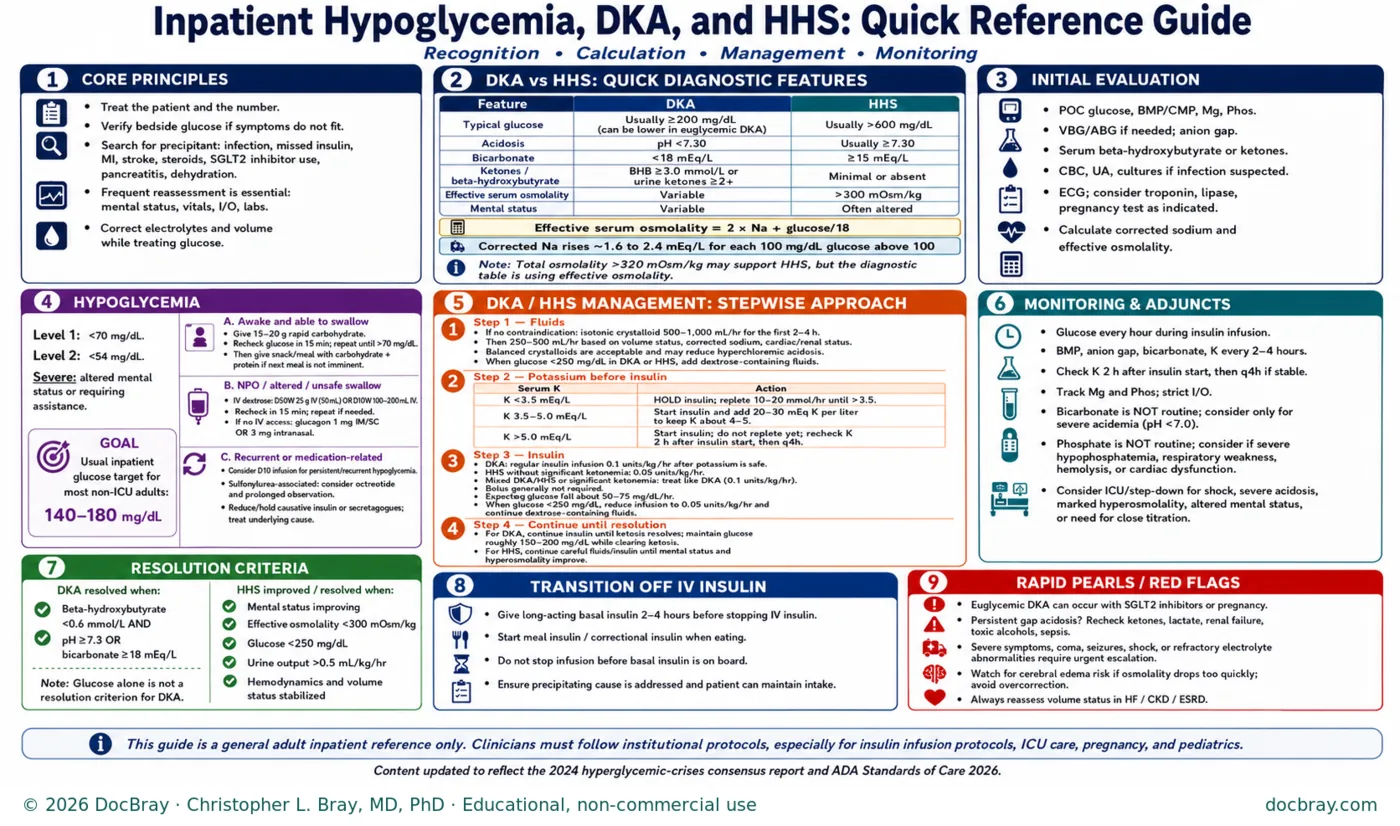
One card holds the operational half of this hour: the features that separate ketoacidosis from the hyperosmolar state, the initial evaluation, the hypoglycemia levels and their treatment, the stepwise management sequence, the monitoring intervals, the resolution criteria, and the transition off intravenous insulin. Print it, photograph it, keep it where you write these orders.
The euglycemic trap — the one that gets missed
Ketoacidosis does not require a high glucose, and the presentation that fools people is the acidotic, ketotic patient whose glucose is near normal. The exposure most associated with it in current practice is the SGLT2 inhibitor class — now prescribed widely for heart failure and chronic kidney disease, in patients with and without diabetes, which means the intern will meet these drugs far outside the diabetes clinic. Other classic settings deserve the same suspicion: pregnancy, prolonged fasting or starvation, heavy alcohol use, and the perioperative or acutely ill patient with reduced intake.
The teaching point is a habit, not a number: in the acidotic patient with an unexplained raised gap, check ketones regardless of the glucose — and know that a patient on an SGLT2 inhibitor who is fasting, ill, or post-operative is at risk by definition. The consensus report’s updated diagnostic framing exists in part because of this presentation;1 teach it from the current version. Practical corollary the ward will use immediately: know your institution’s rule for holding these agents around procedures, fasting, and acute illness — it is a medication-reconciliation habit (the medication-safety session) as much as an endocrine one.
Hypoglycemia — the emergency you can cause
Treat first, then investigate, then fix the order. The treatment runs by protocol — conscious versus obtunded, oral versus intravenous versus intramuscular, the recheck interval, the repeat — and every intern should be able to run it from memory at 3 a.m. because it happens at 3 a.m. But the part interns skip is the part only they can do: ask why it happened, and change what produced it.23
The usual causes are systems failures wearing a clinical costume: insulin given for a meal that never came; the patient made nothing-by-mouth after midnight with the long-acting dose unchanged; tube feeds held or interrupted while the coverage continued; steroids tapered without the insulin following; renal function worsening while doses stayed still; the sliding scale that outlived its indication; the home regimen resumed unreconciled at discharge. Each has an order-level fix, and the hour should end with the room naming the fix for each — that is the transferable skill.
Then the patient-facing half: recurrent hypoglycemia and hypoglycemia unawareness change outpatient management and driving safety, they belong in the discharge conversation and the clinic note, and they are a reason to revisit targets rather than to blame a patient. The discharge session’s teach-back applies directly: the patient states what they will do when they feel it, in their own words, before they leave.
Eight challenges for the room
No answers are supplied, deliberately. Each turns on the three decisions this hour is built around — what gets corrected and in what order, how fast, and when you recheck — and each has a defensible range rather than a single right answer. Work them against your own order sets, and let the disagreements surface: that is where the teaching is.
1. The ketoacidosis admitted to the floor because the unit is full. A 26-year-old with type 1 diabetes, insulin pump failure two days ago. Alert, vomiting, tachycardic, breathing deeply. The intensive-care unit has no bed for at least six hours; the ward has hourly glucose capability but four-hourly nursing checks.
ABG pH 7.29 · PaCO2 26 · HCO3− 12
BMP Na 134 · K 4.2 · Cl 98 · HCO3− 12 · BUN 26 · Cr 1.2 · glucose 460 · ketones positive
- Disposition: does this patient safely start treatment on your ward, and what specifically would change that answer — a number, a trend, or a staffing fact?
- Order of correction: what happens first, and what must be confirmed before insulin starts?
- Rate: what governs the fluid rate here, and what governs the insulin rate — are they the same consideration?
- Recheck: what is checked hourly, what is checked less often, and does your ward’s actual nursing ratio support that plan?
- The escalation trigger: write the sentence you would put in the sign-out that tells the covering intern when to call.
2. The potassium that arrives before the insulin does. A 41-year-old in the unit with severe ketoacidosis after a week of poor intake and missed doses. Central access in place. The nurse has the insulin infusion primed and is asking whether to start it.
ABG pH 7.22 · PaCO2 20 · HCO3− 8
BMP Na 133 · K 2.9 · Cl 95 · HCO3− 8 · BUN 34 · Cr 1.5 · glucose 520 · Mg 1.5 · Phos 1.9
- The sequencing question: does the insulin start now, and what is the reasoning either way?
- Correction: which electrolyte leads, by what route given central access, and what does the magnesium have to do with whether the potassium will rise?
- Rate: what limits how fast you can move the potassium here, what monitoring does that rate require — and what is already running while you wait?
- Recheck: how soon before you would be willing to start insulin, and how often after?
- The counterfactual: what would have happened had insulin been started when the nurse asked — and how do you make sure that is understood rather than just avoided?
3. Coming off the drip at shift change. A 33-year-old, eighteen hours into treatment for ketoacidosis, now in step-down and eating breakfast. The nurse reports the anion gap has closed and asks to stop the infusion. It is 6:45 a.m., handover is at 7:00, and the patient wants to go home.
BMP Na 138 · K 4.0 · Cl 108 · HCO3− 18 · BUN 14 · Cr 0.9 · glucose 180 · small urine ketones remaining
Gap 12 · ABG pH 7.35 · PaCO2 34
- Is he actually ready? Which criteria are you applying, and does “the gap has closed” settle it by itself?
- The overlap: what has to be given before the infusion stops, and how long before — and what happens if that step is skipped?
- Rate and regimen: what does he go onto, and how is the dose decided in a patient whose home regimen failed him?
- Recheck: what is the monitoring plan for the next twelve hours, and who owns it across the shift change?
- The discharge pressure: what needs to be true before he leaves, and how do you say that to a patient who feels well?
4. The nursing-home resident found confused. An 84-year-old with type 2 diabetes and dementia, brought in after two days of decreased oral intake and increasing somnolence. Dry, tachycardic, hypotensive on arrival. Ketones are trace at most.
BMP Na 148 · K 4.6 · Cl 108 · HCO3− 20 · BUN 62 · Cr 2.4 (baseline 1.0) · glucose 980
ABG pH 7.33 · PaCO2 39 · calculated effective osmolality ~350
- What is the sodium really? Work the corrected value, and decide what it tells you that the measured one does not.
- Correction, in what order: fluid, insulin, or both — and does the order differ from the ketoacidosis cases above, or is it the same order with a different emphasis?
- The gap of 20: this is labeled a hyperosmolar state and yet there is a gap — what is making it, and does that change anything you do?
- Rate: two clocks are running here — the osmolality and the volume deficit. What governs each, and which one constrains the other?
- Recheck: what interval for glucose, sodium, and mental status — and what does a mental status that fails to improve on schedule mean?
- The kidney: does the acute kidney injury change the fluid plan, the insulin plan, both, or neither?
5. Steroids, tube feeds, and a picture that is both. A 71-year-old admitted with a COPD exacerbation, on high-dose systemic corticosteroids and continuous enteral feeds, transferred to step-down when his glucose could not be controlled. He is drowsy but rousable; ketones are moderate.
BMP Na 145 · K 4.4 · Cl 100 · HCO3− 14 · BUN 44 · Cr 1.6 · glucose 720
ABG pH 7.31 · PaCO2 29 · gap 31 · effective osmolality ~330
- Name it: ketoacidosis, hyperosmolar state, or both — and does the label change the treatment or only the expectations?
- The feeds: do they continue, hold, or change — and how does that decision interact with the insulin plan?
- The steroids: they are treating his lungs and worsening his glucose. Who decides, and what does the insulin plan have to anticipate when they are tapered?
- Rate: which target leads — the gap or the osmolality — and what happens to the other while you chase the first?
- Recheck: what does the monitoring look like on a step-down unit, and is that sufficient for this patient tonight?
6. Acidotic after surgery, with a normal-looking glucose. A 58-year-old with type 2 diabetes, two days after elective hip replacement, taking an SGLT2 inhibitor prescribed by cardiology for heart failure. Poor intake since the operation, now nauseated and breathing faster than expected. The overnight intern reported “acidosis, but the sugar’s fine.”
ABG pH 7.29 · PaCO2 26 · HCO3− 12
BMP Na 137 · K 4.1 · Cl 101 · HCO3− 12 · BUN 20 · Cr 1.1 · glucose 162 · gap 24 · ketones positive
- Recognition: what was missed overnight, and what single test would have named it hours earlier?
- The treatment paradox: this patient needs insulin, and his glucose is 162. How is that reconciled, and what has to run alongside?
- Rate and endpoint: what are you following to know it is resolving, given that glucose will not be the guide?
- The drug: when was it last taken, when does it stop mattering, and what should have happened before the operation?
- Recheck and prevention: what monitoring for the rest of the admission — and what instruction goes to the patient and the surgical team for next time?
- Then change one fact: suppose he had no diabetes at all and took the drug purely for heart failure. Does anything about your recognition, your workup, or your treatment change — and would you still call it by the same name?
7. The third night in a row. A 76-year-old admitted with pneumonia, on her home long-acting insulin plus correction doses. She has been made nothing by mouth after midnight twice for a procedure that keeps getting postponed, and her enteral feeds were held this evening for a chest film. Nursing has treated her three nights running. At 03:00 she is drowsy but rousable and able to protect her airway.
Glucose log 03:10 — 46 · treated · 03:40 — 88 · feeds restarted 05:00 · 07:30 — 210 · 12:00 — 165 · 22:00 — 134 · 03:00 — 51
Labs Cr 1.3 (baseline 1.0) · albumin 2.9 · eating “about half” her trays when not fasting
- Correction first: what is given at 03:00, by which route, and what determines that choice — her gut works, but does that settle it?
- Recheck: how soon after treatment, and how long does monitoring continue once she is above the threshold — does one normal value close the episode?
- The actual fix: name every order that contributed, and write the one you would change tonight.
- The morning number: the 07:30 reading of 210 — two and a half hours after her feeds restarted — will tempt someone to increase her basal insulin. What is the argument against, and what does that number actually reflect?
- Ownership: this has happened three nights running — what failed at the system level, and what would stop the fourth?
8. Treated, awake, and asking to go home. A 79-year-old brought in by ambulance after being found unresponsive at home; a glucose of 38 was treated by the paramedics and again in the emergency department. He takes a long-acting sulfonylurea and has eaten breakfast. He is now alert, insists he feels perfectly well, and wants to leave. His creatinine has risen since his last clinic visit.
Now glucose 96 (after treatment) · Na 138 · K 4.2 · Cr 2.1 (baseline 1.1) · BUN 38 · albumin 3.2
Home meds long-acting sulfonylurea · ACE inhibitor · a diuretic started three weeks ago
- Disposition: can he go home this afternoon? What in this picture argues against, and how do you explain it to a patient who feels fine?
- Duration of risk: how long does this drug keep him at risk once he is euglycemic, and what does the kidney injury do to that window?
- Correction and rate: if he drops again, what does he need — and does the answer differ from what the paramedics gave?
- Recheck: what monitoring interval and for how long, and where does that happen?
- The medication decision: what changes before discharge, who communicates it, and what does his follow-up need to look like?
Facilitator notes — five places a room reliably goes wrong. The ordering question in the hyperosmolar case is deliberately phrased as an open question, because the current consensus runs one pathway for both syndromes and the real differences are in dose and emphasis rather than sequence — do not let “fluids first in one, insulin first in the other” become the takeaway. The morning hyperglycemia in the hypoglycemia case invites rebound as an explanation; the evidence does not support it, and the useful answers are the restarted feeds, the erratic intake, and the fact that raising basal insulin worsens the nocturnal nadir. The mixed case looks like it should be labeled “both,” and the consensus does name a mixed entity — but the label carries a treatment consequence, so make the room say what it is. The corrected sodium and the printed osmolality in the hyperosmolar case use different sodium values by design; if someone recomputes osmolality with the corrected sodium they will get a different number, and that is worth ten seconds of explanation. And the potassium threshold that gates insulin moved in the recent consensus — check the current figure rather than teaching the one you learned.
These scenarios are fictional composites written for discussion. No answers are provided by design: targets, insulin and fluid rates, transition criteria, and monitoring intervals are governed by your institution’s protocols and by current guidance, and the range of defensible answers is part of what the discussion should surface. Values are illustrative and are not reference standards.
Running the hour
| Minutes | Block |
|---|---|
| 0–5 | Frame: “three crises you must recognize, and one you will personally cause” |
| 5–25 | Two cases run in parallel — the young patient in ketoacidosis and the confused older patient found hyperosmolar; the room commits to the diagnosis and the first hour before the reveal |
| 25–38 | The euglycemic case: an acidotic post-operative patient on an SGLT2 inhibitor with a near-normal glucose — let the room miss it, then let them find it |
| 38–52 | The 3 a.m. hypoglycemia: run the protocol from memory, then the order-level autopsy — each intern names one order they would change |
| 52–60 | Your protocols and order sets on screen · pocket card |
Watch for, and debrief by name: the glucose treated as the whole problem while the precipitant goes unnamed; the euglycemic case dismissed early (“the sugar’s fine”) — that miss is the session; the hypoglycemia treated and closed without an order changed; and the reflex to escalate everything or nothing — the useful question is always “does this patient belong on the ward tonight?” If your program runs protocolized order sets, put them on screen and walk them; the goal is that no intern meets these order sets for the first time at 3 a.m.
Pocket card
- Ketoacidosis is a symptom — always hunt the precipitant.
- Confused older patient? Check the glucose. Hyperosmolar patients are sicker than they look.
- Acidotic with an unexplained gap: check ketones whatever the glucose reads.
- SGLT2 inhibitor + fasting, illness, or surgery = euglycemic ketoacidosis risk.
- Hypoglycemia: treat by protocol, recheck — then change the order that caused it.
- Nothing by mouth, held feeds, tapering steroids: revisit the insulin every time.
Notes
This hour runs in the weeks-2–8 survival series, one conference hour, and pairs with the acid–base hour — run this one after it, so the gap and the delta are already fluent. The consensus report and the annual Standards both revise; check the current versions before teaching, and note that inpatient glycemic management beyond the emergencies is faculty and clinic teaching, not a bootcamp hour.
This page is a curriculum framework, not clinical instruction: it states no diagnostic thresholds, doses, infusion rates, correction limits, or protocol steps. Faculty teach management from the current consensus and Standards of Care and from institutional order sets, and every session carries its own last-reviewed date. Last reviewed July 2026.
Sources
- Umpierrez, G. E., Davis, G. M., ElSayed, N. A., Fadini, G. P., Galindo, R. J., Hirsch, I. B., Klonoff, D. C., McCoy, R. G., Misra, S., Gabbay, R. A., Bannuru, R. R., & Dhatariya, K. K. (2024). Hyperglycaemic crises in adults with diabetes: A consensus report. Diabetologia, 67(8), 1455–1479. https://pubmed.ncbi.nlm.nih.gov/38907161/ Joint consensus of the American Diabetes Association, European Association for the Study of Diabetes, Joint British Diabetes Societies, American Association of Clinical Endocrinology, and Diabetes Technology Society; it updates the diagnostic framing of the hyperglycemic crises, including euglycemic presentations. ↩1 ↩2 ↩3 ↩4
- American Diabetes Association Professional Practice Committee. (2026). 6. Glycemic goals, hypoglycemia, and hyperglycemic crises: Standards of Care in Diabetes—2026. Diabetes Care, 49(Suppl. 1), S132–S149. https://pubmed.ncbi.nlm.nih.gov/41358894/ Revised annually — teach from the current year’s Standards, and re-check the section number, which moves. ↩1 ↩2
- American Diabetes Association Professional Practice Committee. (2026). 16. Diabetes care in the hospital: Standards of Care in Diabetes—2026. Diabetes Care, 49(Suppl. 1), S339–S355. https://pubmed.ncbi.nlm.nih.gov/41358892/ The inpatient order-level material — nothing-by-mouth status, enteral feeding interruptions, corticosteroids, and hypoglycemia prevention in hospital — lives in this section rather than in the glycemic-goals section. ↩