
You’re presenting Thursday:
the conference people actually remember
Sometime this year your name lands on the conference schedule — morning report, a noon lecture, journal club, or the M&M — and nobody teaches you how to do it. So you do what was done to you: forty-five slides, comprehensive, polished, forgotten by Friday. This session is the missing instruction: what actually makes a session memorable, engaging, and applicable — and why the brilliant lecture you are planning will change almost nobody’s practice unless you make the room do the work.
Why this session
Residents present constantly and are taught to present almost never. The result is a genre of conference everyone recognizes and nobody enjoys: the exhaustive slide deck read aloud to a room of people checking their pagers. The presenter worked hard; the audience was polite; two weeks later, nothing is different on the floor. The deeper problem is a belief this session exists to dismantle: too many residents feel that one excellent lecture is going to change the way everyone thinks or practices medicine. It will not — not because the lecture was bad, but because listening is the weakest way humans learn. What the audience does during your hour is the intervention; what you say is only the setup.
This session teaches presenting the way the bootcamp teaches everything else — through a case, with commitments before reveals — which is itself the demonstration: by the end, residents should notice that the method used on them all three days is the same method that will make their own conferences land.
What residents leave able to do
- State the Learning Pyramid’s claim, its honest evidentiary status, and the real finding underneath it: active beats passive, by measured margins.1
- Apply the craft rules to any session: three takeaways, an audience action every five to seven minutes, case before content, commitment before reveal, the tomorrow-morning test.
- Run each of the five formats — morning report, content lecture, journal club, M&M, and the EBM Debate — with the moves specific to that format.
- Handle the M&M’s special obligations: systems over shame, no ambushes, an action item with an owner.2
- Cut a deck in half without losing content, by moving the content into questions.
The case
October. A second-year is assigned morning report and picks hyponatremia — a genuinely great topic; the floors get it wrong weekly. They spend two evenings building fifty-two slides: pathophysiology from osmoreceptors forward, the full diagnostic algorithm, every etiology, correction rates, three landmark trials. It is, honestly, the best summary of hyponatremia anyone in the program has produced.
Before anything else: what do you predict the room remembers in two weeks — and what would you have built instead?
Thursday, 8:05 a.m. The room is full. The presenter narrates the slides, fluently. By slide fifteen, the interns post-call are gone behind their eyes; by slide thirty, half the room is charting on their phones. Two attendings nod along — they already know hyponatremia. There is one question at the end, from the person who needed it least. Everyone says “great talk.” Everyone means it.
Name the failure precisely. Not effort, not knowledge, not slides-per-minute — what did the audience do for those forty minutes?
Twelve days later, a night intern — who sat in the second row — hangs normal saline on a sodium of 118 without checking volume status or urine studies, and nobody can quote a correction limit until the senior arrives. The lecture happened to them; it never became something they had done. In the spring, a chief runs the same topic as a morning report: one case disclosed in stages, the room forced to commit to fluids-or-not out loud before each reveal. Months later, residents are still saying “remember the 118 case” on the wards — because the room managed that patient, and you remember what you did.
Same topic, same hour, same audience. What exactly was different — and how do you build your Thursday session so it works like the second one?
The Learning Pyramid — the myth, the truth underneath, and the honest use
The classic frame for Part 3’s answer is the Learning Pyramid — the famous diagram, shown at some point to nearly every medical educator, that runs from the lecture at its narrow top — the lowest claimed retention — down to teaching-others at its wide base, the highest, with a tidy percentage attached to every layer. It belongs in this session precisely because it is half myth and half truth, and pulling those apart in front of the room is better teaching than either half alone.
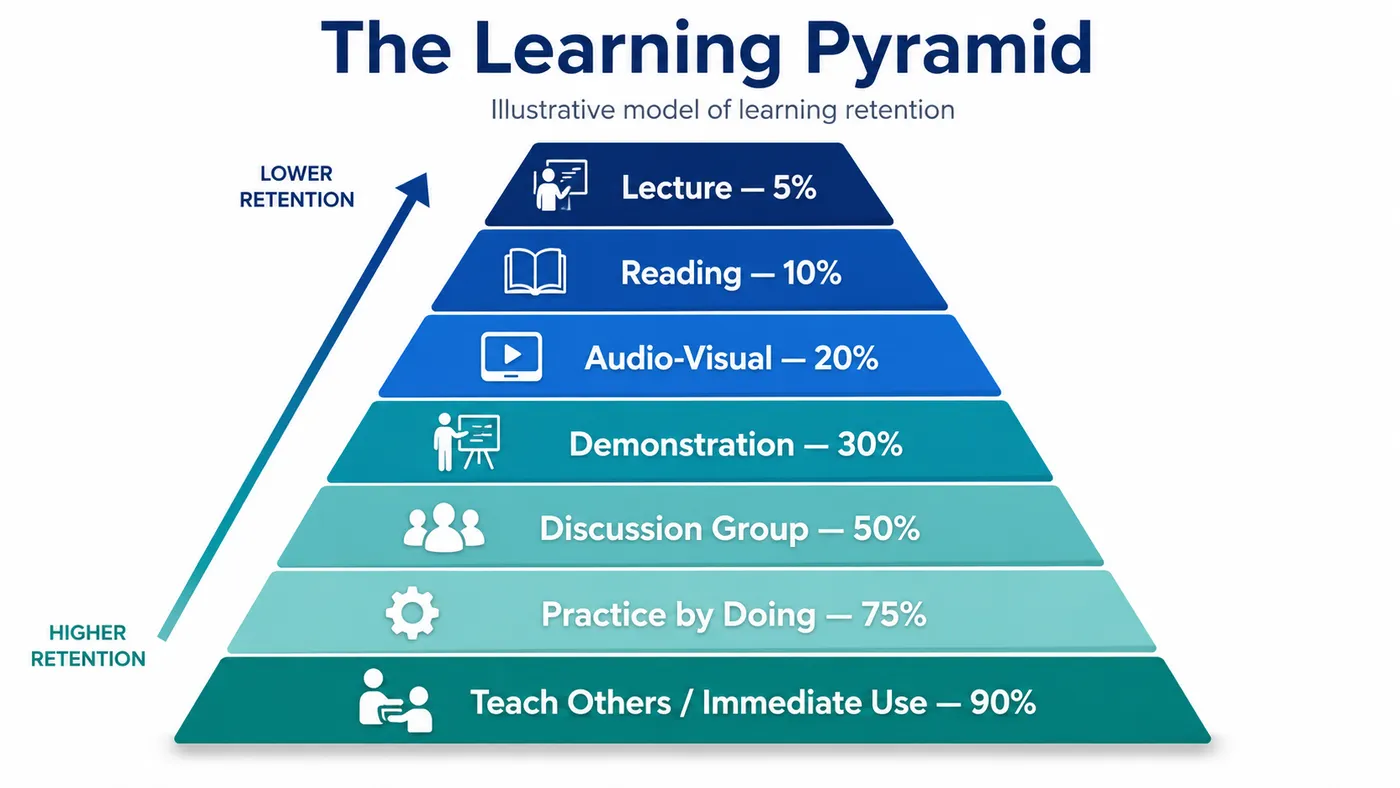
The myth: the percentages are fabricated, and the fixed ratios are the wrong shape for the answer. The numbers are suspiciously round — real memory research does not return a clean ladder of figures divisible by five — and no valid study has ever produced them. Scholars who excavated the chart’s origins found versions of the percentage family circulating for well over a century, predating any research that could have supported them, with every claimed source — including the military studies sometimes named as the origin — a dead end.3 Edgar Dale’s Cone of Experience, the diagram the numbers were later grafted onto, never carried percentages at all; Dale meant it as description, not prescription. The educators who have studied the myth most closely — Will Thalheimer and Michael Molenda among them — recommend ignoring the numbers entirely.4 And the deeper problem outlives the missing citations: retention is not a property of the delivery method. It depends on the content, the learner’s prior knowledge, how and when retention is tested, the delay, and the individual — memory is context-dependent, so no honest experiment could hand you one number per rung. Active engagement generally helps; it does not help in fixed ratios.
The truth underneath: active beats passive — as a direction, never a ratio. The largest meta-analysis of the question — 225 studies in undergraduate science, engineering, and math classrooms, not residencies, but the closest thing to a verdict — found examination performance about six percentage points (0.47 standard deviations) better under active learning than under traditional lecture, and failure rates of 21.8% versus 33.8%: students who were lectured to were one and a half times more likely to fail.1 The practices with the strongest evidence behind them are exactly the ones this curriculum runs on: retrieval practice — being made to answer beats hearing it again5 — and spaced repetition, the two techniques a major review of the learning-techniques literature rated most useful, ahead of rereading and highlighting,6 plus meaningful application: using the material on a real problem soon after. Even so, stay humble about the ceiling: a systematic review of 101 journal-club papers found over 80% documented knowledge and appraisal gains — and not one documented a change in clinical practice.7
The honest use. Stripped of its fake statistics, the pyramid still earns its keep as a prompt: it pushes a presenter to ask what the room will do during the hour, and its shape carries the true point. In the diagram, the lecture sits at the narrow top with the lowest retention, and teaching others sits at the wide base with the highest — every layer between them is the audience doing progressively more. Read it as a map of where your hour lives: the base of the pyramid belongs to the room, not to the speaker, and the presenter’s job is to move the hour down the pyramid, from the sliver where you talk toward the base where they do. Too many residents believe one excellent lecture will change how everyone thinks or practices; it will not, and now you can say why with the evidence rather than the folklore. If you want Thursday’s hour to still exist in someone’s hands two weeks later, make the room retrieve, discuss, decide, practice, and teach back — and design for use on a real patient soon after. For the deeper story of the myth and its century of mutations, Letrud and Hernes’s excavation of its origins is open access.
The craft rules — any format
- Pick three takeaways, then serve them ruthlessly. Decide the two or three things the room will still know in two weeks; every slide, case turn, and question either serves one of them or gets cut. Comprehensiveness is for the handout link, not the hour — the fifty-two-slide deck failed precisely because it refused to choose.
- Make the room do something every five to seven minutes. Commit to a decision out loud, vote hands-up on the next test, argue thirty seconds with a neighbor, write one number down. The moment attention breaks is the moment the audience last did anything — and each action is a retrieval event, which is where the retention actually comes from.5
- Case before content, commitment before reveal. Open inside a situation — a page, a sodium of 118, an abstract’s claim — and make the room take a position before the next fact lands. Being wrong out loud, then corrected, is not a detour from learning; it is the learning. This whole bootcamp runs on that loop, and it transfers directly to your conference.
- Slides are exhibits, not a teleprompter. One assertion per slide, the evidence under it, fewer slides than minutes — if a slide exists so you remember what to say, it is your note card, and it belongs in your pocket. The room can listen to you or read your paragraph; it cannot do both.
- End on the tomorrow-morning test. Close by asking, literally: “what will you do differently on rounds tomorrow?” — and let the room answer. A session that cannot survive that question was a performance, not teaching. This is the applicability check, and it doubles as your best feedback.
- Steal the two-week test. The measure of Thursday is not the compliments at 8:50; it is what the second row does on a real patient in twelve days. Build backward from that moment, and grade yourself against it — it will make you humble, then it will make you good.
The formats — the moves specific to each, plus one invention
Morning report. Start with what the hour is for, because this is the format new presenters get wrong most often: morning report exists to teach clinical reasoning — not classic topic education. A disease review with a case stapled to the front is a noon lecture wearing the wrong name tag. The case is the curriculum, so run it in real order — the triage note, then vitals, then the first labs, disclosed exactly as they arrived — with deliberate diagnostic pauses at every turn: the room commits to a differential and defends it deductively, ranks what would move it, and earns every order by answering two questions out loud — why this test? and what will you do if it comes back positive — or negative? If the honest answer is “the same thing either way,” that is the teaching moment. The presenter’s job is questions, not answers: “what do you want next?” “commit — fluids or not?” A whiteboard beats slides here, because the differential should be built by the room, not revealed to it. Save the disease content for one deliberate evidence minute near the end, and land on the three takeaways. The failure mode is the solved-case retrospective — narrating a finished workup while the room spectates; if everyone already knows the answer, nobody is reasoning. The braided-case machinery from the data stations is exactly this genre.
The content lecture. Noon conference is the format most at risk of living entirely at the pyramid’s top — the pure-lecture, lowest-retention layer — and the fix is conversion, not abolition: frame the topic as two or three short cases and teach the content as the answers to their turns. Interleave questions — a hands-up vote works as a poor resident’s audience-response system — so the room is tested on each takeaway before you state it.5 Then make the takeaways outlive the hour — in a channel your residents will actually reopen. The paper pocket card may be a thing of the past: push at least three key points to the residency group text or post them on the program’s closed site after the talk, where they resurface on real phones instead of dying in a bag. And consider closing with a three-question quiz that doubles as attendance credit — retrieval practice disguised as administration, and a far better record of the hour than a sign-in sheet. And if the topic genuinely requires forty facts — it is a reference, and references are documents, not hours.
Journal club. The paper is a specimen to dissect, not a sermon to deliver. Open with the clinical question and a real patient it belongs to; make the room vote — does this change our practice for this patient? — before the appraisal, and again after, because the shift between votes is the session. Assign roles ahead: a methods skeptic, a statistics reader, an applicability judge, so the appraisal is distributed instead of performed. The systematic review of the format found the successful clubs share structure, not charisma: regular anticipated meetings, clear purpose, a trained leader, and an explicit appraisal framework7 — and its humbling finding, that no study has documented practice actually changing, is the standing challenge: end every journal club with a named, checkable commitment. The critical-appraisal machinery lives in Research 101’s design-and-biostats block.
The M&M conference. The delicate one — the classic Academic Medicine analysis calls learning from error in conference exactly that, delicate, and worth doing well rather than avoiding.2 First, the lane — stated out loud in the first minute: every hospital runs a formal peer-review process for errors and unexpected outcomes, and M&M is not it. That machinery is separate, structured, and confidential, and it exists precisely so this conference does not have to judge anyone; M&M decides nothing about anyone’s practice. This hour is a learning exercise, full stop — and saying so at the top is what makes the candor possible. Then the moves: the presenter’s stance is curiosity, never prosecution — the question is “what did the system allow?” before “who decided what?” No ambushes: anyone involved in the case knows the framing before the room does, and identifying details are stripped. Structure the hour as case → timeline with the decision points the room must vote on → the systems analysis → two concrete fixes, each with an owner and a date — an M&M that ends without an owned action item was a confession, not a conference. And the room’s safety is infrastructure, not mood: the same rules as the error session, set out loud at the start, because half the audience is one bad night away from being the case.
The EBM Debate — the fifth format, this curriculum author’s own invention, and one of his favorites. A group of resident presenters picks a question with two genuinely defensible positions — the benefits of one drug over another, one therapy over another, the cost-effectiveness of an approach, the diagnostic value of a novel test, whether a new procedure earns its place — and the topic is debated through the presentation of the evidence: each side builds its best case from the literature, then rebuts the other’s. The format teaches what journal club alone cannot: evidence must be weighed, not merely appraised — two teams reading the same trials honestly and arriving at opposite recommendations is the realest demonstration of evidence-based medicine a residency can stage — the Sackett stool in motion. And if the group agrees, make it high stakes: vote the audience’s position before the debate, vote it again after, and the side that moved the room most wins. The pre-vote forces every listener to commit to a position — which converts a passive hour into a room full of judges with a stake — and the post-vote gives the presenters the only scoreboard that matters in persuasion-by-evidence. It slots into any noon-conference hour, and residents remember who moved the room for years.
Pocket card
- The lecture is the pyramid’s narrow top — lowest retention. Teaching others is its wide base — highest. What the room does is the intervention.
- Three takeaways, chosen first — and pushed to the group text after. Everything serves them or gets cut.
- The room acts every 5–7 minutes: commit, vote, argue, write.
- Case before content; commitment before reveal.
- Fewer slides than minutes; one assertion per slide.
- Morning report = clinical reasoning out loud: pauses, differentials, why this test — and what if it’s positive, or negative? Journal club: vote, appraise, re-vote.
- M&M is a learning exercise — formal peer review lives elsewhere. Systems over shame, no ambushes, an action item with an owner.
- Steal the EBM Debate: two defensible positions, evidence head-to-head, vote before and after — the side that moves the room wins.
- End on the tomorrow-morning test; grade yourself at two weeks.
Variations
- The deck-cutting drill. Bring a real forty-slide deck a volunteer already owns; the group cuts it to fifteen live, converting the cut content into audience questions. Nothing teaches the craft rules faster than watching content survive as a question after dying as a slide.
- Conference coaching as chief infrastructure. Programs can attach a ten-minute chief huddle to every scheduled resident conference — three takeaways named, the audience actions placed, one rehearsal of the opening — and a two-minute debrief after. The schedule already exists; the coaching just rides it.
- The teach-back close. For longer workshops, end by having each resident teach one takeaway back to the group in ninety seconds — the wide base of the pyramid, teaching others, enacted — and a preview of the intern-teaching they will do on every ward month.
Notes
The Freeman meta-analysis measured undergraduate STEM classrooms, not residency conferences — it is cited for the direction and rough magnitude of the active-versus-passive effect, the closest large-scale evidence available. The Learning Pyramid’s retention percentages appear only inside the figure, reproduced so readers recognize the diagram under discussion; the text never asserts them, because they are fabricated tradition per the debunking references, and the model is taught only as a prompt to vary methods and activate the room. Last reviewed July 2026.
Sources
- Freeman, S., Eddy, S. L., McDonough, M., Smith, M. K., Okoroafor, N., Jordt, H., & Wenderoth, M. P. (2014). Active learning increases student performance in science, engineering, and mathematics. Proceedings of the National Academy of Sciences, 111(23), 8410–8415. https://pubmed.ncbi.nlm.nih.gov/24821756/ ↩1 ↩2
- Orlander, J. D., Barber, T. W., & Fincke, B. G. (2002). The morbidity and mortality conference: The delicate nature of learning from error. Academic Medicine, 77(10), 1001–1006. https://pubmed.ncbi.nlm.nih.gov/12377674/ ↩1 ↩2
- Letrud, K., & Hernes, S. (2018). Excavating the origins of the learning pyramid myths. Cogent Education, 5(1), Article 1518638. https://doi.org/10.1080/2331186X.2018.1518638 ↩
- Thalheimer, W. (n.d.). People don’t remember 10%, 20%, 30% — not even on a cone. Learning Development Accelerator. https://ldaccelerator.com/lda-blog-1/people-dont-remember-10-20-30-not-even-on-a-cone Practitioner explainer by the researcher who led the debunking; it summarizes the peer-reviewed Educational Technology article series by Subramony, Molenda, Betrus, and Thalheimer. ↩
- Roediger, H. L., III, & Karpicke, J. D. (2006). Test-enhanced learning: Taking memory tests improves long-term retention. Psychological Science, 17(3), 249–255. https://pubmed.ncbi.nlm.nih.gov/16507066/ ↩1 ↩2 ↩3
- Dunlosky, J., Rawson, K. A., Marsh, E. J., Nathan, M. J., & Willingham, D. T. (2013). Improving students’ learning with effective learning techniques: Promising directions from cognitive and educational psychology. Psychological Science in the Public Interest, 14(1), 4–58. https://pubmed.ncbi.nlm.nih.gov/26173288/ ↩
- Deenadayalan, Y., Grimmer-Somers, K., Prior, M., & Kumar, S. (2008). How to run an effective journal club: A systematic review. Journal of Evaluation in Clinical Practice, 14(5), 898–911. https://pubmed.ncbi.nlm.nih.gov/19018924/ ↩1 ↩2